
Marxism–Leninism: theory, institutions, and historical development
Marxism–Leninism is a political ideology combining Marxist social theory with Leninist party organization; it shaped 20th-century socialist states and continues to influence several governments today.
Overview
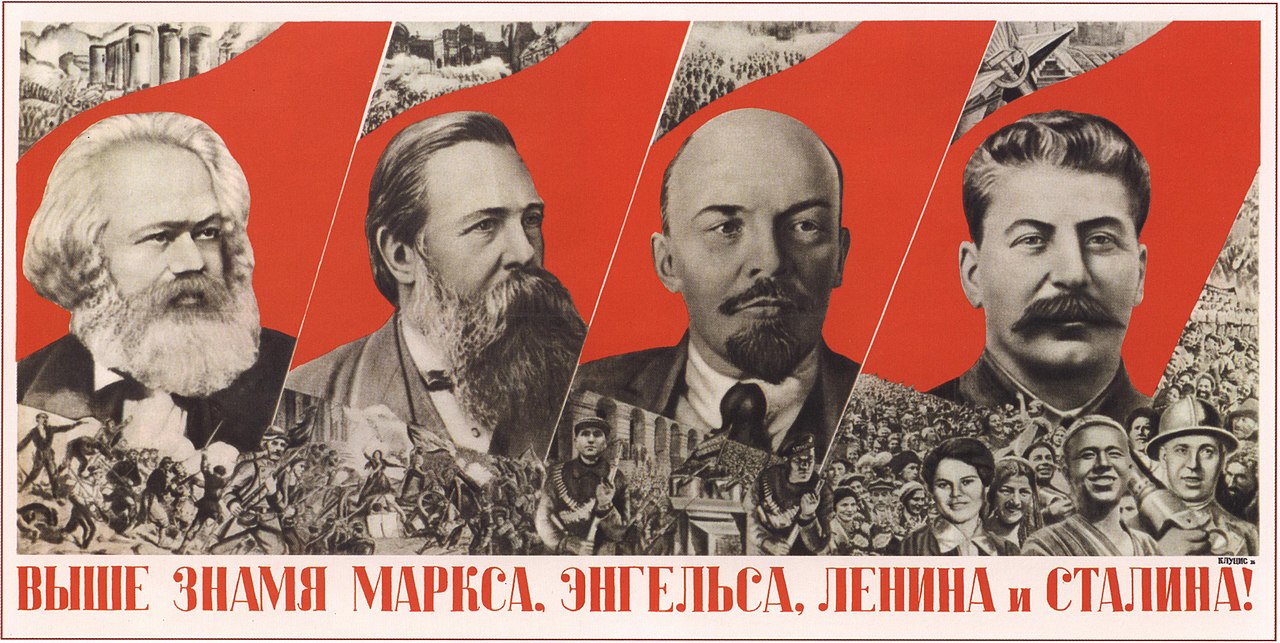
Marxism–Leninism is a political doctrine that synthesizes the ideas of Karl Marx and Vladimir Lenin into a program for revolutionary change and state organization. It proposes that the working class should replace capitalist rule with a socialist political order as a step toward an eventual classless, stateless communist society. In practice, the ideology provided the theoretical framework for the government of the Soviet Union and for many parties and states that emerged in the 20th century, including movements described as Stalinist.
Image gallery
10 Images




Core principles and institutions
Key elements of Marxism–Leninism include:
- Vanguard party: a centralized communist party that claims to lead the working class toward revolution and socialist construction.
- Dictatorship of the proletariat: a transitional political order in which the working class holds state power to prevent restoration of capitalist relations.
- Democratic centralism: internal party practice combining discussion with unified public decisions and disciplined implementation; often invoked to justify one-party rule (democratic centralism).
- Planned economy and nationalization: state ownership of major industry and central planning to replace market mechanisms associated with capitalist economies and build a socialist system.
Historical development
The doctrine developed after the 1917 Russian Revolution. Lenin adapted Marxist theory to conditions of a largely agrarian empire by emphasizing a disciplined revolutionary party and the seizure of state power. Facing economic collapse and civil war, Lenin introduced the New Economic Policy (NEP) in 1921 as a temporary measure to revive production and stabilize society. After Lenin's death, debates over strategy and leadership shaped further evolution; under Joseph Stalin the Soviet model emphasized rapid industrialization, collectivization, and strong central control.
Spread, adaptations, and distinctions
Throughout the 20th century, Marxism–Leninism influenced anti-colonial movements and governments in Europe, Asia, Africa, and Latin America. National variants emerged as leaders adapted the ideology to local circumstances: for example, Mao Zedong developed a rural-based revolutionary strategy in China, and other parties combined Marxist–Leninist theory with local political traditions. Some states later articulated distinct doctrines—North Korea developed Juche while retaining historical ties to Marxism–Leninism and is commonly associated with North Korea as a distinct case.
Implementation and contemporary presence
Implementation mixed social transformation and coercive measures. Supporters point to rapid industrialization, expanded education and healthcare, and anti-imperialist stance; critics emphasize political repression, limited pluralism, and economic inefficiencies in various periods. Today, parties and governments that identify with Marxist–Leninist principles remain in several countries. Contemporary states commonly associated with the tradition include China, Cuba, Vietnam, and Laos. Historical associations with the USSR continue to inform scholarly discussion.
Significance and critical perspectives
Marxism–Leninism has been influential as both an intellectual framework and a practical program for state-building. Analysts evaluate it on multiple grounds: theoretical coherence with Marxist ideas; effectiveness in transforming societies; ethical questions about individual rights and political pluralism; and adaptability to changing economic and global conditions. Debates persist over how closely actual policies in different countries adhered to the original theoretical aims, and how much historical context shaped divergent outcomes.
For additional background and primary sources, readers often consult party documents, contemporary histories, and comparative studies that examine variations and consequences of Marxist–Leninist rule.
Related terms and topics: proletariat, democratic centralism, Stalinism, and national adaptations such as Juche. Further reading can help distinguish theory from the range of historical practices and national experiences.
Related articles
Author
AlegsaOnline.com Marxism–Leninism: theory, institutions, and historical development Leandro Alegsa
URL: https://en.alegsaonline.com/art/62451