
Mars Science Laboratory (MSL) — the Curiosity rover mission
NASA's Mars Science Laboratory delivered the Curiosity rover to Gale Crater in 2012 to assess past habitability, study geology and climate, and perform long‑duration in situ chemical and environmental investigations.
The Mars Science Laboratory (MSL) is a flagship robotic mission led by NASA that delivered the rover Curiosity to the surface of Mars. Launched on November 26, 2011 aboard an Atlas V 541 vehicle, Curiosity achieved a precision landing in Gale Crater on August 5, 2012. The entry, descent and landing sequence combined a heat shield, parachute, powered descent and the first operational "sky crane" maneuver to lower the rover safely to the surface, enabling access to scientifically important terrain.
Image gallery
10 Images




Mission objectives and scientific approach
MSL's primary goal was to determine whether selected regions of Mars ever offered environmental conditions favorable for microbial life. The mission emphasizes in situ geological and chemical studies to reconstruct ancient environments, search for organic compounds, and measure radiation and atmospheric properties relevant to habitability and future human exploration. Curiosity was designed to examine rocks and soils with instruments that perform laboratory‑scale analyses on the rover itself rather than returning samples to Earth.
Major instruments and capabilities
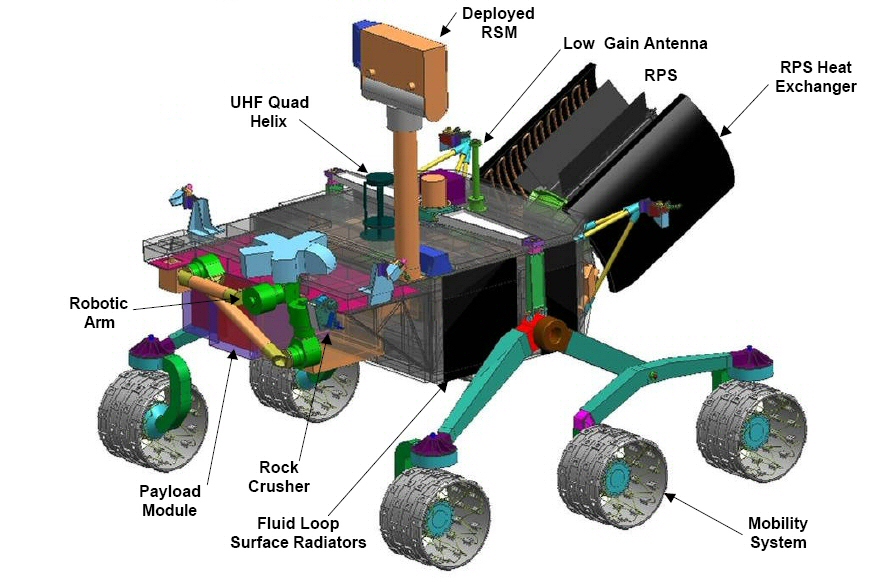
- Analytical laboratories: SAM (Sample Analysis at Mars) and CheMin perform evolved‑gas analysis, mass spectrometry and X‑ray diffraction to identify organic molecules, volatiles and mineralogy.
- Remote sensing and imaging: Mast‑mounted cameras (Mastcam), ChemCam laser‑induced breakdown spectroscopy and multispectral imagers provide context and compositional data from distance.
- Contact and sample tools: A robotic arm, drill, and scoop collect powdered rock and soil for internal processing and analysis.
- Environmental sensors: Instruments such as a radiation detector and weather sensors monitor current conditions and assess surface habitability over time.
Curiosity is substantially larger than earlier rovers, weighing about 900 kilograms and carrying a more massive and capable science payload. Unlike the solar‑powered Mars Exploration Rovers, Curiosity uses a radioisotope thermoelectric generator (RTG) that provides continuous electrical power and heat, permitting extended operations through dust storms and seasonal changes.
Key discoveries and scientific significance
Field investigations by Curiosity have shown that multiple locations within Gale Crater once hosted persistent liquid water and sedimentary environments. Analyses of sedimentary rocks, clays and mineral assemblages indicate past neutral to mildly alkaline conditions, low salinity, and energy sources that could have supported microbial life billions of years ago. The rover has detected a variety of organic molecules preserved in ancient rocks and has mapped chemical and mineral gradients that record environmental change through time.
Curiosity also monitors modern surface processes: it tracks atmospheric and radiation conditions, documents present‑day surface chemistry, and has contributed to studies of transient gas releases such as reported methane detections; interpretations of those transient signals remain the subject of ongoing research and debate. The mission's measurements refine models of Mars' climate evolution and help define targets and requirements for future missions.
Operations, management and legacy
MSL is a central element of the broader Mars Exploration Program. The project is managed by the Jet Propulsion Laboratory (JPL) at the California Institute of Technology (Caltech) for NASA. Curiosity's nominal mission duration was one Martian year, and the rover has continued to operate well beyond that baseline, conducting extended field campaigns and long traverses. The total project cost has been reported at about US$2.3 billion, covering development, launch and early operations.
The mission demonstrated new technologies and operational techniques—most notably the precision landing and sky crane—that influenced later programs and rover designs. Curiosity's scientific record has informed plans for sample caching and return strategies and provided context for subsequent missions. For technical summaries, instrument details and ongoing mission updates, readers can consult mission pages and program resources such as rover overview, Mars context, Gale Crater, Curiosity specifics, habitability goals, sample handling, mission timeline, agency pages, JPL mission pages and institutional summaries at Caltech.
Although Curiosity was not designed to return Martian samples to Earth, its in situ laboratory analyses have provided high‑quality data that shape both scientific understanding and the engineering requirements of future sample‑return campaigns. The rover continues to explore, document, and send measurements that enrich our understanding of Mars as a dynamic planet with a complex history.
Questions and answers
Q: What is the Mars Science Laboratory (MSL)?
A: The MSL is a NASA mission to land and control a rover named Curiosity on the surface of the planet Mars.
Q: When was the MSL launched?
A: The MSL was launched on November 26, 2011.
Q: What did the MSL accomplish?
A: The MSL successfully completed the first-ever precision landing on Mars at Gale Crater on August 5, 2012 and began exploring the surface.
Q: What is the goal of Curiosity?
A: The goal of Curiosity is to study the history of Mars and see if it has ever had an environment that could support microbial life.
Q: What evidence did Curiosity find?
A: It found evidence that 3 Billion years ago there was once water and an environment that could support life, though not necessarily that it certainly did exist. It will also carefully look at samples scooped up from the soil and drilled powders from rocks.
Q: How does Curiosity compare to other rovers?
A: Curiosity is five times as heavy as Spirit or Opportunity and carries more than ten times their mass of scientific instruments .
Q: How was Curiosity launched?
A:It was launched by an Atlas V 541 rocket.
Related articles
Author
AlegsaOnline.com Mars Science Laboratory (MSL) — the Curiosity rover mission Leandro Alegsa
URL: https://en.alegsaonline.com/art/62245
Sources
- reuters.com : "New NASA rover to scout for life's habitats on Mars"
- space.com : "Touchdown! Huge NASA Rover Lands on Mars"
- nbcnews.com : "Video from rover looks down on Mars during landing"
- skyandtelescope.com : "Watch Curiosity Descend onto Mars"
- marsrovername.jpl.nasa.gov : "Name NASA's Next Mars Rover"
- nasa.gov : "NASA Selects Student's Entry as New Mars Rover Name"
- marsprogram.jpl.nasa.gov : "Mars Science Laboratory: Mission"
- usatoday.com : "Troubles parallel ambitions in NASA Mars project"
- nytimes.com : "NASA Delays Next Mars Rover Mission"
- washingtonpost.com : "Landing on Mars is hard, but another mission to the Red Planet is about to begin"