
Arsacid (Arshakuni) Dynasty of Armenia
Armenian ruling house of Parthian origin (54–428 CE) that shaped Armenian politics, adopted Christianity, and fostered the creation of the Armenian alphabet and literary culture.
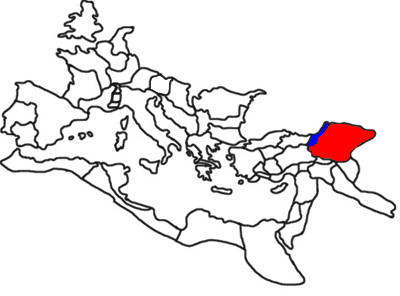
The Arsacid or Arshakuni dynasty governed the Kingdom of Armenia roughly from 54 to 428 CE. Originating as a branch of the Parthian Arsacids, the family gradually became an Armenian royal house in its own right. Positioned on the frontier between Rome and the great Iranian empires, Armenia under the Arsacids was repeatedly drawn into the strategic rivalry of its larger neighbors. Over several centuries the dynasty produced a succession of kings who combined Iranian, Hellenistic and native Armenian elements in government, court culture and material life.
Image gallery
5 Images



Origins and political setting
The early Arsacid presence in Armenia emerged amid the collapse of the preceding Artaxiad line and the tug-of-war between Rome and Parthia for regional influence. Ties of kinship with the Parthian royal family gave the Arsacids legitimacy and military support, while local Armenian elites and nobles shaped a distinctive political identity. During the first two centuries of their rule Armenian kings often served as client or allied rulers relative to Rome or to the Parthian/Sasanian state, navigating shifting alliances and periodic military interventions from outside powers.
Consolidation, rulers and the dynasty's end
Although Arsacid rulers first controlled Armenia intermittently, a more continuous line became established by the late second century under rulers such as Vologases II of Armenia (often rendered Vagharshak). This line retained the throne through alternating phases of independence and dependence. The dynasty survived Rome’s and later Sasanian Persia’s pressures until the early fifth century. In 428 CE the native monarchy was abolished under increasing Sasanian influence and Armenia entered a new administrative phase as a province governed by marzbans, marking the effective end of Arsacid kingship.
Cultural and religious influence
Two transformative developments occurred in Armenia while the Arsacids sat on the throne. In the early fourth century the mission of St. Gregory the Illuminator led to the widespread acceptance of Christianity; Armenia is widely cited as the first state to adopt Christianity as its official religion, a change that reshaped its institutions and artistic expression. Later, in the early fifth century, Mesrop Mashtots invented the Armenian alphabet, an innovation that enabled the development of a distinct written literature, the translation of scripture and administrative records, and a strengthening of Armenian cultural identity. For discussion of the conversion see St. Gregory and Christianization and for the alphabet see Mesrop Mashtots and the Armenian script.
Characteristics and legacy
- Political role: The Arsacids acted as a buffer dynasty, balancing Roman and Iranian influence while preserving local noble power structures.
- Cultural synthesis: Court art, coinage and religious life mixed Iranian, Hellenistic and indigenous Armenian elements.
- Religious transformation: Adoption of Christianity established institutions that endured beyond the dynasty’s political lifespan.
- Literary and linguistic impact: The invention of the Armenian alphabet facilitated the growth of national literature, law and historiography.
The Arsacid period is therefore central to Armenian historical identity: it saw the consolidation of a royal house of foreign origin into an Armenian dynasty, the acceptance of a state religion that distinguished Armenia from neighboring powers, and the cultural innovations that helped preserve Armenian language and traditions through subsequent centuries. For further context on Armenia's geopolitical position during this era see contemporary sources and modern syntheses available at Roman–Parthian frontier studies.
Related articles
Author
AlegsaOnline.com Arsacid (Arshakuni) Dynasty of Armenia Leandro Alegsa
URL: https://en.alegsaonline.com/art/6175