
Roman Empire: origins, government, territories, decline and legacy
Overview of the Roman Empire: origins under Augustus, imperial institutions, major provinces and languages, factors in decline, and enduring cultural, legal, and architectural legacy.
Overview
The Roman Empire was one of the largest and most influential polities of the ancient Mediterranean world. Its capital was the city of Rome, and historians commonly mark the beginning of the imperial period at 27 BC when Octavian assumed the title Augustus. The western imperial line is conventionally considered to have ended in 476 AD, an event often associated with the transition to the Middle Ages. The empire represents the third major phase of Ancient Rome, following the era of the Roman kings and the republican institutions of the Roman Republic. For broad introductions and synthetic accounts see general surveys and overview collections (general overviews).
Image gallery
10 Images




Government and institutions
Imperial government concentrated supreme military and civil authority in the person of the emperor, backed by a professional administration. Key elements included the imperial court, a corps of equestrian and senatorial officials, provincial governors, and bureaucratic offices responsible for taxation, public works and justice. Municipal self-government persisted in many cities, under local councils and magistrates who applied Roman law and local custom. Over time, emperors enacted fiscal and military reforms to address changing strategic needs and internal challenges.
Territories, language and administration
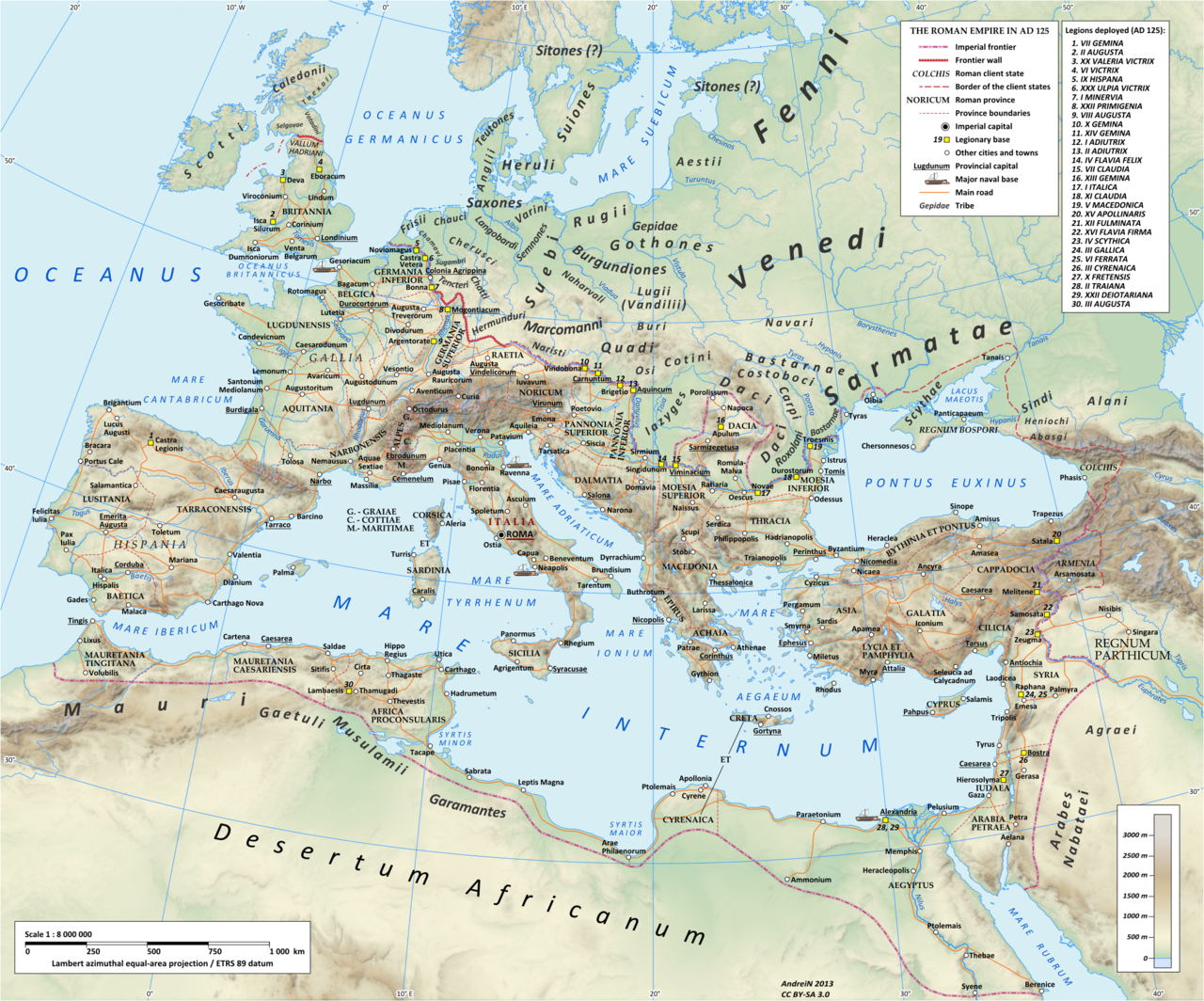
The empire extended across large parts of Europe, North Africa and the Near East. It included provinces that overlap modern countries: Britain (largely excluding much of modern Scotland), the Iberian Peninsula (Spain, Portugal), Gaul (France), the Italian peninsula (Italy), the Greek world (Greece), Anatolia (Turkey), parts of central Europe including areas of modern Germany, wide stretches of North African coast (North Africa), and eastern provinces such as Egypt, the Levant and the Crimean region (Crimea). Alpine and inland regions including Switzerland were within Rome's sphere. The principal administrative language in the West was Latin; Greek remained dominant as a cultural and administrative language in many eastern provinces.
Society, economy and urban life
Roman society was socially stratified, with distinctions among senators, equestrians, local elites, freedmen, artisans and enslaved people. Urban centers featured forums, baths, amphitheaters and temples; a system of roads and maritime links supported trade, communication and military movement. Agriculture formed the economic backbone, complemented by mining, crafts and long-distance commerce. Cities often acted as administrative and economic hubs where Roman law, coinage and municipal institutions shaped daily life.
Military and engineering
The Roman military combined disciplined legions, auxiliary units recruited from provincials, and fortified infrastructure such as forts, walls and roads. Engineering achievements—roads, bridges and aqueducts—were instrumental to administration and economic integration. Public building programs, sponsored by emperors or wealthy elites, asserted civic identity and provided amenities that sustained urban populations across diverse provinces.
Religion and culture
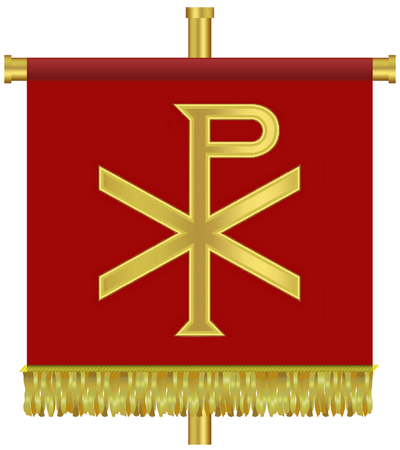
Religious life mixed traditional Roman cults, local deities and, over time, imported beliefs. Cults of the emperor, mystery religions, Judaism and eventually Christianity all played roles in imperial society. By the fourth century AD Christianity had become a major religious force within the empire, influencing institutions and cultural expression. Roman literature, law and artistic traditions drew on Italic and Greek models and contributed to a shared imperial culture even amid local variation.
Division, decline and continuation
The empire faced recurring pressures: political turmoil, economic strain, military challenges, and movements of peoples across its frontiers. Administrative division into western and eastern courts became formalized in the late fourth century; the western imperial line ceased with the deposition of Romulus Augustus by the chieftain Odoacer in 476 AD. The eastern Roman state continued, centered on Constantinople (later called Istanbul), and is commonly referred to as the Byzantine Empire. It retained Roman administrative traditions while adapting to new political and religious realities in regions such as the Balkans and Anatolia. Some eastern provinces, notably parts of the Levant and Egypt, were lost to Arab conquests in the seventh and eighth centuries.
Legacy
Roman law, administrative practices, architectural forms and languages left a lasting imprint on later European and Mediterranean civilizations. Latin evolved into the Romance languages and remained central in law, scholarship and liturgy for many centuries. Roman concepts of citizenship, municipal administration and legal procedure influenced later state formation. Engineering, urban planning and the material legacy of cities and roads continued to shape landscapes long after political change.
Further reading and resources
- Introductory surveys and synthesis articles provide accessible starting points: survey resources.
- Regional and provincial studies examine local adaptation in places such as Gaul, Egypt and the Levant.
- Works on language and law discuss the role of Latin and the transmission of Roman legal concepts to later traditions.
- Biographies and prosopography illuminate emperors, generals and administrators, and their reforms.
- Maps and archaeological syntheses help visualize provincial organization: see maps of Italy, Spain and Greece.
- For later continuity and transformation consult studies of the Byzantine state and of medieval Mediterranean polities.
- Specialized corpora, inscriptions and numismatic collections support primary-source research (period studies, language corpora).
- Regional entries and archaeological reports are available for Britain (Britain), North Africa (North Africa), Anatolia (Anatolia) and the Crimea (Crimea).
For targeted research consult academic bibliographies, museum catalogues and curated digital archives; many libraries and online collections maintain guides and translations suitable for study at different levels.
Questions and answers
Q: What was the capital of the Roman Empire?
A: The capital of the Roman Empire was Rome.
Q: When did the Roman Empire start?
A: The Roman Empire started in 27 BC, when Octavian became the Emperor Augustus.
Q: When did it end?
A: The Roman Empire ended in 476 AD.
Q: What languages were spoken in the Roman Empire?
A: The main language of the Roman Empire was Latin with Greek as an important secondary language, especially in the Eastern provinces of the Empire.
Q: How long did the western half of the empire last for?
A: The western half of the Roman Empire lasted for about 500 years till its final emperor Romulus Augustus was defeated by barbarian general Odoacer.
Q: How long did its eastern half last for?
A: The eastern half, consisting of the Balkans, Anatolia, The Levant and Egypt, continued for about a thousand years more (though parts were lost to Arabs in 8th century).
Q: What was this eastern part called? A: This eastern part was called Byzantine Empire and its capital was Constantinople (now Istanbul).
Related articles
Author
AlegsaOnline.com Roman Empire: origins, government, territories, decline and legacy Leandro Alegsa
URL: https://en.alegsaonline.com/art/83851
Sources
- books.google.com : The Roman Empire: Roots of Imperialism
- books.google.com : Collapse: how societies choose to fail or succeed: revised edition
- books.google.com : Trajan: Optimus Princeps : a life and times
- doi.org : 10.2307/1170959
- jstor.org : 1170959
- repository.upenn.edu : "Historical estimates of world population: an evaluation"
- doi.org : 10.2307/1971891
- jstor.org : 1971891
- peterturchin.com : "East-West orientation of historical empires"
- worldcat.org : 1076-156X
- books.google.com : The Cambridge Ancient History: Volume 12, The Crisis of Empire, AD 193–337