
Marbled polecat (Vormela peregusna)
A compact overview of the marbled polecat: identification, range, behaviour, habitat, threats and distinguishing features of this small mustelid found from southeast Europe across Asia.
Overview
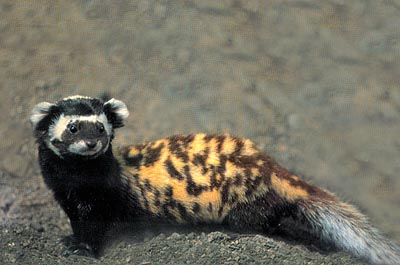
The marbled polecat (Vormela peregusna) is a small carnivorous mammal in the Mustelinae group. It is noted for its striking, blotched or "marbled" coat, a pale face with dark patches, a relatively short tail and a compact, low-slung body. Like many mustelids it is equipped with anal scent glands and can release a strong, unpleasant secretion when threatened.
Image gallery
4 Images


Range and habitat
This species occupies open landscapes across a broad swath of Eurasia. Its historical and present distribution includes parts of southeast Europe and stretches into Asia, with records from Russia, China, Turkey, Iran, Afghanistan, north‑western Pakistan, northern India, Mongolia and Kazakhstan. It prefers steppe, semi‑desert, grassland and agricultural margins where it can find burrows and prey.
Appearance and behaviour
Marbled polecats are small, typically described as weasel‑ to ferret‑sized. Their coat pattern provides camouflage in dry, grassy terrain. They are primarily terrestrial and often use the burrows of rodents or other small mammals for shelter and raising young. Activity tends to be nocturnal or crepuscular, though individuals may be seen during daylight in quieter areas.
Diet and reproduction
As opportunistic predators they feed mainly on small mammals such as voles and gerbils, supplemented by insects, birds and eggs. Breeding occurs seasonally; females rear a litter in a den where the young grow until independent. Parental care and denning behaviour mirror that of other small mustelids.
Conservation and human interactions
The marbled polecat has declined in parts of its range because of habitat conversion, reductions in rodent prey, persecution and accidental poisoning. It is considered at risk in several countries and benefits from habitat protection and monitoring where conservation measures are applied. It occasionally enters agricultural areas where it can be both tolerated for consuming rodents and exposed to hazards such as pesticides and trapping.
Distinctive facts
- Taxonomy: Vormela is treated as a distinct genus, with the marbled polecat as its best known species.
- Defence: Its ability to emit a foul scent from anal glands is a notable anti‑predator trait shared with other mustelids.
- Identification: The marbled coat, facial mask and compact build distinguish it from related weasel and ferret species.
The marbled polecat remains a species of interest for ecologists studying steppe ecosystems and the effects of land use change on small carnivores. For basic species accounts and range details consult regional faunal guides and conservation summaries: Mustelinae overview, range portals for southeast Europe and Asia, and national resources for Russia, China, Turkey, Iran, Afghanistan, Pakistan, India, Mongolia and Kazakhstan.
Author
AlegsaOnline.com Marbled polecat (Vormela peregusna) Leandro Alegsa
URL: https://en.alegsaonline.com/art/61571
Sources
- iucnredlist.org : "Vormela peregusna"