
Manucodia — the manucodes, a genus of birds-of-paradise
Manucodia is a small genus of birds-of-paradise found in New Guinea, nearby islands and parts of northeastern Australia. They are notable for monogamy, similar plumage between sexes, and frugivorous habits.
Overview
The name Manucodia (commonly called manucodes) designates a small genus of birds-of-paradise. Most modern authorities recognize five medium-sized species in the group. Unlike many other members of the family Paradisaeidae, manucodes are largely monogamous and sexually monomorphic, meaning males and females appear similar rather than showing the extreme sexual dimorphism familiar from other birds-of-paradise. The genus is treated in taxonomic literature as a distinct genus with several closely related species.
Image gallery
10 Images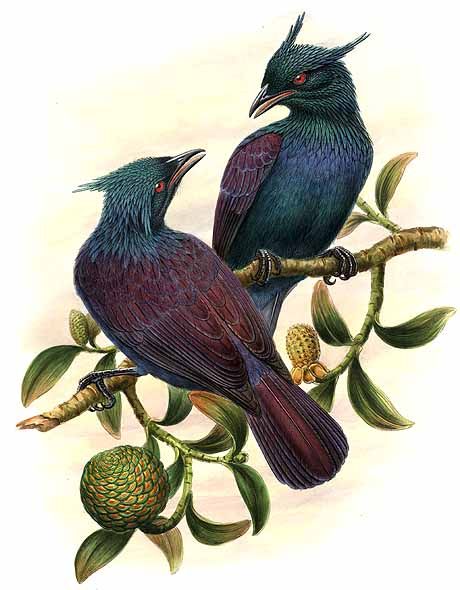






Physical characteristics
Manucodes are robust passerines with glossy, often iridescent plumage in dark greens, blues and blacks. They lack the highly elaborate plumes, wire-like tail feathers or dramatic facial ornaments seen in many of their relatives; instead their appearance is relatively subdued but striking in sheen. Body and tail proportions are moderate; vocal behavior and subtle color patterns are important for identification. Their bills are adapted to a largely frugivorous diet, though they may take insects and other small prey opportunistically.
Behavior and reproduction
Behaviorally, manucodes contrast with the lekking, polygynous displays of many birds-of-paradise. Pairs generally form stable bonds and cooperate in nesting. They build simple cup nests in trees and raise their young together, with parents provisioning fledglings until independence. Their calls are characteristic—often strong and far-carrying—and serve both territorial and pair-bonding functions rather than functioning as components of elaborate display arenas.
Distribution and ecology
Manucodes inhabit lowland and hill forests across New Guinea, a number of adjacent islands, and parts of northeastern Australia (northeastern Australia) and (New Guinea). They occupy primary and secondary rainforest, forest edges and gallery woodlands where fruiting trees are available. As primarily frugivores, they play an important ecological role in seed dispersal, helping to maintain forest regeneration and plant diversity.
Taxonomy, conservation and notable facts
The genus sits within the bird-of-paradise family (Paradisaeidae) and has attracted attention because its social system and lack of sexual dimorphism provide a clear contrast to the classic lekking taxa. The vernacular and scientific names reflect early contacts between naturalists and local languages, and the group has been the subject of both behavioral and ecological study. Conservation status varies by species: while some manucodes remain relatively widespread, others are vulnerable to habitat loss, hunting and fragmentation. Their dependence on intact forest makes protected areas and habitat management important for their long-term persistence.
- Key traits: monogamy, sexual monomorphism, glossy plumage, frugivory.
- Ecological role: seed dispersers and forest ecosystem contributors.
- Research interest: contrasts in mating systems within Paradisaeidae.
Related articles
Author
AlegsaOnline.com Manucodia — the manucodes, a genus of birds-of-paradise Leandro Alegsa
URL: https://en.alegsaonline.com/art/61453