
Manchester Piccadilly station
Main railway station for central Manchester; overview of layout, history, services, connections, facilities and its role within the UK rail network.
Overview
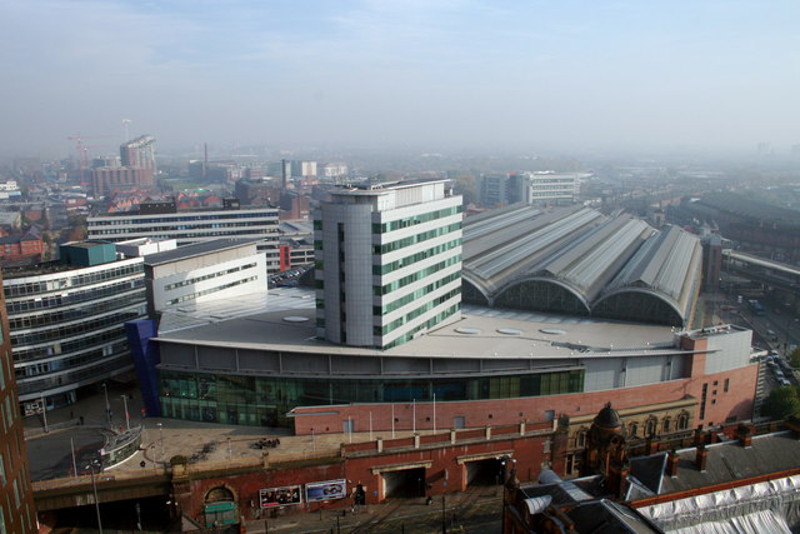
Manchester Piccadilly is the principal railway station serving central Manchester in England. Managed by Network Rail, it functions as the chief rail hub for Greater Manchester and the north-west of England. The station handles a mix of long-distance intercity trains, regional services and local commuter routes, and it provides interchange with light rail, local buses and taxi services. It is one of a small number of major stations in the United Kingdom directly managed by Network Rail rather than by a single train operating company.
Image gallery
2 Images
Layout and facilities
The station complex includes a main concourse with ticketing facilities, waiting areas and a range of retail and catering outlets. There are both through platforms for services passing through the city and terminal (bay) platforms on one side for services that start or terminate at Piccadilly. Passenger amenities typically include staffed information points, electronic departure displays, step-free access between concourse and platforms via lifts and ramps, cycle parking and secure storage, taxi ranks and short-term parking in nearby streets. A tram stop serving the city's light rail network is located at the station forecourt, providing easy interchange for many travellers.
Platforms and operations
Piccadilly's platforms are used by several different train operators. Long-distance services to the south and London are commonly routed from dedicated platforms, while regional and local services to towns across northern England use others. Train dispatching and platform allocation vary by time of day and operator; passengers are advised to check departure screens and platform announcements before boarding. Major operators serving the station include long-distance companies and regional providers; examples of commonly recognised operators are services to London Euston and other southern destinations, intercity routes linking to cities such as Birmingham and coastal services, and cross-border connections to Scotland.
Services and destinations
Typical destinations served from Piccadilly include long-distance services to London and the Midlands, cross-country and regional services to cities across northern England, and services that continue to and from parts of South Wales. Regular services also run northwards into Scotland, calling at major Scottish stations such as Glasgow Central and Edinburgh on particular routes. Commuter trains provide frequent connections to suburban stations and nearby towns, forming an important part of daily travel for thousands of passengers.
History and development
Piccadilly developed during the 19th century as the city's rail network expanded and several adjacent railway facilities were consolidated into a principal station. Over the 20th and 21st centuries the station has been modernised in phases: platform renewals, concourse remodelling, improvements to passenger facilities and enhanced accessibility. Major works over recent decades have sought to increase capacity and improve interchange with Manchester's tram and bus networks.
Connections and role in the city
The station sits within walking distance of key central districts and hotels, making it a principal gateway for visitors and business travellers. It offers direct interchange with the local tram system, bus services across the city region and onward rail connections to other city-centre stations including Victoria, Oxford Road and Deansgate. Transport partnerships and local authorities, including city and regional transport bodies, coordinate services and station-area improvements to support onward journeys.
Passenger usage and reputation
Piccadilly is the busiest station in England outside of London and one of the busiest in the United Kingdom outside the capital. It handles high volumes of passenger traffic and plays a central role in regional connectivity. Customer experience and satisfaction are priorities for the station's managers and the train operators serving it; information services, accessibility and retail provision are continually reviewed and upgraded.
Future improvements and planning
Ongoing and proposed rail capacity projects in the north of England aim to improve journey times, reliability and platform capacity at major hubs including Piccadilly. Planned schemes emphasise electrification, track upgrades and station enhancements to cope with increasing demand. Detailed project scope and timetables are set by national and regional transport authorities and by train operators; passengers are advised to consult official sources for up-to-date information.
Practical information
For current timetables, platform information and station facilities consult official operator pages or the station information service: station information. Travellers should allow time for interchange during peak periods and check for any temporary changes due to engineering works or special events. The wider Manchester rail network provides alternative arrival and departure points, and local transport maps and customer centres can assist with onward journey planning.
As a working transport hub, Piccadilly continues to evolve to meet passenger needs and regional transport objectives. For detailed enquiries about services, accessibility, retail outlets or ongoing works, contact the station operators or the local transport authority directly, or visit official information pages before travelling.
Related articles
Author
AlegsaOnline.com Manchester Piccadilly station Leandro Alegsa
URL: https://en.alegsaonline.com/art/61208
Sources
- rail-reg.gov.uk : "Station Usage 2007-2008"
- news.bbc.co.uk : Revamped station tops train poll