
Maribyrnong River Viaduct (Quarter Mile Bridge)
A major railway trestle across Melbourne’s Maribyrnong River, built 1927–29. Noted for its length and height, it carries freight and intercity trains and is listed on the Victorian Heritage Register.
Overview
The Maribyrnong River Viaduct, commonly called the Quarter Mile Bridge, is a prominent railway crossing in the western suburbs of Melbourne, Australia. Spanning the Maribyrnong River near the E.J. Whitten Bridge, the viaduct provides a high-level route for rail traffic on the Albion–Jacana line. Its long, elevated profile has made it a local landmark since the late 1920s.
Image gallery
3 Images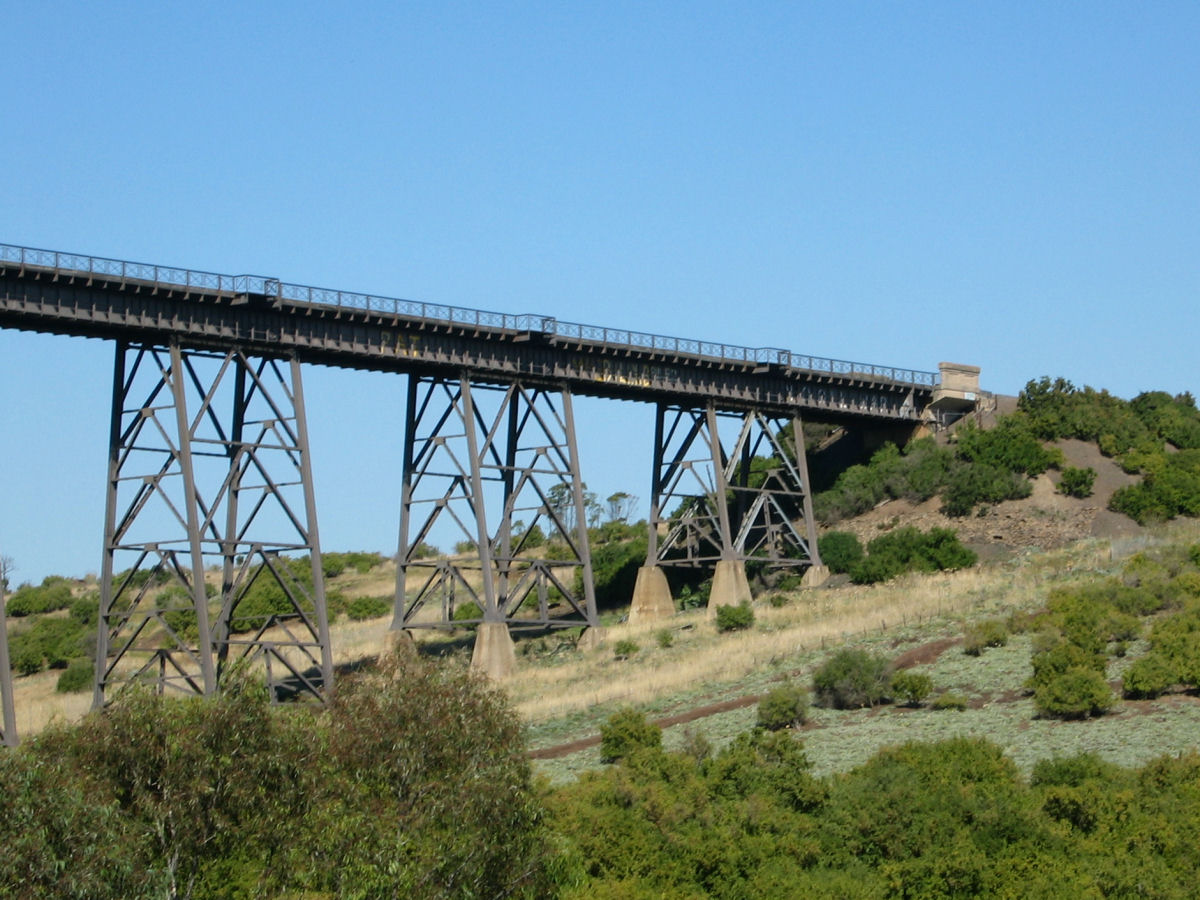

Design and dimensions
The structure is a trestle-style railway viaduct composed of a sequence of spans supported by closely spaced piers. Measured along its deck, the bridge is about 1257 feet (approximately 383.13 metres) long—hence the popular name “Quarter Mile Bridge.” Its deck reaches roughly 180 feet (about 54.86 metres) above the water, making it one of Victoria’s highest rail viaducts. The height and continuous span were engineered to carry heavy rail loads while maintaining clearance over the river valley.
Construction and early history
Construction of the viaduct took place between 1927 and 1929 under the direction of the Victorian Railways Construction Branch. When it opened in June 1929 it was celebrated as the largest trestle bridge in Australia. The project employed around 200 workers; contemporary records note one recorded fatality during construction. The bridge was built to improve freight movements around Melbourne and to strengthen the rail link between the city and interstate routes.
Rail operations and uses
The viaduct primarily carries freight trains using the Albion–Jacana freight corridor. It is also on the route used by longer-distance passenger services, including the Melbourne to Sydney CountryLink XPT service. Its importance lies in providing a grade-separated, direct path for heavy rail traffic across the Maribyrnong valley, reducing curvature and gradients that would otherwise constrain train operations.
Notable comparisons and distinctions
Because of its height and length the viaduct is often compared to better-known bridges. It is sometimes cited as the second highest bridge structure in Victoria after the West Gate Bridge, and at its deck height it exceeds the deck height quoted for the Sydney Harbour Bridge. Its designation as a large trestle when completed distinguishes it from longer suspension or cantilever river bridges built elsewhere.
Heritage, preservation and public interest
The Maribyrnong River Viaduct is listed on the Victorian Heritage Register in recognition of its historical, technical and social significance. Heritage listing acknowledges the bridge’s role in enabling rail freight movements around Melbourne and its status as a notable example of early 20th-century railway engineering. Ongoing maintenance and careful management are necessary to retain its structural integrity while allowing continued rail use.
Quick facts
- Common name: Quarter Mile Bridge
- Location: Maribyrnong River, western suburbs of Melbourne
- Line: Albion–Jacana (primarily freight)
- Length: ~1257 ft (≈383.13 m)
- Height above water: ~180 ft (≈54.86 m)
- Construction: 1927–1929; completed June 1929
- Historic status: listed on the Victorian Heritage Register
Questions and answers
Q: What is the Maribyrnong River Viaduct?
A: The Maribyrnong River Viaduct is a railway bridge that spans the Maribyrnong River in Melbourne, Australia.
Q: How long is the Maribyrnong River Viaduct?
A: The Maribyrnong River Viaduct is almost 400 meters long.
Q: What railway line uses the Maribyrnong River Viaduct?
A: The Albion-Jacana railway line uses the Maribyrnong River Viaduct.
Q: Is the Maribyrnong River Viaduct mainly used for passenger trains?
A: No, the Maribyrnong River Viaduct is mainly used for freight trains.
Q: How high is the Maribyrnong River Viaduct?
A: The Maribyrnong River Viaduct is 180 feet (54.86 m) above the water.
Q: Is the Maribyrnong River Viaduct the highest bridge in Victoria?
A: No, the Maribyrnong River Viaduct is the second highest bridge in Victoria, behind the West Gate Bridge.
Q: When was the Maribyrnong River Viaduct built?
A: The Maribyrnong River Viaduct was built in 1927-29 by the Victorian Railways Construction Branch, and was the largest trestle bridge in Australia when completed in June 1929.
Related articles
Author
AlegsaOnline.com Maribyrnong River Viaduct (Quarter Mile Bridge) Leandro Alegsa
URL: https://en.alegsaonline.com/art/61855
Sources
- vhd.heritage.vic.gov.au : "Victorian Heritage Database"
- mvcc.vic.gov.au : City of Moonee Valley Gap Heritage Study
- historyvictoria.org.au : "The Railway Top 20!"
- heritage.gov.au : "Rail Bridge (Albion Viaduct)"