
Maine Road: Manchester City's former stadium in Moss Side
Maine Road was Manchester City's long-serving stadium in Moss Side, Manchester (1923–2003). Known for its large capacity, record attendances and long association with the club, it was demolished in 2004.
Maine Road was a major football stadium located in the Moss Side district of Manchester. For eighty years it served as the home ground of Manchester City F.C., opening in 1923 and remaining the club's base until the end of the 2002–03 season. The ground took its name from the road on which it stood and became one of the best-known venues in English club football. Its story touches on urban development, crowd culture and stadium design through most of the twentieth century.
Image gallery
10 Images





Origins and historical context
The site lay south of Manchester city centre and stood on a route with a long local history. When construction began in the early 1920s the new stadium was intended to replace smaller premises and to accommodate large crowds attracted by the growing popularity of the game. From the moment it opened, Maine Road was among the country's largest club grounds, second only to national venues in overall capacity. The stadium remained closely associated with the surrounding community in Moss Side and with football life in England.
Design, stands and facilities
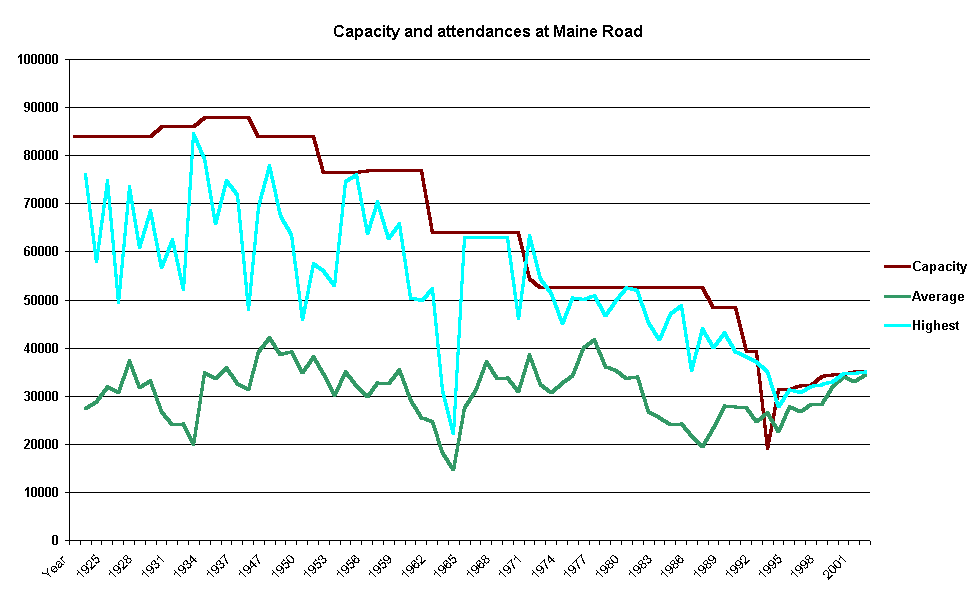
Over its life Maine Road underwent several rounds of redevelopment. Initially it offered terraces and basic facilities typical of the era; later modifications introduced covered stands and, after the safety reforms of the 1980s and 1990s, it became an all-seater ground. The layout included distinct stands on each side of the pitch, corporate and press areas, and facilities for matchday operations. Before closure its official capacity was listed at about 35,150, reflecting seating-only configurations required by modern regulations.
Notable matches and attendance records
- In 1934 Maine Road recorded its highest ever attendance when 84,569 spectators watched an FA Cup tie involving Manchester City and Stoke City; this remains the record attendance for an English club ground and a defining moment in the stadium's history. The game is often cited when discussing pre-war football crowds and the scale of public interest at the time.
- The ground also held the highest recorded Football League attendance for a Manchester City home match: 79,491 for a league fixture against Arsenal the following year—an indication of how league games could attract enormous local followings.
- Maine Road hosted countless league and cup ties, and while it was never the national stadium—venues such as Wembley held that role—it was a major stage for club-level football and memorable matches in the club's own history. Significant competitions, including the FA Cup, were staged there on occasion.
Closure, relocation and legacy
Manchester City's final season at Maine Road was 2002–03; the last match at the ground took place on 11 May 2003. The club then moved to the modern City of Manchester Stadium in east Manchester, now the club's permanent home, a move that reflected changing expectations about comfort, safety and commercial facilities in top-level football (City of Manchester Stadium). The old stadium was demolished in 2004, and the site has since been redeveloped.
Today Maine Road is remembered for its immense crowds in the interwar years, for decades of local support for Manchester City F.C. (the club), and for illustrating the evolution of football stadia from large terraced arenas to all-seater venues. Its record attendances—against teams such as Stoke City—remain notable statistics in English football lore and are often referenced when discussing stadium safety, modernisation and the social history of the game.
For further reading on specific matches, architectural changes and the stadium's role in Manchester's sporting life, see contemporary match reports and club histories linked through archival resources and club publications. Many fans and historians continue to commemorate Maine Road's place in the city's cultural heritage.
Questions and answers
Q: What was Maine Road?
A: Maine Road was a large football stadium in Moss Side, Manchester, England that was home to Manchester City F.C. from 1923 to 2003.
Q: What was the origin of the name Maine Road?
A: Maine Road was named after the street it was built on, which was originally known as Dog Kennel Lane and was part of an ancient route south of Manchester.
Q: How did the size of Maine Road compare to other club grounds in England?
A: When first opened, Maine Road was the largest club ground in England and the second largest in the country after Wembley Stadium.
Q: What was the record attendance at Maine Road and when was it set?
A: The record attendance at Maine Road was 84,569 people, which was set in 1934 during an FA Cup tie between Manchester City and Stoke City.
Q: What was the highest Football League attendance at Maine Road and who was the opponent?
A: The highest Football League attendance at Maine Road was 79,491 for a game against Arsenal.
Q: Was the design of Maine Road consistent throughout its history?
A: No, the design of Maine Road changed several times over its 80-year history.
Q: When did Manchester City move from Maine Road to City of Manchester Stadium and what happened to Maine Road after that?
A: Manchester City moved from Maine Road to City of Manchester Stadium in east Manchester after the 2002-03 season. Maine Road was torn down in 2004.
Related articles
Author
AlegsaOnline.com Maine Road: Manchester City's former stadium in Moss Side Leandro Alegsa
URL: https://en.alegsaonline.com/art/60800
Sources
- mcfc.co.uk : "Stadium history"
- en.structurae.de : Maine Road on Structurae database
- news.bbc.co.uk : "BBC Sport - Maine Road through the ages"
- news.bbc.co.uk : "Sale step closer to Maine Road"
- manchestereveningnews.co.uk : "Sea of rubble at the end of the Road"
- manchestereveningnews.co.uk : "Transfer to Maine Road"
- manchestereveningnews.co.uk : "Derby day for fans' clubs"