
City of Manchester Stadium (Etihad Stadium)
Multiuse stadium in Manchester, England—home of Manchester City F.C., built for the 2002 Commonwealth Games and later converted for football and major events.
Overview
The City of Manchester Stadium, commonly referred to by its sponsored name the Etihad Stadium and informally known as Eastlands or COMS, is a major multiuse sport and events venue in Manchester. Originally constructed for athletics competition, it was adapted after the games to serve as a modern football ground and has since become the primary home for Manchester City F.C.. The venue combines a contemporary bowl layout with a distinctive roof structure and is used for club football, concerts and other large-scale events.
Image gallery
10 Images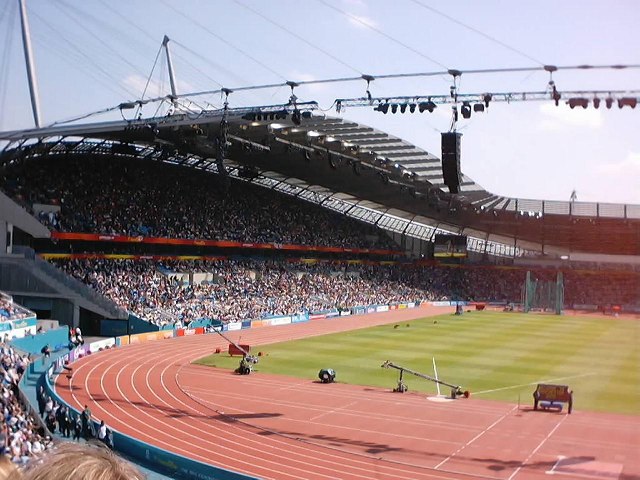






Design and structure
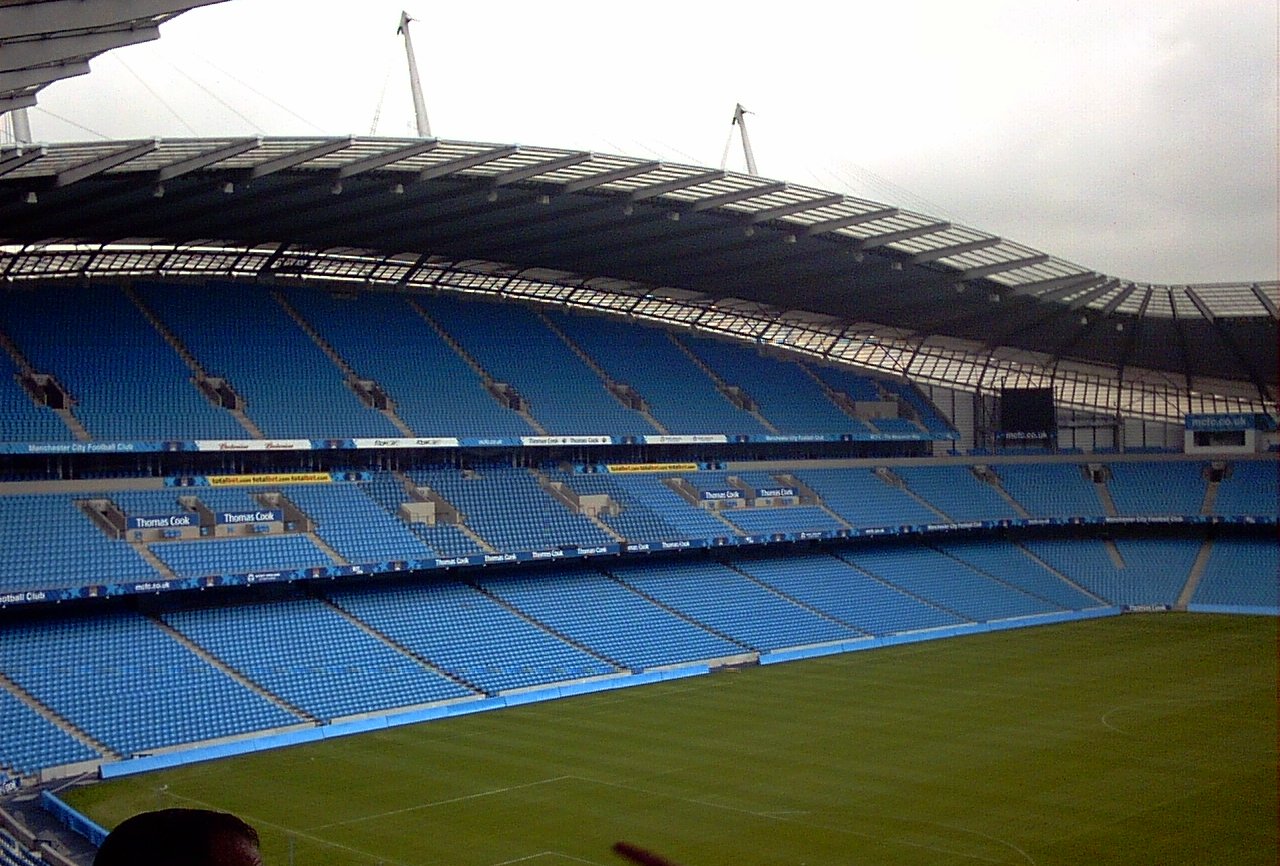
The stadium was designed by Arup and built by contractor John Laing. Its outward form is a continuous bowl with two full seating tiers and partial third-tier stands behind the dugouts and along either side. The building was planned to be convertible: it originally included an athletics track to host major track-and-field competitions and was configured to allow later installation of additional seating when athletics usage ended.
History and development
Conceived during Manchester's campaign to expand its sporting infrastructure—an effort linked to a failed 2000 Olympic bid—the stadium was completed in time to stage the athletics events at the 2002 Commonwealth Games. After the Games the stadium underwent conversion to remove or adapt the running track and add permanent football seating. The initial project cost was reported at around £110 million. In 2003 Manchester City made the move from their long-standing ground at Maine Road, signing a long-term lease on the facility.
Usage and capacity
Following conversion the arena became dedicated primarily to football and related events. Its capacity is commonly cited at about 55,000 fixed seats, placing it among the larger club stadiums in England and one of the larger grounds in the United Kingdom; it has been described in lists of the largest stadiums in the country by seating. Beyond club matches, the stadium has hosted significant fixtures and finals, including the 2008 UEFA Cup Final, and is a regular venue for concerts and community events.
Redevelopment and future plans
Since taking residency, the club and the local authority have worked on incremental development of the surrounding site. In 2010 the club entered an agreement with Manchester City Council to accelerate regeneration of the area and to consider stadium expansion through redevelopment projects. Proposals have included schemes to increase capacity to around 60,000 and to improve transport and public spaces; phased work on the precinct and facilities around the stadium began in the early 2010s. Discussions have also addressed long-term occupation terms and a renewed lease for the club at the site, part of ongoing redevelopment planning between the parties.
Notable facts and distinctions
- The venue is widely known by its sponsorship title but retains its civic name in many official contexts.
- Its flexible design — initially for athletics then converted for football — is an example of legacy planning where a major event venue is repurposed for long-term use.
- The move from a traditional inner-city ground to a purpose-built modern stadium reflected broader trends in stadium design and urban regeneration.
The City of Manchester Stadium remains an important sporting and cultural asset for the city, illustrating how a purpose-built games venue can be transformed into a club stadium and a multifunctional events arena used throughout the year.
Questions and answers
Q: What is the City of Manchester Stadium also called?
A: The City of Manchester Stadium is also called the Etihad Stadium, COMS or Eastlands.
Q: Who designed and built the stadium?
A: The stadium was designed by Arup and built by John Laing.
Q: What was the original purpose for building the stadium?
A: The stadium was first designed as part of Manchester's failed bid for the 2000 Summer Olympics.
Q: How much did it cost to build the stadium?
A: It cost £110 million to build the stadium.
Q: When did Manchester City F.C. move into the stadium?
A: Manchester City F.C moved into the stadium in 2003 after signing a 250-year lease.
Q: How many seats does it have?
A: As of 2010/2011 season, it has 55,097 seats.
Q: What is being discussed between Manchester City F.C and Manchester City Council regarding redevelopment of land around the stadium?
A:Manchester City F.C and Manchester City Council are discussing an agreement to allow redevelopment of land around the stadium which may include adding more seats to make 60,000 in total in addition to making a new lease on the future for use of this space
Related articles
Author
AlegsaOnline.com City of Manchester Stadium (Etihad Stadium) Leandro Alegsa
URL: https://en.alegsaonline.com/art/20557