
M60 Patton
Cold War-era American main battle tank introduced in 1960, developed from the M48 Patton with improved armor, a 105 mm gun, diesel engine, and later upgrades; served widely with U.S. allies.
The M60 Patton is an American main battle tank introduced in December 1960. Designed as an evolution of the earlier Patton series, it became the United States Army's principal armored platform during much of the Cold War. The M60 combined increased protection and firepower with improved mobility compared with its predecessor and remained in front-line service for several decades before being superseded by the M1 Abrams.
Image gallery
10 Images


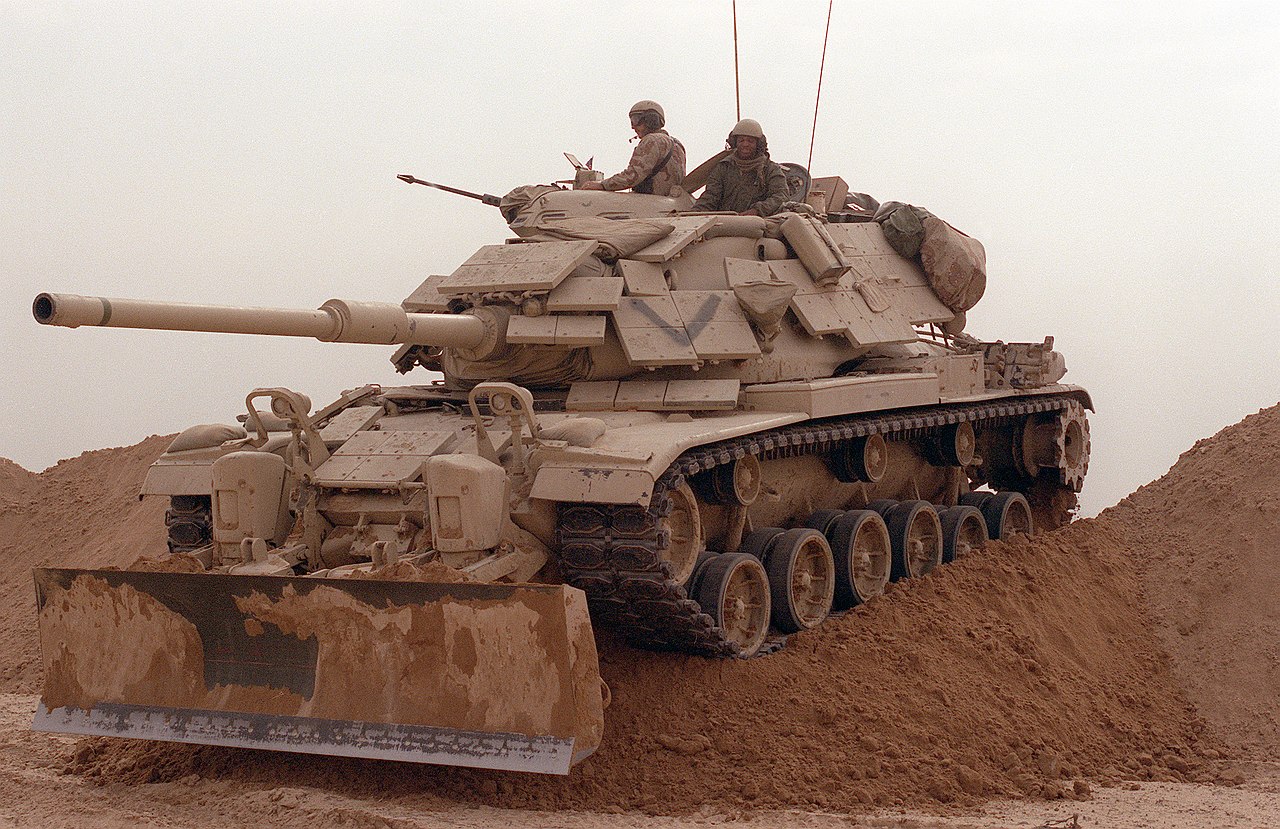


Characteristics
- Armament: The tank was equipped with the widely used British-designed L7 105 mm rifled tank gun as its primary weapon, giving it effective anti-armor capability for its era.
- Protection: Armor was enhanced relative to the M48, with design changes aimed at increasing survivability against contemporary anti-tank threats.
- Powerplant: The M60 series marked a move away from gasoline engines to diesel propulsion, improving range and reducing fire risk compared with earlier designs.
- Crew and layout: Typical crew size was four (commander, gunner, loader, driver), with a conventional turret and hull arrangement.
More advanced fire-control systems, improved optics, and upgraded stabilization were added to later models to enhance accuracy and night-fighting ability. These improvements reflected evolving battlefield requirements and technological advances in electronics and optics.
Development and history
The M60 originated as a response to perceived Soviet armor improvements, notably the widespread deployment of the T-54 family, which prompted U.S. planners to modernize their main battle tanks. The program adapted the M48 Patton hull and incorporated a new turret, heavier armor, and the L7 105 mm gun. Official entry into service occurred in 1960, and successive upgrade programs produced several major variants during the Cold War era.
Variants and upgrades
- M60A1: Improved turret design and hull modifications for better ballistic protection and system reliability.
- M60A3: Upgraded electronics and fire control, thermal sights, and other systems to extend combat relevance.
- Export and locally modernized versions: Many allied nations accepted the M60 and implemented national upgrade packages.
While the United States eventually replaced the M60 with the M1 Abrams for front-line service, the M60 remained in use with allied armies around the world well into the 21st century.
Operational use and legacy
The M60 saw service in a number of regional conflicts and was operated by multiple countries. It is considered an important transitional design that helped define the modern main battle tank concept: combining firepower, protection and mobility on a single chassis. Its widespread export and the longevity of upgraded variants underscore the platform's adaptability.
For more technical details and historical accounts, see material on the platform as a main battle tank, its role during the Cold War, the context of the Soviet T-54 developments that partly motivated its creation, the U.S. decision-making process in the United States, and the shift from gasoline to diesel powerplants.
Related articles
Author
AlegsaOnline.com M60 Patton Leandro Alegsa
URL: https://en.alegsaonline.com/art/60227
Sources
- gao.gov : "Increasing Procurement Cost Of M60A1 Tanks" · web.archive.org
- fas.org : "Archived copy"
- fas.org : "M60 Series Tank (Patton Series)"
- fas.org : "Basic Issue Plan"