
Ligeia Mare — a large hydrocarbon sea on Titan
Ligeia Mare is a vast liquid hydrocarbon sea near Titan's north pole. Mapped by Cassini, it is notable for its size, methane–ethane composition, shoreline channels and interest as a future exploration target.
Overview. Ligeia Mare is a prominent body of liquid on Saturn's moon Titan. Located at about 79.0° N, 248.0° W, it spans roughly 500 km across and is classed as a lake or sea of hydrocarbons. The feature's name derives from Ligeia, one of the sirens of Greek mythology, following the International Astronomical Union's naming conventions for Titan's seas (Latin mare).
Image gallery
10 Images


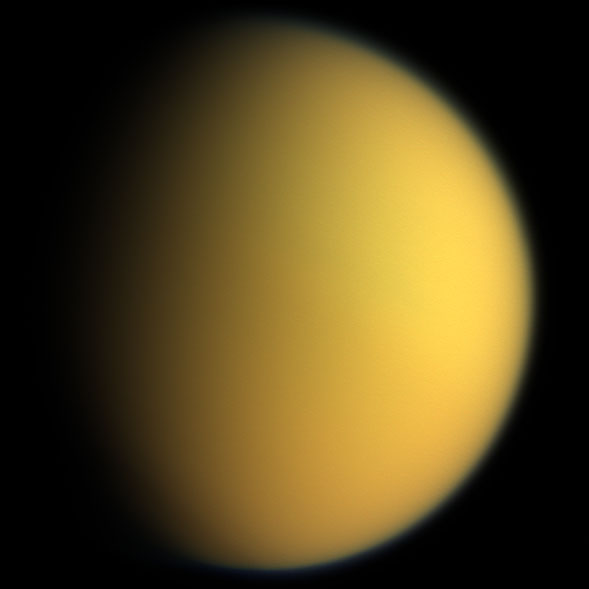
Characteristics and composition
Ligeia Mare is filled with liquid primarily composed of methane and ethane, with dissolved nitrogen and other organic compounds. Radar and radiometric measurements by the Cassini spacecraft show a dark, low-reflectivity surface consistent with a smooth liquid. Shorelines are irregular and radar images reveal inlet channels and drowned valleys that suggest the sea receives flow from surrounding terrain. Depth estimates are uncertain and vary by location; some regional sounding suggests significant depth in parts while shallower shelves occur near the margins.
History and discovery
The seas and lakes of Titan were discovered and mapped in detail by the Cassini–Huygens mission. Cassini's radar instrument revealed extensive polar hydrocarbon seas in the mid-2000s, bringing Ligeia Mare to attention as one of the largest northern seas. The International Astronomical Union adopted the name to reflect mythological associations and standardized nomenclature for Titan's surface features.
Scientific importance and exploration
Ligeia Mare is scientifically valuable as one of the few known stable bodies of liquid beyond Earth. Its chemistry and seasonal behaviour offer insights into prebiotic organic processes, exotic hydrocarbon weather cycles and comparative planetology. Observations from orbit have reported transient bright features and changes along the surface interpreted variously as waves, floating solids, or transient foam, illustrating active processes. Because of these qualities, Ligeia Mare has been proposed as a target for in situ missions, including concepts like the Titan Lake In-situ Sampling Propelled Explorer (TiME) and other space probe concepts that would study lake composition, dynamics and potential habitability.
Notable facts and distinctions
- Ligeia Mare is one of Titan's largest seas, often cited as second in size to Kraken Mare.
- Unlike the Moon's maria, Titan's "maria" are true liquids on the surface rather than hardened lava plains.
- Cassini data show complex shorelines, tributary channels and seasonal variations linked to Titan's climate.
Future missions that could float, sample or even sail across Ligeia Mare would provide direct measurements of its liquids and boundary interactions, improving our understanding of hydrocarbon-based hydrology and the organic chemistry of icy worlds.
Further reading and mission summaries are available through mission pages and scientific reviews (lake resources, Titan overview, mythological name origin, nomenclature details, TiME concept, mission proposals).
Related articles
Author
AlegsaOnline.com Ligeia Mare — a large hydrocarbon sea on Titan Leandro Alegsa
URL: https://en.alegsaonline.com/art/57923