
Local Group (galaxy group containing the Milky Way and Andromeda)
The Local Group is the galaxy association that contains the Milky Way, Andromeda and dozens of smaller galaxies. It spans roughly ten million light‑years and is part of the Virgo Supercluster.
Overview
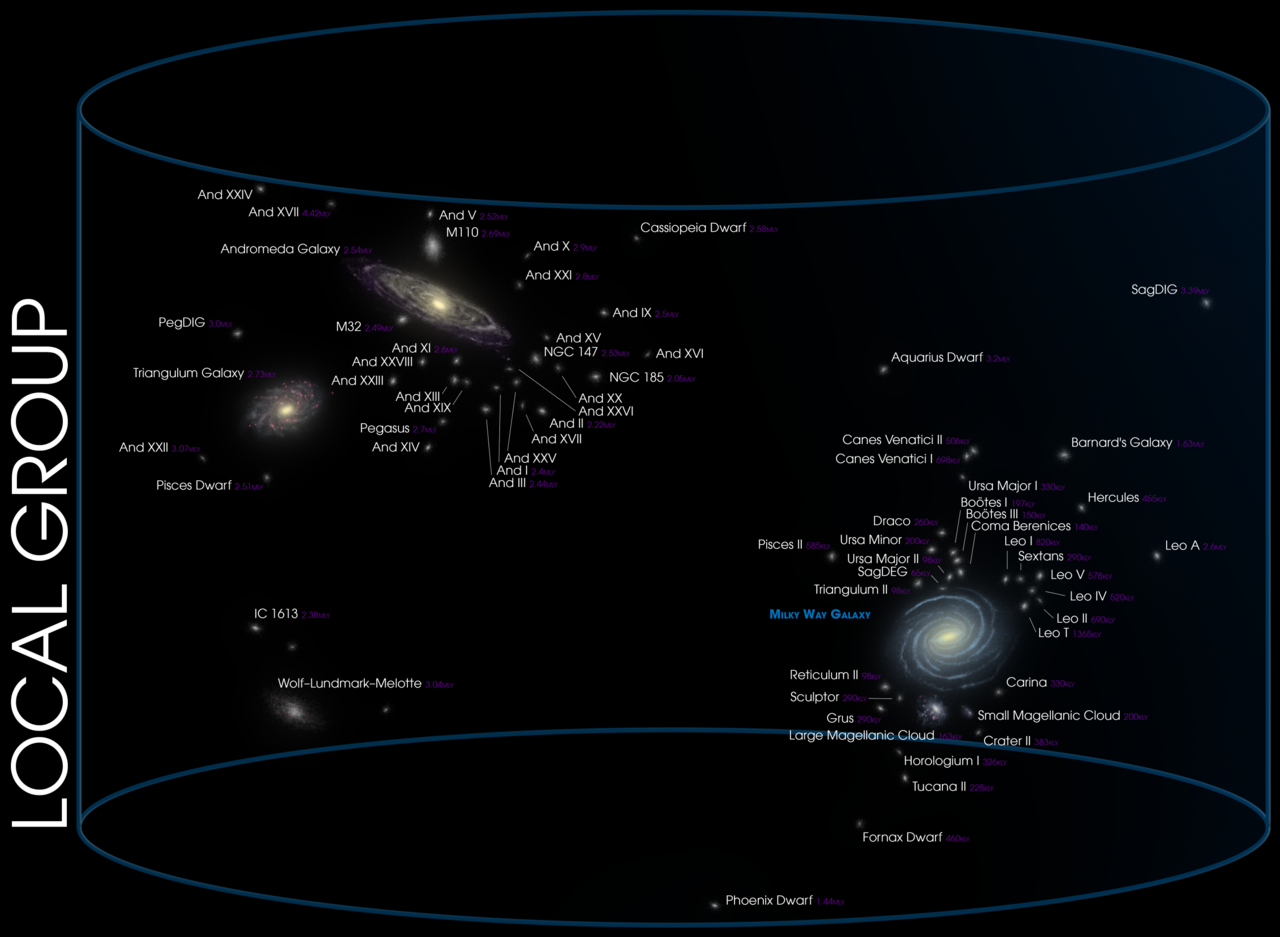
The Local Group is the gravitationally bound group of galaxies that includes our home system, the Milky Way system (commonly called the Milky Way). It comprises more than fifty known member galaxies, from large spirals to faint dwarf satellites, and is the nearest laboratory for studying galaxy formation, dynamics and the distribution of dark matter.
Image gallery
10 Images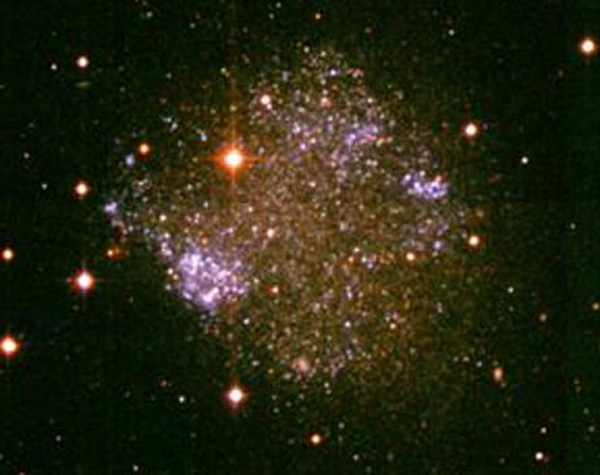




Size, shape and center
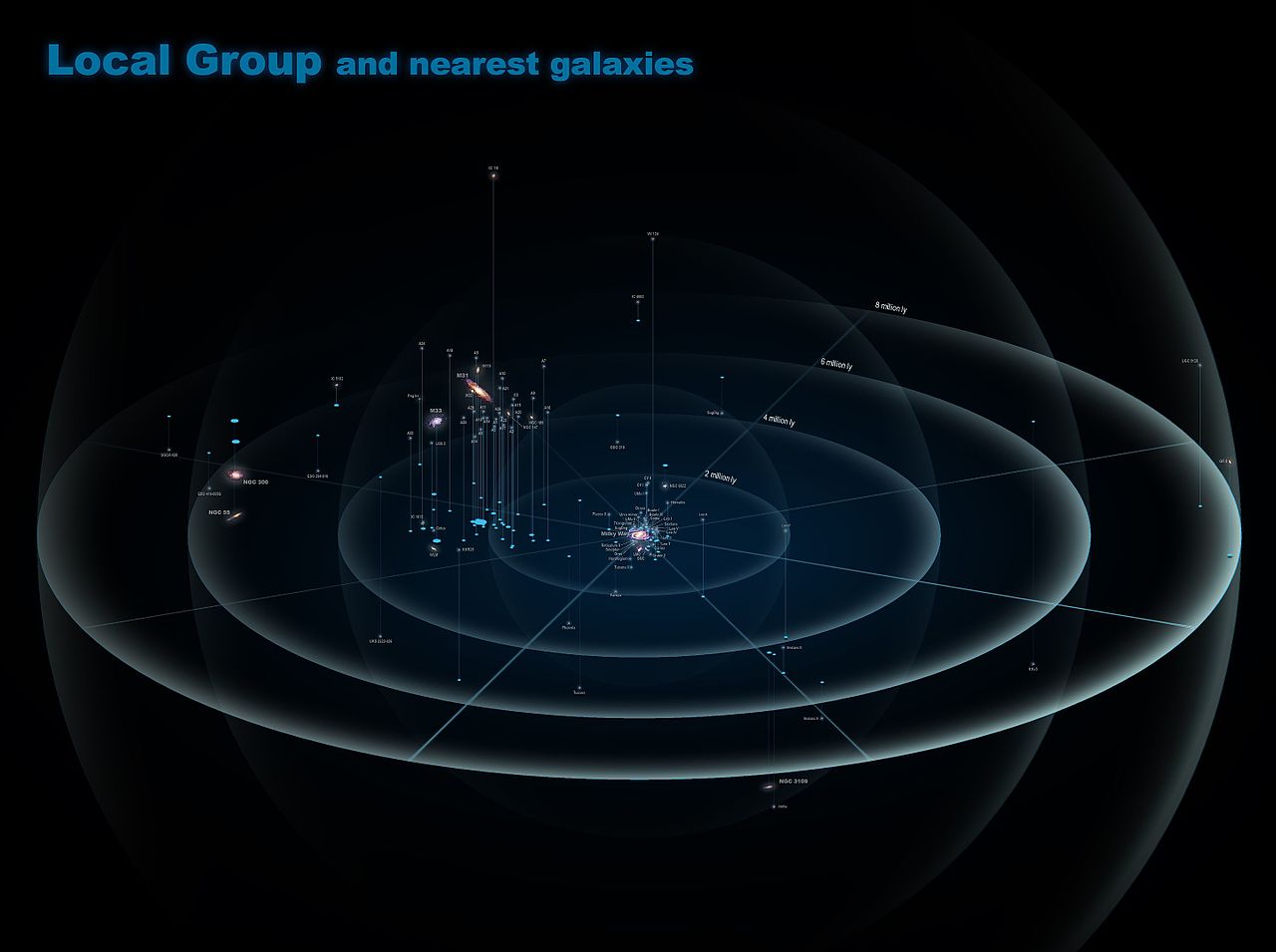
Members of the Local Group occupy a region roughly ten million light‑years across. The spatial distribution is lopsided: most of the mass is concentrated in two dominant galaxies, giving the ensemble a binary or "dumbbell" appearance. The effective center of mass of the system lies between the Milky Way and the Andromeda galaxy, reflecting their combined gravitational influence on smaller companions.
Members
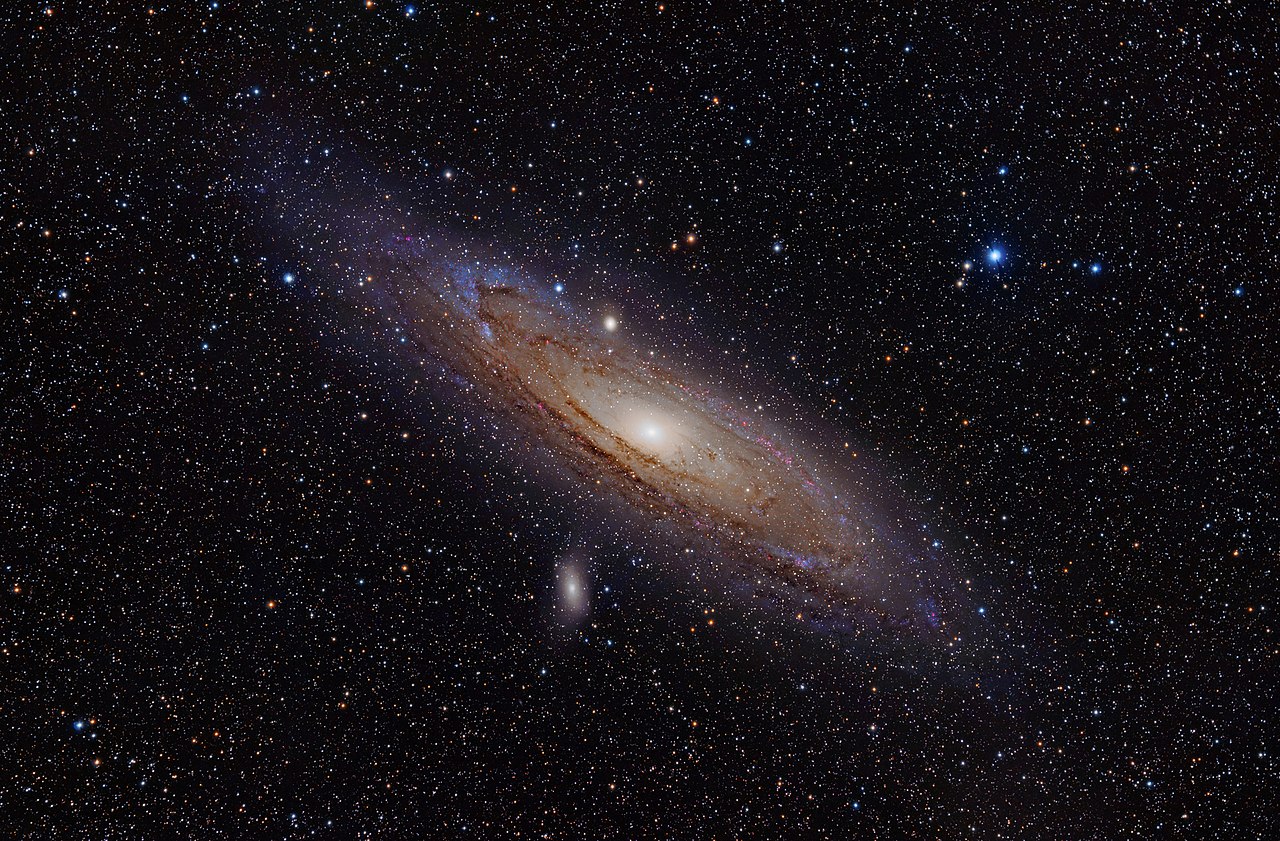
Besides the Milky Way and Andromeda, the Local Group contains the Triangulum Galaxy and a large population of dwarf galaxies, including several satellites visible to small telescopes. Continuing wide and deep surveys have increased the count of recognized members, especially at the faint end, and have improved knowledge of their positions and motions.
Mass and dynamics
Mass estimates for the Local Group place it on the order of 10^12–10^13 solar masses; recent dynamical studies give values consistent with a few trillion times the mass of the Sun (mass estimates). The mutual gravity of the largest members governs internal motions: the Milky Way and Andromeda dominate the potential and influence the orbits of many smaller systems.
Future evolution
Observations show that the Milky Way and Andromeda are approaching each other. They are expected to have a major interaction and eventual merger in several billion years, a process that will reshape the Local Group and its satellite population. Smaller galaxies may be captured, disrupted or ejected during these interactions.
Cosmic context and history
The Local Group is itself part of a larger network of structures and lies within the nearby Virgo Supercluster. Recognition of the Local Group grew during the 20th century as astronomers established that many nebulae were external galaxies and then catalogued nearby systems and their motions. Today the Group remains central to tests of cosmological models on small scales.
Significance
- Nearest well‑studied example of a small galaxy association, allowing resolved studies of stars and interstellar matter (group overview).
- Contains both large spirals (Milky Way, Andromeda) and numerous faint dwarf galaxies, important for understanding galaxy formation.
- Spans about 10 million light‑years and has a total mass constrained by kinematics (mass estimates).
- Embedded in the larger large‑scale structure, such as the Virgo Supercluster, connecting it to the cosmic web.
For general introductions and catalogues of Local Group members consult accessible summaries and survey papers that compile positions, velocities and membership probabilities; key entries discuss the Milky Way (Milky Way), group dynamics (group center) and the census of faint dwarf systems.
Questions and answers
Q: What is the Local Group?
A: The Local Group is the group of galaxies that includes our galaxy, the Milky Way.
Q: How many galaxies are included in the Local Group?
A: The Local Group has more than 50 galaxies, including dwarf galaxies.
Q: Where is the center of mass for the Local Group located?
A: The center of mass for the Local Group is somewhere between the Milky Way and the Andromeda galaxy.
Q: What is the shape of the galaxies in the Local Group?
A: The galaxies in the Local Group have a binary (dumbbell) shape.
Q: What is the total mass of the Local Group?
A: The Local Group has a total mass of about (1.29 ± 0.14)×1012Ms.
Q: What is the diameter of the Local Group?
A: The galaxies of the Local Group cover a 10 million light-year diameter.
Q: What is the Virgo Supercluster?
A: The Local Group is part of the Virgo Supercluster (also called the Local Supercluster).
Related articles
Author
AlegsaOnline.com Local Group (galaxy group containing the Milky Way and Andromeda) Leandro Alegsa
URL: https://en.alegsaonline.com/art/58745
Sources
- ui.adsabs.harvard.edu : 2006Ap.....49....3K
- doi.org : 10.1007/s10511-006-0002-6
- ui.adsabs.harvard.edu : 1982ApJ...257..389T
- doi.org : 10.1086/159999
- ui.adsabs.harvard.edu : 2003astro.ph..5042V
- nature.com : nature.com/articles/s41550-016-0036