
Loge (Saturn moon)
Loge (Saturn XLVI, S/2006 S 5) is a small, distant irregular moon of Saturn with a retrograde orbit. Discovered in 2006, it belongs to the Norse group and is named after a fire giant from Norse myth.
Overview
Loge, officially Saturn XLVI and provisionally designated S/2006 S 5, is one of Saturn's many small outer satellites. It is classified as an irregular, retrograde moon, meaning it orbits far from the planet and in the opposite direction of Saturn's rotation. Like other irregular satellites, Loge is small and faint; estimates place its diameter at about 6 kilometres. Because of its size and distance, much of what is known about Loge comes from telescopic astrometry and photometry rather than direct imaging.
Image gallery
4 Images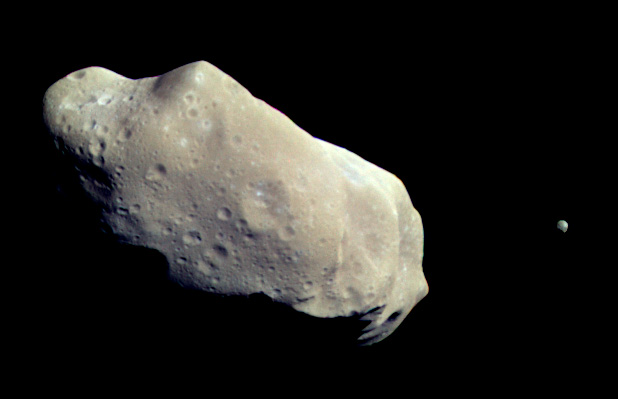


Discovery and designation
The discovery of Loge was announced on 26 June 2006 by a team led by Scott S. Sheppard and David C. Jewitt, along with Jan Kleyna and Brian G. Marsden, based on observations obtained between January and April 2006. The original announcement and related notices are associated with the discoverers' pages and discovery circulars; see the team pages for more detail: Scott S. Sheppard and David C. Jewitt. After confirmation of its orbit, the moon received the provisional designation S/2006 S 5 and later the permanent number and name Saturn XLVI (Loge).
Orbit and physical characteristics
Loge follows a distant, inclined, and moderately eccentric path around Saturn. Key orbital parameters include:
- Average orbital distance (semi-major axis): about 23,142,000 km from Saturn
- Orbital period: roughly 1,314.364 days
- Inclination: approximately 166.5° to the ecliptic (about 165.3° relative to Saturn's equator)
- Eccentricity: around 0.1390
These values are drawn from published orbital solutions and observatory reports; for detailed element sets and updates consult orbital parameter lists and circulars: orbital elements and orbital parameters. The moon's small size implies a low brightness (high apparent magnitude), and its surface composition remains unmeasured except by color indices inferred from photometric observations.
Group membership and origin
Loge is grouped with Saturn's Norse satellites, a collection of distant, retrograde moons that share broadly similar inclinations and orbital distances. Such groups are interpreted as possibly originating from one or more larger bodies that were captured by Saturn's gravity and later fragmented by collisions. Studies of these groups—by comparing orbits, colors, and sizes—help researchers reconstruct collisional histories and capture mechanisms of the outer satellite system.
Name and mythology
In April 2007 the moon was named Loge after a figure from Norse mythology, often rendered as Logi or Loge, a fire giant and son of Fornjót. The name honors the mythological tradition used for this group of Saturnian moons. In popular references Loge is sometimes confused with the trickster god Loki; the naming authorities distinguish the two figures when assigning names to planetary satellites. See the naming citation and mythological background: naming citation and mythological source.
Scientific significance
Although individually small, moons like Loge are scientifically valuable because they probe processes of satellite capture, dynamical evolution, and collisional fragmentation in the outer reaches of planetary systems. Continued astrometric monitoring refines their orbits, and photometric surveys improve estimates of size, albedo, and surface properties. Future observations with larger telescopes or space missions could yield more precise information on rotation, composition, and potential relationships to collisional families.
Related articles
Author
AlegsaOnline.com Loge (Saturn moon) Leandro Alegsa
URL: https://en.alegsaonline.com/art/58857
Sources
- ifa.hawaii.edu : Institute for Astronomy Saturn Satellite Data
- cfa-www.harvard.edu : IAUC 8727: Satellites of Saturn
- cfa-www.harvard.edu : MPEC 2006-M45: Eight New Satellites of Saturn
- cfa-www.harvard.edu : IAUC 8826: Satellites of Jupiter and Saturn