
Leclanché battery (zinc–carbon cell)
A primary zinc–carbon cell invented by Georges Leclanché in the 19th century. Uses zinc and manganese dioxide with ammonium or zinc chloride electrolytes; largely superseded by alkaline cells for high-drain use.
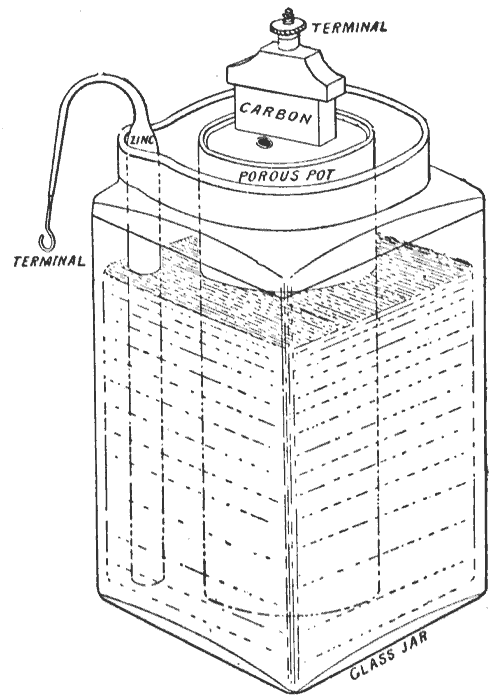
The Leclanché battery, commonly called a zinc–carbon cell or Leclanché cell, is an early and influential type of disposable primary battery. Invented by the French engineer Georges Leclanché about 1866, it converts chemical energy into electrical energy by the oxidation of zinc at the negative electrode and the reduction of manganese dioxide at the positive side. As a primary cell it is intended for single-use service and cannot be recharged; for a discussion of cell categories see primary cell.
Image gallery
3 Images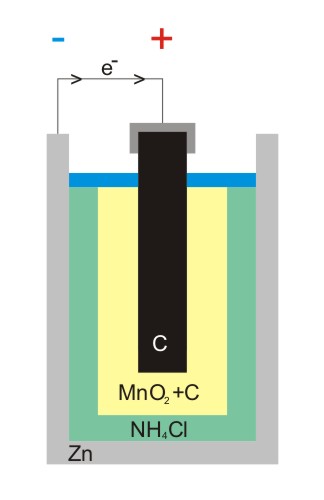

Construction and common materials
Modern zinc–carbon cells are produced as sealed dry cells. The typical construction uses the zinc metal outer can as the negative electrode and container, a central carbon (graphite) rod as the current collector, and a surrounding mixture of manganese dioxide with conductive additives as the active cathode material. The electrolyte is supplied as a moist paste rather than a free liquid; two common electrolytes are ammonium chloride and zinc chloride. The manganese compound and carbon depolarize the cathode and accept electrons during discharge; the zinc is oxidized at the anode and dissolves into the electrolyte. For background on electrolyte roles, see electrolytes.
Variations and labeling
Over time manufacturers produced variants with different electrolyte formulations and internal constructions. Cells labeled "Heavy Duty", "Extra Heavy Duty" or "Super Heavy Duty" typically refer to zinc–carbon variants formulated to give improved shelf life or somewhat longer service at light loads. Zinc–chloride versions are generally more robust and have longer shelf life than older ammonium chloride types. The basic active materials remain zinc and manganese dioxide.
Performance and typical uses
Leclanché or zinc–carbon batteries offer acceptable energy at low manufacturing cost. They have higher internal resistance and lower practical capacity than modern alkaline cells, so their run time falls off rapidly in high-drain devices. Because of this they are most appropriate for low-current and intermittent-use products such as clocks, basic flashlights, remote controls, small toys and inexpensive household devices. For many decades the Leclanché type was the common everyday cell until the introduction of the alkaline cell, which provides higher energy and better performance in demanding applications; see alkaline for comparison.
History and development
Georges Leclanché's original wet cell design evolved into the dry zinc–carbon cell as solid pastes and sealed constructions were developed. Improvements in sealing, electrolyte chemistry and materials reduced leakage and improved storage life. During the 20th century alkaline cells, introduced commercially in the mid-century, gradually displaced zinc–carbon cells for most portable electronics because of their greater capacity and lower internal resistance.
Environmental, safety and disposal considerations
Historically some zinc–carbon cells contained small amounts of mercury to suppress hydrogen evolution and limit self-discharge, but mercury is now largely eliminated from consumer batteries due to regulation and improved design. Zinc and manganese are not as toxic as heavy metals like lead or cadmium, yet batteries should still be disposed of or recycled through appropriate municipal programs. Incineration is unsafe and may release hazardous substances; recycling recovers metals and reduces environmental impact.
Manufacturing notes and identifiers
- Negative electrode: zinc metal can, often serving also as the cell container.
- Positive electrode: powdered manganese dioxide with carbon additives surrounding a graphite rod.
- Electrolyte: paste of ammonium chloride or zinc chloride with fillers to control conductivity and viscosity.
Practical guidance
For consumers, zinc–carbon cells remain a low-cost option when devices draw little current or are used intermittently. For cameras, modern toys, and other high-drain electronics, alkaline or rechargeable cells are preferable. Storage in a cool, dry place extends shelf life. When selecting batteries, manufacturers' labels and specification data give guidance about expected performance under different loads.
The Leclanché battery occupies an important place in the development of portable electric power: its basic design established the principles used in many later primary cells and it remained the everyday battery for many decades before being largely superseded by newer chemistries.
For further reading on related topics see links on primary cells, electrolytes and material properties: primary cell, electrolytes, zinc, manganese dioxide, zinc chloride, ammonium chloride and alkaline.
Related articles
Author
AlegsaOnline.com Leclanché battery (zinc–carbon cell) Leandro Alegsa
URL: https://en.alegsaonline.com/art/56857