
Ammonium chloride
Ammonium chloride (NH4Cl) is a white crystalline salt formed from ammonium and chloride ions; used in metallurgy, batteries, fertilizers, medicine and laboratory chemistry.
Ammonium chloride (chemical formula NH4Cl) is a white, crystalline inorganic salt composed of the ammonium and chloride species. In solid form it is typically a fine, granular or crystalline powder that is slightly hygroscopic. It behaves as the salt of a weak base (ammonia) and a strong acid (hydrogen chloride), and dissolves readily in water to give an acidic solution. The word "sal ammoniac" is an historical name for the substance.
Image gallery
4 Images
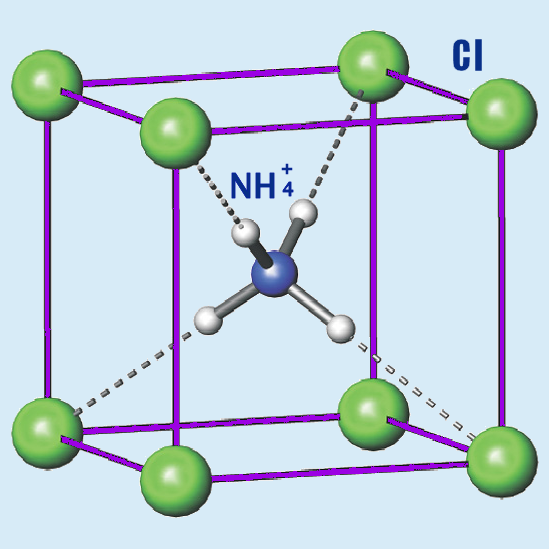


Physical and chemical properties
Ammonium chloride sublimes when heated: rather than melting cleanly it tends to decompose to ammonia and hydrogen chloride which can recombine on cooling. In aqueous solution the salt dissociates into ions, and it can be deprotonated by strong bases such as sodium hydroxide, liberating ammonia gas. Its solubility increases with temperature, a typical behavior for many inorganic salts.
Preparation and reactions
Industrially and in the laboratory, ammonium chloride is produced by neutralizing aqueous ammonia with hydrogen chloride or as a by-product in several chemical processes. It reacts with strong bases to produce ammonia and the corresponding base salt; with strong acids it may generate additional chloride-containing species. On heating it can decompose, and in contact with very strong oxidizers it should be treated with caution.
Uses and applications
Ammonium chloride has a wide range of uses across different fields:
- Metallurgy and electronics: as a flux in soldering and metalworking to remove oxides from metal surfaces — commonly called sal ammoniac in this context; see soldering flux.
- Batteries: historically used as the electrolyte in the Leclanché primary cell and related small dry cells; see Leclanché cell.
- Agriculture and industry: as a nitrogen-containing fertilizer and as a precursor or reagent in dyeing, textile printing and metal finishing.
- Pharmacy and food: used in some expectorant formulations and as a regulated food additive (E510) in limited applications.
- Laboratory reagent: for qualitative tests, buffer preparation, and other routine chemical procedures.
Safety and distinctions
Ammonium chloride is not highly toxic in small amounts, but it can be an irritant to the skin, eyes and respiratory tract; ingestion or inhalation of large quantities can cause more serious effects. It should be stored in a dry, labeled container and handled with appropriate protective equipment. Because it releases ammonia when treated with strong bases, mixtures that might generate gas should be avoided in confined spaces. Chemically, it is distinct from other ammonium salts (for example ammonium sulfate) in its chloride anion and related solubility and acidity characteristics.
For practical guidance on handling, disposal and specific industrial uses consult material safety data sheets and technical literature from suppliers or regulatory agencies. Additional background and references are available through general chemistry resources and specialty texts on inorganic salts.
Related articles
Author
AlegsaOnline.com Ammonium chloride Leandro Alegsa
URL: https://en.alegsaonline.com/art/3592
Sources
- chemister.ru : ammonium chloride
- saltlakemetals.com : "Solubility Products of Selected Compounds"
- ui.adsabs.harvard.edu : 1993SSCom..85..135B
- doi.org : 10.1016/0038-1098(93)90362-Q
- cdc.gov : "NIOSH Pocket Guide to Chemical Hazards #0029"