
Archaic period (North America)
The Archaic period in North America (roughly 8000–1000 BC) marks post-glacial hunter-gatherer adaptations, regional diversity in tools and subsistence, and the gradual shift toward food production and greater sedentism.
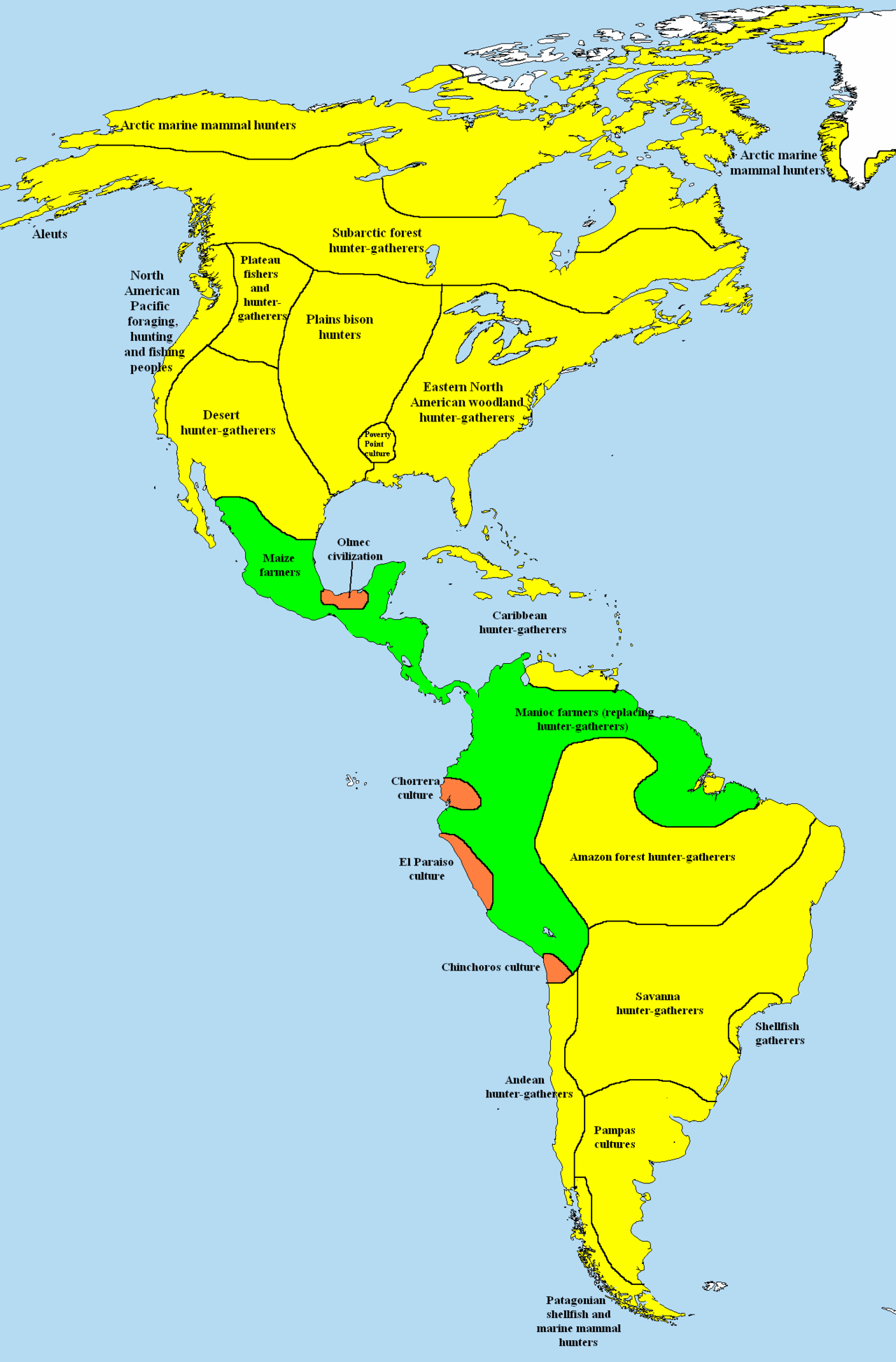
The Archaic period in North America is an archaeological stage that follows the end of the last Ice Age and precedes widespread horticulture and pottery in many regions. Commonly dated from roughly 8000 BC to about 1000 BC in broad continental schemes, the term covers many centuries of cultural change rather than a single uniform society. Chronology and cultural markers vary geographically: what is considered "Archaic" in one area can overlap with earlier or later developments elsewhere. For a general overview of how this period fits into continental sequences see regional chronologies.
Image gallery
6 Images



Characteristics and material culture
Archaic communities are often characterized by a broad-spectrum subsistence strategy and an emphasis on locally available resources. Archaeologists usually identify the period through distinctive chipped-stone projectile points, the increasing use of ground-stone tools for processing plant foods, and abundant remains such as shell middens or fish bone concentrations near lakes and coasts. Organic technologies — baskets, nets, and cordage — were important but rarely preserve, so interpretations rely on associated artifacts and feature types. Examples of common Archaic artifacts include grinding stones, manos and metates, and specialized fishing implements.
- Stone tool diversity: flaked points, knives, and ground tools.
- Features: hearths, storage pits, seasonal camps, and shell middens.
- Perishable technology: baskets, plant-processing gear, and traps (inferred).
Subsistence, settlement, and social change
Subsistence in the Archaic era typically involved hunting wild game, foraging wild plants (nuts, seeds, tubers), fishing, and collecting shellfish where available. In some regions, people developed specialized strategies such as intensive shellfish harvesting, riverine fishing, or exploitation of prairie resources. Over millennia many groups became more sedentary, building repeated seasonal camps or semi-permanent villages where storage pits and more substantial dwellings appear in the record. These shifts often coincide with growing population density, wider exchange networks, and craft specialization.
Regional developments and examples
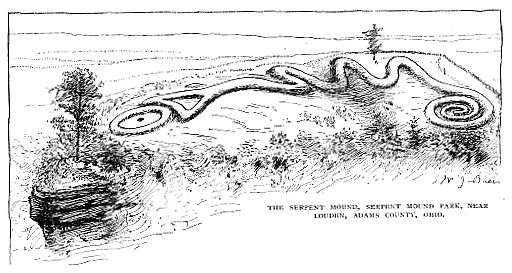
The Archaic is not uniform across the continent. In the Eastern Woodlands, people constructed shell and earthwork mounds at several sites during the Middle to Late Archaic, reflecting complex ritual and social behaviors. On the West Coast and California, abundant marine and plant resources supported relatively dense coastal populations and extensive use of shellfish, recorded as large middens. In the Great Basin and Plateau, mobility and seasonal rounds around dispersed resources predominate, while in the Southwest late Archaic developments set the stage for later farming cultures. For regional summaries and site examples consult Eastern sites, coastal records, and interior traditions.
Transition to agriculture and historical significance
The end of the Archaic period is conventionally marked by the appearance of domesticated plants, pottery, or other technologies associated with more sedentary agricultural life, but the timing of that transition differs widely. In some places the move toward cultivation and permanent villages began earlier, while other regions remained forager-horticultural well into the first millennium BC and later. The Archaic era is significant for illustrating how diverse human groups adapted to post-glacial environments, experimented with plant management, and developed the social and technological foundations that led to later regional civilizations. For further reading on transitions and long-term processes see studies of cultural change.
Overall, the Archaic period represents a long and varied chapter in North American prehistory in which people refined strategies for exploiting a wide range of environments, created recognizable regional traditions, and gradually moved toward the settled lifeways that shaped subsequent cultural trajectories.
Related articles
Author
AlegsaOnline.com Archaic period (North America) Leandro Alegsa
URL: https://en.alegsaonline.com/art/5285