
Kepler's laws of planetary motion
Three empirical laws that describe how bodies move around the Sun: elliptical paths, equal areas in equal times, and the relation T² ∝ a³ connecting orbital period and size.
Overview
Kepler's laws are three concise statements that summarize the dominant features of how planets move around the Sun. They were derived from careful analysis of observational data and remain a foundation for classical celestial mechanics. Rather than explaining why motion occurs, they describe regularities that later received a theoretical explanation.
Image gallery
8 Images





The three laws
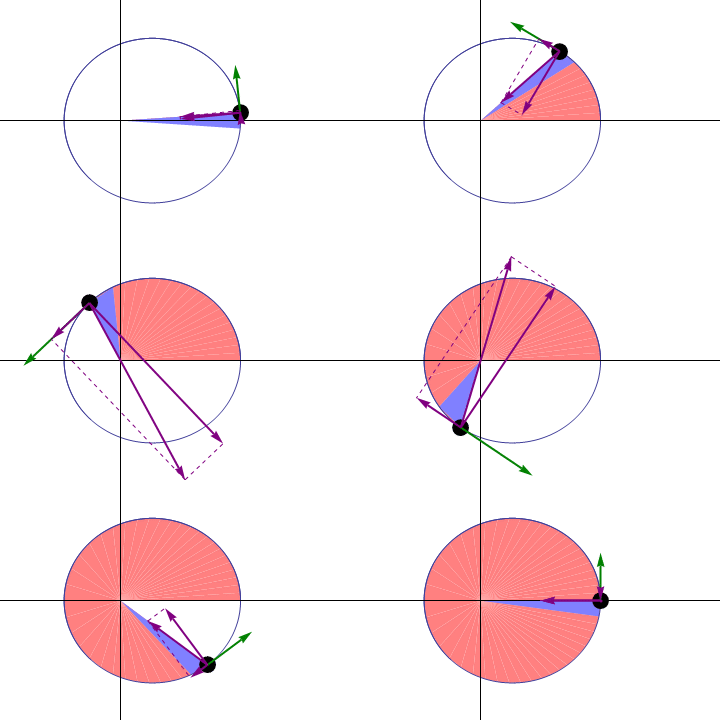
- First law (shape): Each planet travels on an elliptic path with the Sun at one focus; this replaces earlier assumptions of perfect circular motion.
- Second law (area): A line joining a planet to the Sun sweeps out equal areas in equal times, meaning the planet moves faster when it is nearer to the Sun and slower when it is farther away.
- Third law (period–size relation): The square of a planet's orbital period is proportional to the cube of the orbit's semimajor axis; in symbolic form, T² ∝ a³, which links how long an orbit takes to its overall size and shape for similar central masses.
Interpretation and important details
Kepler's statements are empirical: they summarize observed motion without providing the underlying force. The second law is closely related to conservation of angular momentum in a central force field. The third law becomes more general when the mass of the central body or the masses of orbiting bodies are included; for very different central masses it must be adjusted. These laws apply to a wide range of orbits and are approximate when additional forces or perturbations are significant.
History and scientific significance
The laws were published in the early 17th century by Johannes Kepler, who used precise positions collected by Tycho Brahe. Kepler first announced two laws in 1609 and added the third in 1619. Their importance grew when Isaac Newton later showed that an inverse-square gravitational force explains them, placing Kepler's results within a broader dynamical framework.
Examples and applications
These laws describe the motions of planets, comets, and many artificial satellites to a useful degree of accuracy. They guide mission planning, orbit determination, and understanding of exoplanet systems. Deviations from ideal behavior highlight additional influences such as gravitational perturbations, non-spherical mass distributions, or relativistic effects.
Notable distinctions
Kepler's laws are often taught as historical milestones: they mark the shift from circular to elliptical orbits and from descriptive to explanatory physics. While simple in form, their consequences pervade astronomy and space science and serve as a bridge to Newtonian and modern orbital mechanics.
Questions and answers
Q: What are Kepler's laws of planetary motion?
A: Kepler's laws of planetary motion are three laws that describe the motion of planets around the sun.
Q: How do planets move around the sun according to Kepler's laws?
A: Planets move around the sun in elliptic orbits.
Q: Where is the sun located in the orbit of a planet according to Kepler's laws?
A: The sun is in one of the two foci of the orbit.
Q: What is the significance of a line segment joining a planet and the sun in Kepler's laws?
A: A line segment joining a planet and the sun sweeps out equal areas during equal intervals of time.
Q: Who discovered Kepler's laws and when were they discovered?
A: Johannes Kepler found these laws, between 1609 and 1619.
Q: How is the orbital period of a planet related to the semi-major axis of its orbit according to Kepler's laws?
A: The square of the orbital period of a planet is proportional to the cube of the semi-major axis of its orbit.
Q: What is the importance of Kepler's laws in the study of planetary motion?
A: Kepler's laws are fundamental laws that describe the motion of planets around the sun and they are important in the study of planetary motion.
Related articles
Author
AlegsaOnline.com Kepler's laws of planetary motion Leandro Alegsa
URL: https://en.alegsaonline.com/art/52999