
Karaikal — coastal town and district headquarters in the Puducherry region
Karaikal is a coastal municipality on India's southeastern coast, part of the Union Territory of Puducherry. It is known for its Kaveri delta farmland, historic French links, rivers, temples and annual festivals.
Overview
Karaikal is a coastal municipality and the administrative centre of the Karaikal district in the Union Territory of Puducherry. Located on the south-eastern coast of India, the town functions as a local hub for administration, trade and religious pilgrimage. It is commonly described as a port city because of its coastal location and associated fishing and trade activities.
Image gallery
10 Images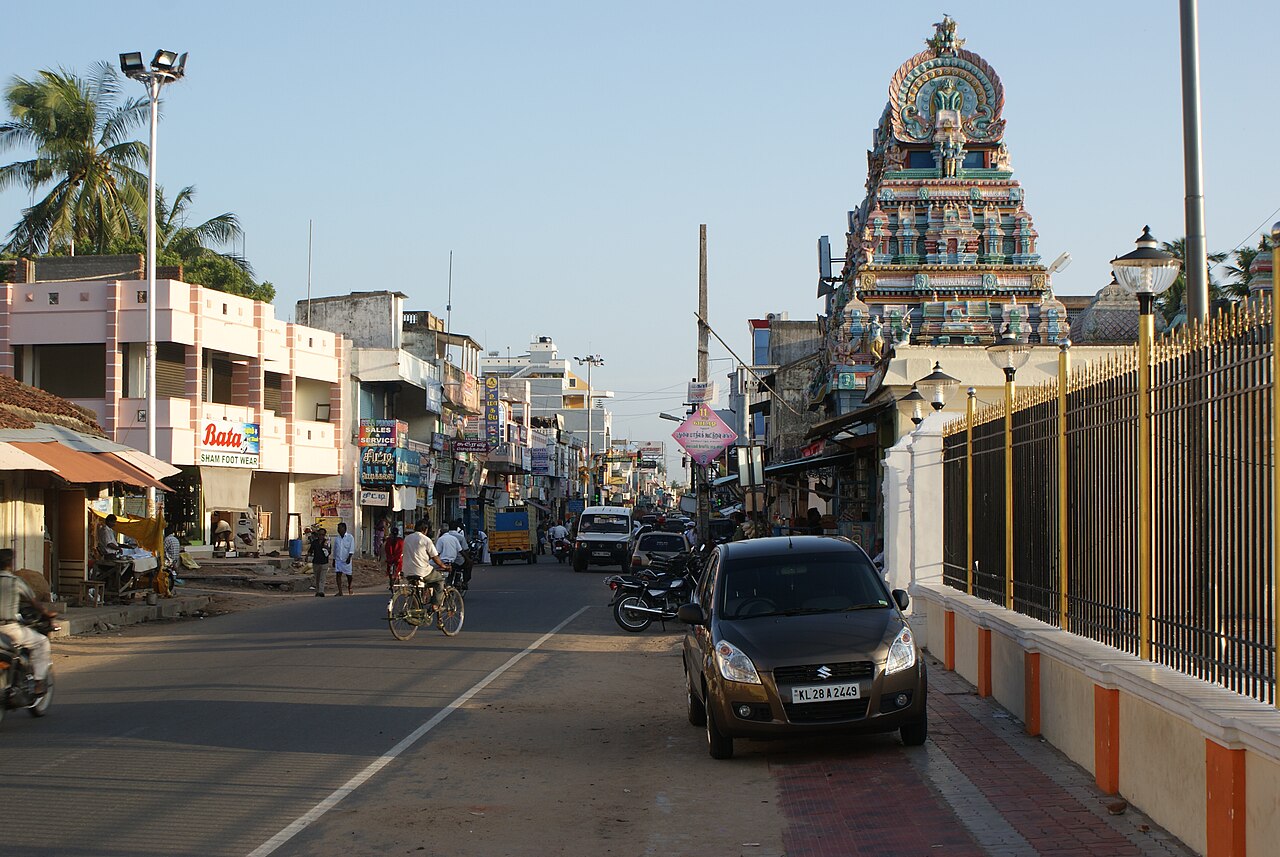


Geography and rivers
Karaikal lies within the Kaveri (Cauvery) river delta, an area of rich alluvial soils that supports intensive agriculture. Several small rivers and distributaries pass through or empty near Karaikal, notably the Arasalar River, along with waterways locally named Virasolanar, Tirumalairajanar and Vikramanar. These rivers and their tributaries reach the Bay of Bengal close to the town, shaping local wetlands, estuaries and fisheries.
History and administration
The area that is now Karaikal came under French colonial control in the late 17th century and remained associated with France for centuries; Pondicherry and its enclaves were transferred to Indian administration in the mid-20th century. Following that transition, Karaikal was integrated with other former French enclaves such as Yanam, Pondicherry and Mahe to form the present-day Union Territory of Puducherry. The long period of French presence left traces in town planning, some buildings and local institutions, while the dominant regional language remains Tamil.
Economy, transport and land use
The surrounding delta plain is fertile and supports cultivation of rice, coconut and other crops typical of coastal Tamil country. Fishing and small-scale trade are important to the local economy. Karaikal is connected by road and rail to neighbouring districts of Tamil Nadu and serves as a local market town for agricultural produce. Recent decades have seen infrastructure improvements aimed at linking the port and inland areas more effectively to regional networks.
Culture, temples and festivals
Karaikal is an important centre for Saivite Hindu devotion and local religious traditions. It is known as the birthplace of the saint Karaikal Ammaiyar, one of the canonical Tamil Shaivaite devotees (Nayanmars), who is closely associated with worship of Lord Shiva. Prominent temples include the Karaikal Ammaiyar Temple, Kailasanathar Kovil and the Sri Nithyakalyana Perumal temple. The town's calendar features several festivals; the annual Mangani festival draws many pilgrims and is one of the best-known local celebrations.
Local places and notable facts
The Karaikal district includes a number of surrounding towns and villages such as Tirumalairayanpattinam, Thirunallar, Nedungadu, Kottucherry, Neravy and Varichikudy, and it occupies a distinct territorial position relative to neighbouring Tamil Nadu districts. The presence of Karaikal as an enclave of Puducherry produces an administrative geography in which nearby districts, including Nagapattinam, are arranged around the union territory. Visitors and researchers note both the agricultural richness of the delta and the continuing cultural visibility of Karaikal's historic links.
Practical information
- Administration: Karaikal is the district headquarters and municipal centre of its district (municipality).
- Transport: Road and rail connect the town with larger cities of Tamil Nadu and the rest of Puducherry.
- Civic life: Local economy combines agriculture, fishing, small industry and services; traditions rooted in temple festivals remain central to community life.
For further local and historical context consult regional overviews and official sources on the Union Territory of Puducherry and the former French settlements in India (France).
Questions and answers
Q: What is Karaikal?
A: Karaikal is a port city in the south-eastern coast of India. It is also a municipality and headquarters of the Karaikal district.
Q: How long did France rule over Karaikal?
A: France ruled over Karaikal for over 280 years until Pondicherry became independent in 1954.
Q: What other parts form the Karaikal district?
A: The other parts that form the Karaikal district are Tirumalairayanpattinam, Thirunallar, Nedungadu, Kottucherry, Neravy, Varichikudy etc.
Q: What rivers flow into the sea through Karaikal?
A: The rivers of Arasalar River, Virasolanar River, Tirumalairajanar River, Vikramanar River and tributary rivers of Arasalar River flow into the sea through Karaikal.
Q: Who was born and lived in Karaikal?
A:Karaikal Ammaiyar, one of the 63 nayanmars was born and lived in Karakial. She was also known as the mother of southern music.
Q: What famous festival is celebrated in Karakial?
A:The grand and famous festival of Mangani festival is celebrated in Karakial.
Q: What temples are found in Karakial?
A:The temples found in Karakial include theKaraikalamma Temple , Kailasanathar Kovil , Sri Nithyakalyana Perumaltemple etc
Related articles
Author
AlegsaOnline.com Karaikal — coastal town and district headquarters in the Puducherry region Leandro Alegsa
URL: https://en.alegsaonline.com/art/52267
Sources
- censusindia.gov.in : "Sub-District Details"