
John Deere: Inventor of the Steel Plow and Founder of Deere & Company
Biography of John Deere (1804–1886), his invention of the polished steel plow, the founding and growth of Deere & Company, and his influence on 19th‑century American agriculture and industry.
Overview
John Deere (February 7, 1804 – May 17, 1886) was an American blacksmith, inventor and entrepreneur whose practical improvements to plow design helped transform farming on the American prairie. Best known for developing a polished steel plow that shed sticky Midwestern soil, he founded the business that became Deere & Company. Deere’s work addressed a specific regional problem and had broader economic and social consequences: by making cultivation of the fertile prairie easier, his design facilitated more productive agriculture, larger farms, and settlement of the Midwest during the 19th century.
Image gallery
5 Images


Early life and training
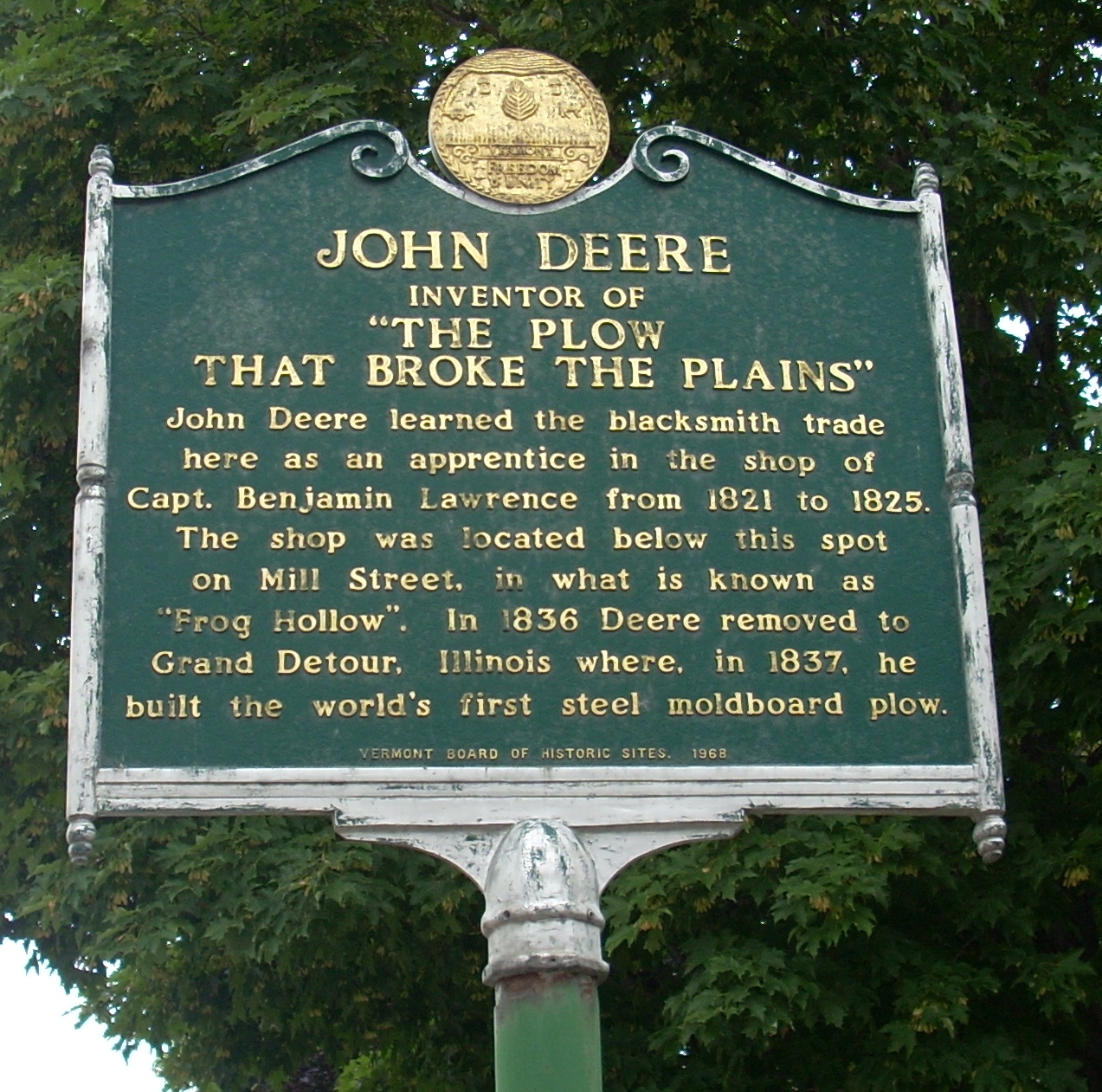
Deere was born in Rutland, Vermont, and raised in a household of modest means after his father disappeared during a voyage when John was a child. His formal schooling was limited to the elementary level common in rural New England, and he learned a trade through apprenticeship. As a teenager he trained as a blacksmith and worked in several Vermont towns, where he developed metalworking skills, an understanding of tools in use by farmers and craftsmen, and a habit of practical problem solving that would shape his later work.
Move to Illinois and the problem of prairie soil
In 1836, seeking opportunity for a young family, Deere moved west to Grand Detour, Illinois, a frontier farming community on the developing American prairie. There he encountered a recurrent difficulty: the heavy, cohesive prairie sod did not behave like the light, sandy soils of New England. Wooden plows and the cast-iron implements common at the time tended to clog, requiring frequent cleaning and making plowing slow and laborious. Observing the needs of local farmers, Deere sought a solution that combined durability with an improved surface finish to resist soil adhesion.
Invention of the polished steel plow
Drawing on an analogy with finely polished metal tools, including household items such as tailoring needles, Deere reasoned that a well-shaped, smooth metal surface would allow soil to slide off rather than cling. In 1837 he fashioned a plowshare from a broken saw blade and carefully polished and shaped it so that the curved moldboard would turn the sod and shed soil. The result was a plow that largely avoided fouling and greatly reduced the effort required to plow dense prairie ground. He sold his first plow to a neighbor and demand grew as word spread among farmers who appreciated its superior performance.
Design principles and practical advantages
- Smooth surface: careful polishing and the use of steel reduced adhesion of sticky soils.
- Curved moldboard: a shape that turned and shed soil rather than packing it against the implement.
- Durability: steel resisted wear and breakage better than wooden or brittle cast-iron parts in many field conditions.
- Labor savings: the plow allowed faster, more continuous plowing with fewer interruptions for cleaning, increasing the area a team could cultivate.
Business development and relocation to Moline
Deere began producing plows by hand and gradually increased output to meet local and regional demand. Faced with growing orders, he worked with associates and by the late 1840s moved manufacturing to Moline, Illinois, where access to river transport, water power and coal made larger-scale production and distribution more practical. In Moline the business expanded its product range to include other implements and attachments suited to farm work. Although John Deere later put his son Charles in operational charge, the founder continued to serve as company president and remained involved in business decisions while taking on other civic and commercial roles in the community.
Civic life and later years
Beyond his role as an industrialist, Deere participated in civic affairs in Moline. He was active in local institutions, helped to establish a bank, and served in municipal positions. These activities reflected a common pattern among 19th‑century entrepreneurs who combined business leadership with community engagement. John Deere retired from daily management in stages and died at his home in Moline on May 17, 1886. His family and the company he founded continued the enterprise into subsequent generations.
Legacy and historical significance
John Deere’s contribution is notable both for the specific technical improvement he made and for the way that targeted invention altered agricultural practice. The polished steel plow solved a clear regional problem and enabled farmers to cultivate richer soils more efficiently, supporting increased agricultural output and the settlement of large areas of the American Midwest. Deere & Company grew from a small blacksmith shop into a manufacturer recognized for tractors, combines and other agricultural machinery; the company’s machines and the distinctive green-and-yellow livery became widely associated with modern mechanized farming around the world.
Context and interpretation
Historians view Deere’s work as part of a broader pattern of technological adaptation in which inventors and manufacturers modified tools to suit differing environmental and economic conditions. The shift from implements designed for Eastern soils to those suited to prairie agriculture illustrates how local problems can drive innovation. Deere’s story is also an example of 19th-century industrial scaling: a practical idea combined with favorable transport, energy and market conditions permitted the growth of a manufacturing enterprise that had lasting influence.
Further reading and resources
Biographical sketches and company histories provide fuller narratives of Deere’s life and of the firm that bears his name. For concise overviews, see a general biographical overview. Technical and agricultural histories that explain plow design and soil conditions are available through specialized sources; consult a technical note or essay at technical descriptions. Regional and agricultural collections document equipment and farming practices; examples are listed at equipment and implements collections. For discussion of prairie soils and their effect on tool design, see resources compiled on Midwestern land and cultivation. Corporate archives and museum resources offer primary documentation of the company’s development and innovations; these can be explored through institutional sites and archives at corporate and museum collections.
John Deere remains a widely recognized figure in agricultural history. His combination of craft skill, observation of users’ needs, and willingness to scale production captures an era in which modest inventions had outsized economic and social effects. The polished-steel plow is often cited as a clear example of design that matched material, form and function to a specific environmental challenge, with consequences that extended far beyond the single tool.
Related articles
Author
AlegsaOnline.com John Deere: Inventor of the Steel Plow and Founder of Deere & Company Leandro Alegsa
URL: https://en.alegsaonline.com/art/50610