
John Dunn (Australian bushranger)
John Dunn (1846–1866) was an Australian bushranger who joined Ben Hall's gang as a teenager. He took part in robberies with the group, was convicted of murder and executed in 1866; his life illustrates colonial-era outlawry.
Overview
John Dunn (14 December 1846 – 19 March 1866) was an Australian outlaw known as a bushranger. A youth when he entered a life of crime, Dunn became one of the best‑known members of the mid‑19th century gang led by Ben Hall and that included John Gilbert. His brief career and early execution made him a notable, if tragic, figure in the history of colonial Australia.
Image gallery
5 Images


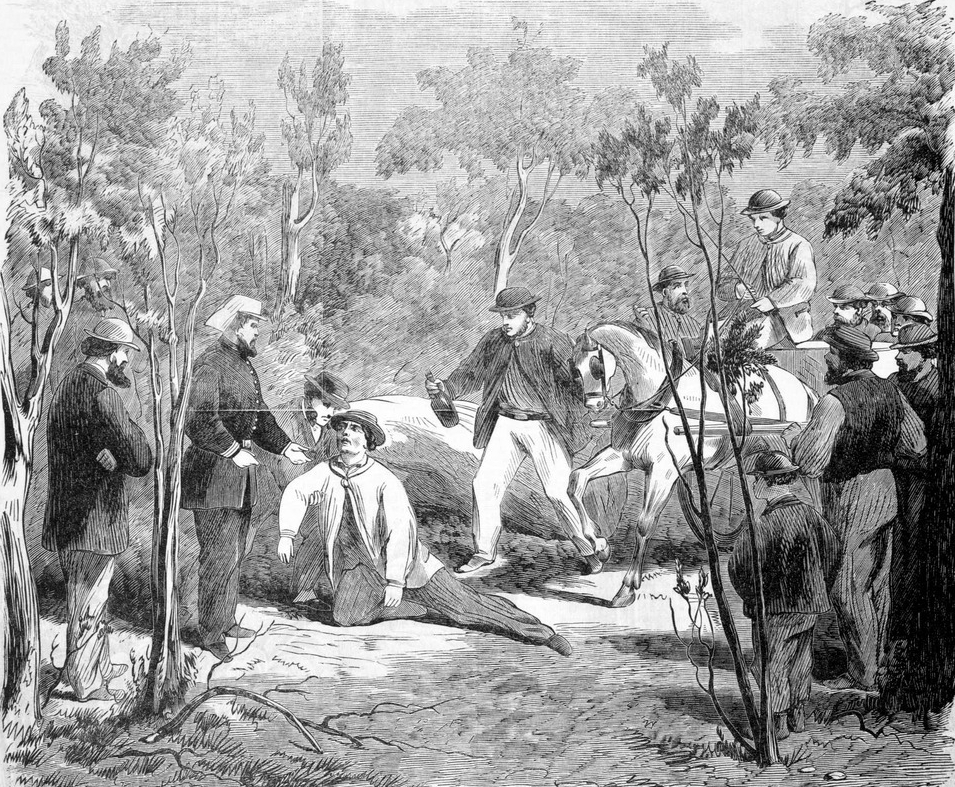
Background and joining the gang
Dunn came from rural New South Wales. He was only about 17 years old when he allied himself with Hall and other companions; like many young men of the period, he was drawn into violent thefts and armed robberies that took place in isolated countryside and along coach routes. His involvement exemplifies a phase of bushranging in which mobile mounted bands targeted mail coaches, homesteads and travellers.
Activities and capture
The group that included Dunn engaged in raids and hold‑ups across a wide district. Authorities increased patrols and offered rewards, and public pressure led to intensified police efforts. Dunn was eventually captured, tried and found guilty of murder. His prosecution and execution at a young age drew public attention and debate about crime, punishment and social conditions in the colony.
Trial, execution and legacy
Dunn was executed in March 1866. He was still in his teens at the time of his death. Contemporary accounts and later histories treat him both as a hardened criminal and as a symbol of the harsh frontier circumstances that produced several well‑known bushrangers. His story appears in studies of colonial law enforcement and in cultural portrayals of bushrangers.
Context and notable facts
- Bushrangers were a distinctive phenomenon in 19th‑century Australia, often emerging in remote pastoral districts where policing was sparse.
- Dunn's association with Ben Hall's gang links him to one of the most active and publicised outlaw groups of the period.
- His youth and rapid rise and fall are frequently noted in discussions of crime, social dislocation and punishment in colonial society.
For further reading about the era and principal figures, see works on Ben Hall and John Gilbert and on the broader phenomenon of bushranging in New South Wales. The life of John Dunn is a concise, cautionary episode in that larger history.
Related articles
Author
AlegsaOnline.com John Dunn (Australian bushranger) Leandro Alegsa
URL: https://en.alegsaonline.com/art/50618
Sources
- policensw.com : "The Thin Blue Line"
- gold-net.com.au : "Ben Hall - Bushranger Part 7"