
James River (Virginia)
Major river running across Virginia from the Allegheny Mountains to the Atlantic; important for history, navigation, ecology, and regional water supply.
Overview
The James River is a principal waterway in the commonwealth of Virginia. It rises in the highlands of the Allegheny Mountains and flows generally eastward across the state to reach the Atlantic Ocean via the Chesapeake Bay and Hampton Roads. Sources commonly give its overall length as around 410 miles, though measurements vary depending on how tidal and estuarine stretches are counted. The river lies entirely within Virginia, making it one of the longest rivers confined to a single U.S. state in the United States.
Image gallery
10 Images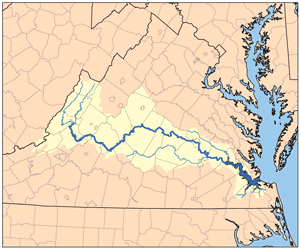




Course and physical characteristics
The James drains a broad basin and passes through a sequence of environments: mountain headwaters, rolling piedmont, the fall line at Richmond where rapids and falls historically limited navigation, and a large tidal estuary near the coast. Major cities along its corridor include Lynchburg and Richmond, and the river receives numerous tributaries that expand its watershed. Its channel, flow regime and tidal influence change substantially from upstream freshwater stretches to downstream brackish estuary.
History and cultural importance
The river has been central to Virginia's human history. Indigenous peoples used its waters and floodplain for sustenance and travel before European contact. In 1607 English colonists established Jamestown along the lower James, naming the river for King James I and launching decades of colonial development. The falls at Richmond shaped settlement and early industry, providing sites for mills and later urban growth.
Uses and ecology
- Navigation and commerce: the lower James long served as a transportation route; ports near its mouth facilitated trade.
- Water supply and power: it provides municipal and industrial water and has supported small hydroelectric projects.
- Recreation: boating, fishing, paddling and shoreline parks are popular along many reaches.
- Wildlife and conservation: the river supports fish, waterfowl and estuarine habitats; restoration and pollution-reduction efforts are ongoing to improve water quality and ecosystem health.
Notable facts and distinctions
The James is often highlighted for its archaeological and colonial sites, its changing character from mountain stream to tidal estuary, and for being one of the longer rivers that flows only within a single state. Readers seeking maps, hydrologic data or recreational guides can consult state agencies and regional resources for detailed, up-to-date information on the river's flow, access points and conservation initiatives. For further context about its length and rankings, see references that discuss measurement methods for river courses and tidal reaches (length; river information).
Whether approached for history, outdoor activity, or watershed stewardship, the James River remains a defining natural feature of Virginia and an important component of the broader United States coastal and inland water systems.
Related articles
Author
AlegsaOnline.com James River (Virginia) Leandro Alegsa
URL: https://en.alegsaonline.com/art/49273