
Day of Infamy speech (Franklin D. Roosevelt, December 8, 1941)
Franklin D. Roosevelt's December 8, 1941 address to Congress after the attack on Pearl Harbor, declaring the event 'a date which will live in infamy' and securing a declaration of war that entered the US into WWII.
Overview
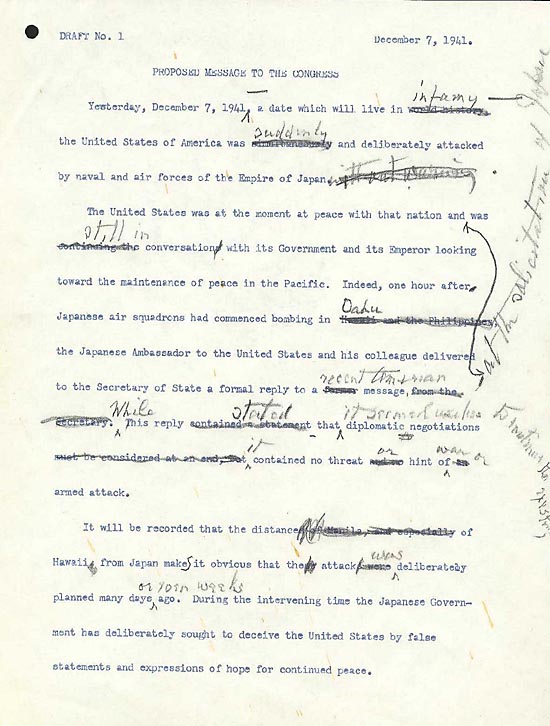
The "Day of Infamy" speech is the common name for the brief address delivered by President Franklin D. Roosevelt to a Joint Session of Congress on December 8, 1941. It was given one day after the surprise military strike by the Empire of Japan against United States forces at Pearl Harbor, Hawaii. The opening line — "a date which will live in infamy" — became an immediate and enduring phrase in American political language. The speech has come to symbolize the moment the United States shifted from reluctant neutrality to full wartime footing.
Image gallery
10 Images


Context and delivery
The address followed an early-morning radio and news flurry describing the attack and the Japanese communications that preceded a formal declaration of hostilities. The president spoke to a unified congressional audience and the nation by radio; his tone combined moral condemnation with a legalistic presentation of facts. The purpose was explicit: to inform lawmakers, justify a request for a formal declaration of war, and rally public support for a national response.
Content and style
Roosevelt's remarks were concise and tightly structured. He summarized the known facts of the assault, framed it as an unprovoked act, and emphasized the criminality of the attack. The speech relied on a few memorable phrases and a steady, controlled delivery to communicate resolve. It also listed the diplomatic context and the failure of negotiations, thus presenting the case that military response was necessary to defend national interests and honor.
Aftermath and significance
Congress met the president's request and enacted a declaration of war against Japan, marking the formal American entry into World War II. Within days, declarations and counter-declarations between the United States and the Axis powers extended the conflict. The address influenced public opinion, mobilized military and industrial effort, and remains a touchstone in discussions of presidential rhetoric during crises.
Notable features and legacy
- Famous opening line: "a date which will live in infamy," which helped cement the speech's popular name.
- Immediate political effect: Congress acted quickly to authorize war powers and resources.
- Historical memory: the speech is often taught as an example of concise crisis rhetoric and presidential leadership in wartime.
- Related events: the speech directly followed the attack and the Japanese declaration of war, and preceded broader wartime declarations involving the British Empire and other nations.
Further reading and references
For primary-text study and archival recordings, consult government archives and historical collections that preserve the text and broadcast of the address. Contemporary accounts and later historical analyses examine both the immediate effects of the speech and its long-term place in American political culture. See resources linked through historical collections and educational sites for verbatim text and annotated commentary. Read more about the attack itself at accounts of the attack on Pearl Harbor and about the wider diplomatic background in histories of the Pacific War.
Related articles
Author
AlegsaOnline.com Day of Infamy speech (Franklin D. Roosevelt, December 8, 1941) Leandro Alegsa
URL: https://en.alegsaonline.com/art/47259
Sources
- americanhistory.si.edu : Presidential Materials, September 11: Bearing Witness to History, Smithsonian Institution (2002)
- faculty.virginia.edu : the University of Virginia School of Law project page, Peter DeHaven Sharp, ed.
- books.google.com : In the shadow of the rising sun: the political roots of American economic decline (1991), p. xii.
- books.google.com : The Columbia documentary history of the Asian American experience, p. 77.