
Indian rhinoceros (Rhinoceros unicornis)
Large one‑horned rhinoceros of the Indian subcontinent, known for armour‑like skin and grassland habitats; conservation progress contrasts with threats from habitat loss and illegal horn trade.
Overview
The Indian rhinoceros, Rhinoceros unicornis, commonly called the one‑horned rhinoceros, is a large herbivorous mammal native to parts of the Indian subcontinent. It is distinguished by a single horn on the snout and a thick, folded hide that gives the animal an armored appearance. The species plays an important ecological role in wet grassland and floodplain ecosystems where it helps shape vegetation structure.
Image gallery
10 Images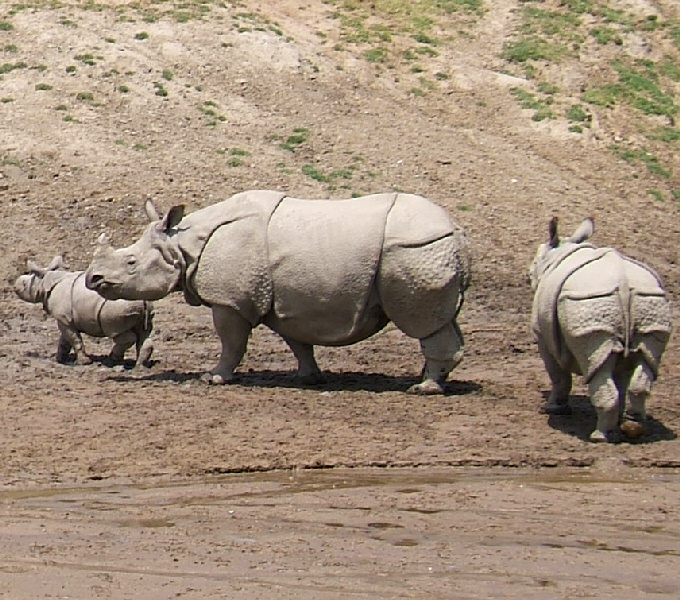


Physical characteristics
Adults are heavy-bodied with a large head, a prehensile upper lip adapted for grasping grasses and leaves, and skin folds that form plate-like segments. The single horn is composed of keratin rather than bone. Males and females are similar in appearance, though mature males are often larger and may have broader heads. The species is adapted to a semi-aquatic lifestyle and spends much time in shallow water and mud to thermoregulate and remove parasites.
Habitat and distribution
Today the one‑horned rhino is primarily found in a limited range across South Asia. Significant populations occur in parts of Pakistan, north‑eastern India, Nepal and parts of Bhutan. It prefers alluvial floodplains, riverine areas and wetlands dominated by tall grasses such as reed and elephant grass and by gallery forests. These animals are most abundant where extensive tall grasslands and seasonal flooding create a mosaic of feeding and wallowing sites.
Behaviour and diet
The Indian rhinoceros is primarily a grazer that feeds on grasses, but it will also browse on leaves, branches and aquatic plants when available. Individuals may be solitary or form loose social aggregations around rich feeding areas and waterholes. Breeding is seasonal in some areas, and females rear a single calf, which remains dependent for more than a year. Wallows, mud baths and shallow pools are important for cooling and protection from parasites.
Threats and conservation
Historically the species suffered from hunting for sport and for its horn; more recently the main threat has been illegal poaching driven by demand for horn in traditional markets. The horn is used in some forms of traditional Chinese medicine and is also marketed under claims of efficacy in various forms of alternative medicine, despite lack of scientific support. Habitat loss from agriculture, flood control and development further reduces available range.
Conservation measures and notable facts
Conservation efforts include protected reserves, anti‑poaching patrols, translocation to create new populations, and community engagement to reduce human‑wildlife conflict. Where protection is strong, local populations have recovered from severe declines, illustrating both the vulnerability and resilience of the species. The Indian rhinoceros remains an important cultural and ecological symbol in the regions it inhabits.
Related articles
Author
AlegsaOnline.com Indian rhinoceros (Rhinoceros unicornis) Leandro Alegsa
URL: https://en.alegsaonline.com/art/47126