
Antiprism (geometry)
An antiprism is a polyhedron formed by two parallel, rotated copies of a polygon joined by a band of alternating triangles. It contrasts with prisms and appears in mathematics, chemistry and design.
Overview
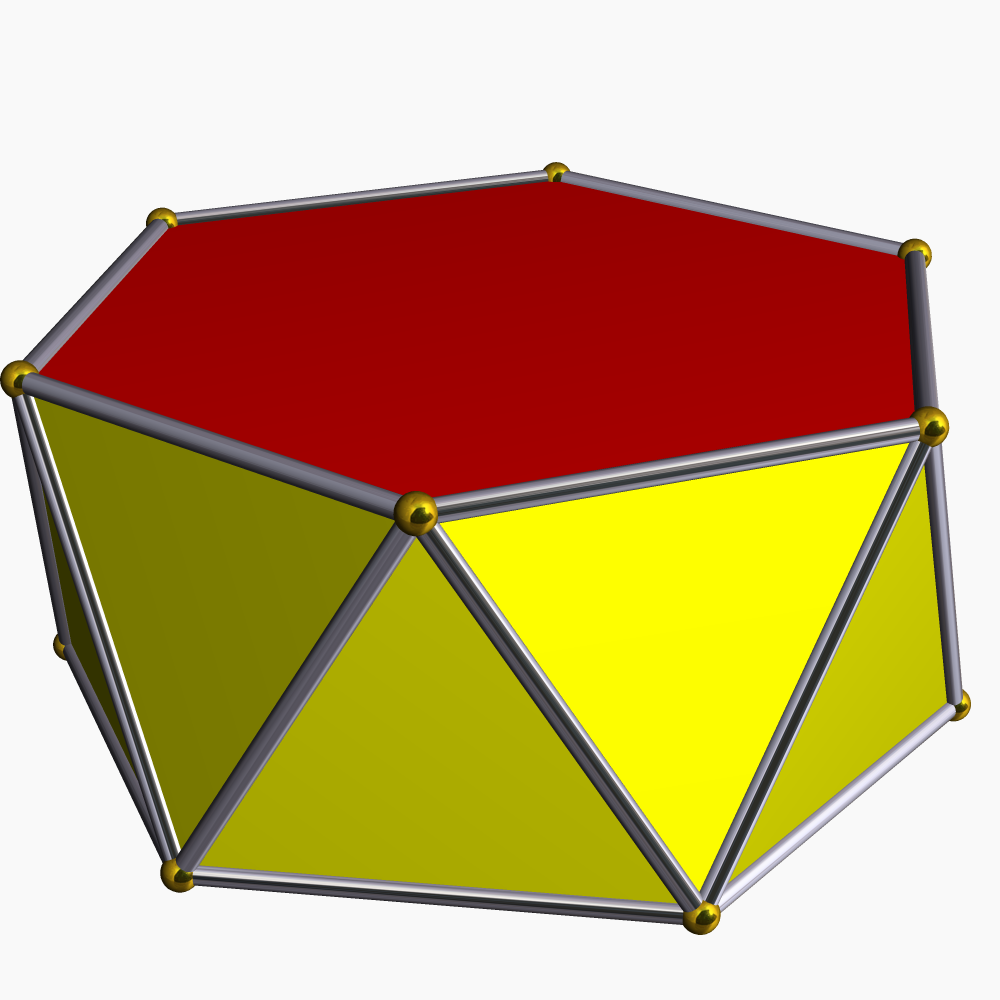
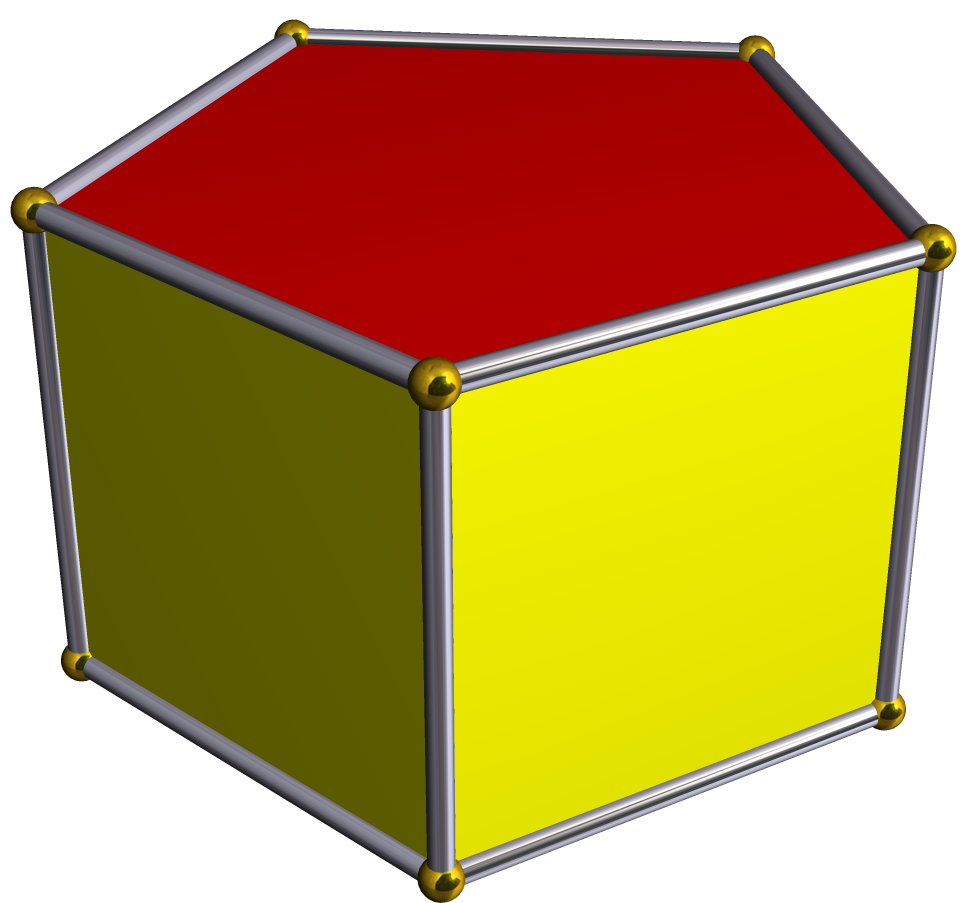
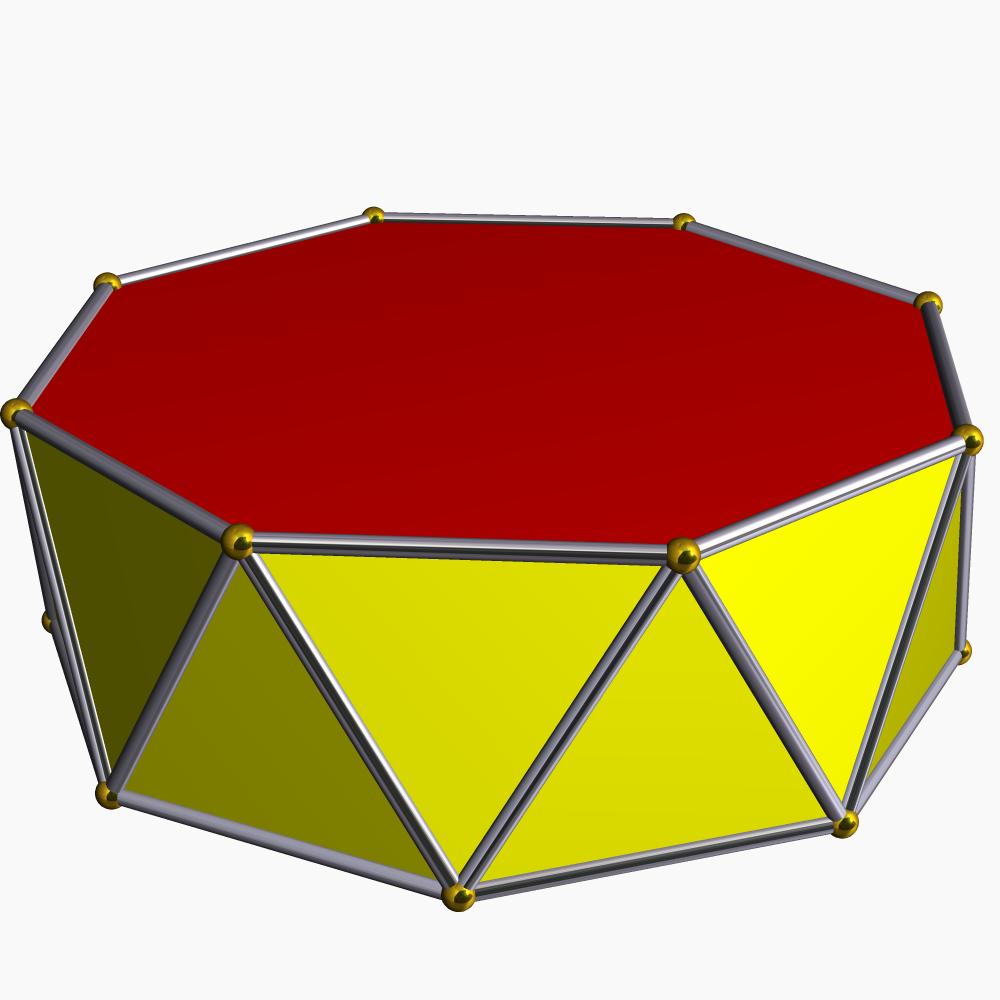
An antiprism is a class of polyhedron built from two congruent copies of a regular polygon placed in parallel planes, one rotated relative to the other, and connected by a belt of triangles. The lateral faces alternate between connecting vertices of the two bases, producing a twisted band of triangular faces rather than the quadrilateral sides found in a prism.
Image gallery
10 Images


Structure and basic properties
For an n-sided base the band contains 2n triangular faces; together with the two polygonal bases the total number of faces is 2n+2. The typical combinatorial counts are:
- Vertices: 2n (n on each base)
- Edges: 4n
- Faces: 2n+2 (two n-gons and 2n triangles)
When the bases are regular and the lateral triangles are congruent, the antiprism has a high degree of symmetry. A right antiprism denotes the common orientation in which the axis through the centers of the bases is perpendicular to their planes. A uniform antiprism is one whose triangles are equilateral and whose bases are regular; these form an infinite family of highly symmetric solids.
Examples and special cases
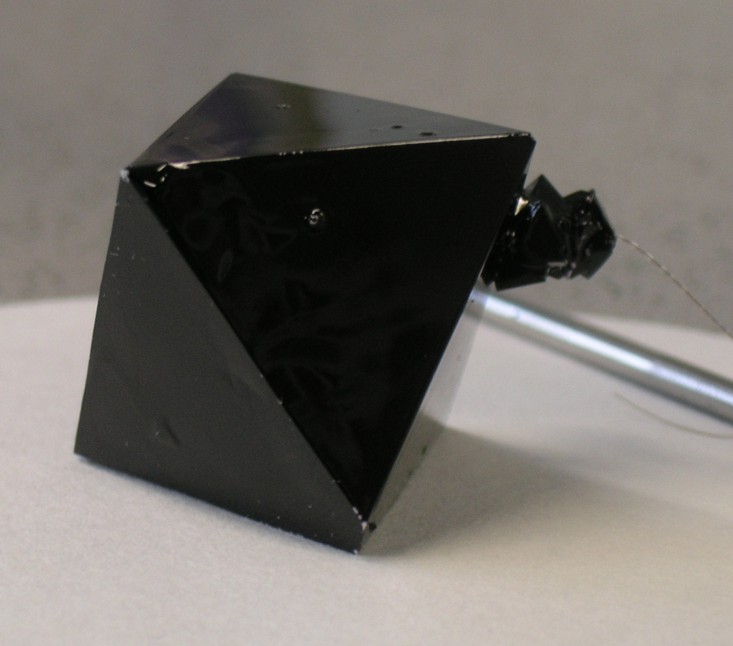
Small values of n give familiar solids. The n=3 antiprism is the regular octahedron: two triangles and six connecting triangles yield eight triangular faces. Higher n give the square antiprism (n=4), pentagonal antiprism (n=5) and so on. Antiprisms differ from prisms because the side faces are triangles instead of parallelograms, and this leads to different rigidity and symmetry properties.
History and applications
Antiprisms have been studied in classical and modern polyhedral geometry and appear in the classification of uniform polyhedra. They also occur in practical contexts: certain coordination geometries in chemistry are described as antiprismatic (for example, square antiprismatic arrangements of ligands around a central atom), and the form is used in architectural and mechanical designs where a twisted, stable band of triangles is advantageous.
Distinctions and notable facts
The dual polyhedron of an n-antiprism is an n-gonal trapezohedron (also called a deltohedron), which has kite-shaped faces. Antiprisms illustrate how a simple change — a relative rotation of the two bases — produces a distinct infinite family of solids with different combinatorial and metric properties from prisms. Further reading on their symmetry and classification can be found via general references on polyhedra and solid geometry, as well as surveys of uniform polyhedra in geometry and specialized treatments of antiprismatic coordination in chemistry and materials science.
Related articles
Author
AlegsaOnline.com Antiprism (geometry) Leandro Alegsa
URL: https://en.alegsaonline.com/art/4682