
Prism (geometry)
A prism is a polyhedron formed by two congruent, parallel polygonal bases connected by parallelogram faces. This article explains types, properties, formulas and common examples and uses.
Overview
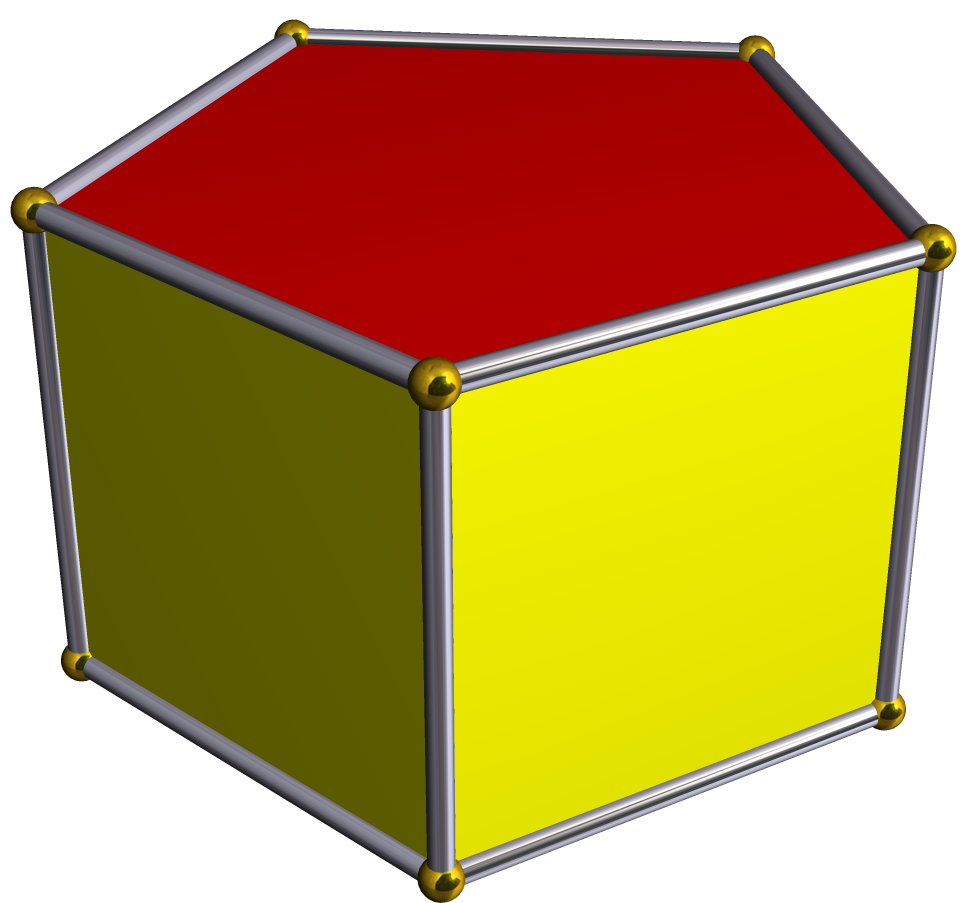
A prism is a three-dimensional polyhedron with two congruent polygonal faces called bases and a set of parallelogram faces joining corresponding edges of those bases. The bases lie in parallel planes; they are congruent copies of the same polygon. Prisms are named after the shape of their bases (for example, a triangular prism or a hexagonal prism).
Image gallery
10 Images


Structure and properties
For an n-sided base, a prism has n+2 faces, 3n edges and 2n vertices. The lateral faces are parallelograms; if those lateral faces are rectangles (or squares) the prism is called a right prism, otherwise it is an oblique prism. The distance between the parallel planes that contain the bases is its height.
- Volume: V = B × h, where B is the area of one base and h is the prism's height.
- Surface area: A = 2B + P × h, where P is the perimeter of the base.
- Euler characteristic: V - E + F = 2 for convex prisms (V vertices, E edges, F faces).
Classification and examples
Common examples include the triangular prism (bases are triangles), rectangular prism or cuboid (bases are rectangles), and more generally n-gonal prisms. A prism whose bases are regular polygons and whose lateral edges are perpendicular to the bases is often used in geometric constructions and modelling.
History and notable facts
The term prism derives from Greek roots and has been part of Euclidean geometry since antiquity. In solid geometry, prisms provide simple examples of translational symmetry: a prism can be seen as the extrusion of its base along a straight line. In crystallography and optics the word "prism" is also used for triangular glass blocks that refract or disperse light; these optical prisms are typically triangular in cross section and function because of the same geometric face arrangement applied to transparent material.
Uses and distinctions
Prisms appear in architecture, engineering, and manufacturing where extruded shapes are common. They are distinct from pyramids (which have a single polygonal base and triangular faces meeting at a vertex) and from antiprisms (which have a different lateral face arrangement). For further diagrams and constructions see axis and orientation discussions and examples of lateral face construction at parallelogram face references.
Related articles
Author
AlegsaOnline.com Prism (geometry) Leandro Alegsa
URL: https://en.alegsaonline.com/art/79256