
Ice cap: definition, characteristics, formation, and importance
An ice cap is a dome-like mass of glacial ice covering less than 50,000 km². This article explains its form, behaviour, examples, role in climate and how it differs from ice sheets, glaciers and ice fields.
Overview: An ice cap is a broad, continuous cover of glacial ice that blankets terrain and flows outward from a central dome. By convention an ice mass that covers less than 50,000 km² is called an ice cap; larger continuous masses are termed ice sheets. Ice caps occur in polar and subpolar regions as well as at high altitudes.
Image gallery
1 Image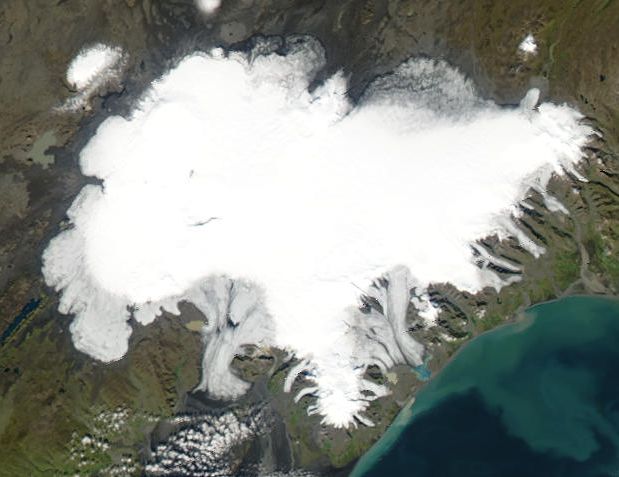
Characteristics
- Generally dome-shaped and radial in ice flow, supplying outlet glaciers that extend into valleys.
- Thickness varies from tens to several hundreds of metres depending on accumulation and temperature.
- Mass balance is governed by snowfall (accumulation) and melting, sublimation or calving (ablation).
Formation and behaviour: Ice caps build up where snowfall persistently exceeds melt over many years. Layers of compacted snow transform into dense glacial ice; internal deformation and basal sliding cause slow outward movement. Ice caps respond to climate shifts: sustained warming reduces area and thickness, while cooling allows growth.
Examples and importance
Well-known ice caps include those on parts of Iceland and some Arctic islands. They act as freshwater reservoirs, influence regional hydrology, and are sensitive indicators of climate change. Scientists study ice cap cores and surface mass balance to reconstruct past climates and predict future sea‑level contributions.
Distinctions and notable facts
- Ice cap vs ice sheet: size is the main practical distinction (50,000 km² threshold).
- Ice cap vs glacier: a glacier is a flow of ice confined to a valley or path, while an ice cap covers broader terrain and feeds multiple glaciers.
- Ice cap vs ice field: ice fields are often constrained by underlying topography and lack a clear dome; ice caps tend to be more dome-like and cover their substratum more uniformly.
For basic definitions and technical descriptions see Ice cap definition and materials on glacial ice dynamics. Understanding ice caps helps interpret regional water resources, ecosystem impacts, and global sea-level change.
Related articles
Author
AlegsaOnline.com Ice cap: definition, characteristics, formation, and importance Leandro Alegsa
URL: https://en.alegsaonline.com/art/46416
Sources
- geography-site.co.uk : "Ice Caps"