
Hydrogen economy: concept, uses, challenges, and development
Overview of the hydrogen economy: production and storage methods, applications in transport and power, environmental trade-offs, infrastructure needs, and current challenges for scaling up.
Overview
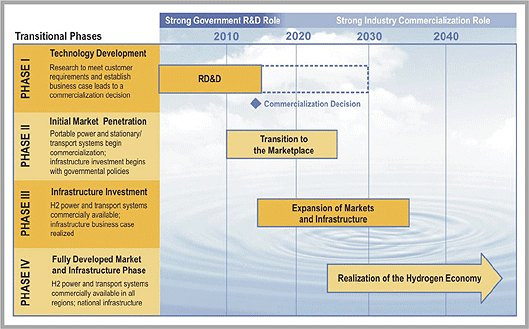
The hydrogen economy is an energy system concept in which hydrogen plays a central role as a carrier of energy rather than a primary fossil fuel. Proponents describe a transition to a concept of fuel supply that could power a future low-carbon economy by complementing renewable sources. In practice, hydrogen would be produced, stored, transported and converted to useful work or heat to supply energy services for industry, buildings and transport.
Image gallery
9 Images




Characteristics and common methods
Hydrogen is an energy carrier, not an energy source. It can be produced in several ways, commonly categorized by color labels that reflect their environmental impact. Typical production and handling options include:
- Electrolysis of water using electricity from renewables (often called "green" hydrogen).
- Steam reforming of natural gas with or without carbon capture ("grey" or "blue" hydrogen respectively).
- By-product hydrogen from industrial processes and thermochemical or biological routes under development.
Uses and examples
Hydrogen can be used directly in combustion or, more efficiently, in fuel cells to generate electricity and heat. Key applications under active development include transportation (especially heavy duty and long-range automobiles and vehicles where battery weight is a limitation), industrial heat and feedstock for chemicals, and seasonal energy storage to support grid balancing and bulk electricity supply. Hydrogen also serves as a reductant in metalmaking and an ingredient in synthetic fuels.
History, development and notable distinctions
The idea of a hydrogen-based energy system has been explored for decades. Recent policy interest is driven by climate goals and falling renewable costs. Distinctions such as "green" versus "blue" hydrogen are important: green hydrogen uses low-carbon electricity, while blue relies on fossil-based processes paired with carbon management. These distinctions matter for lifecycle emissions and policy design.
Challenges and outlook
Scaling a hydrogen economy faces technical and economic barriers: production cost, energy losses in conversion and transport, storage challenges, and the need for new infrastructure. Safety practices and standards are also essential because of hydrogen's properties. Despite hurdles, many governments and industries view hydrogen as a flexible complement to electrification that could decarbonize sectors difficult to electrify directly, keeping hydrogen at the center of several long-term decarbonization strategies.
Related articles
Author
AlegsaOnline.com Hydrogen economy: concept, uses, challenges, and development Leandro Alegsa
URL: https://en.alegsaonline.com/art/46098