
Hyderabad State (1724–1948): the Nizam's princely realm in the Deccan
Hyderabad State was a large princely territory in south-central India ruled by the Asaf Jahi Nizams from 1724 until integration with India in 1948.
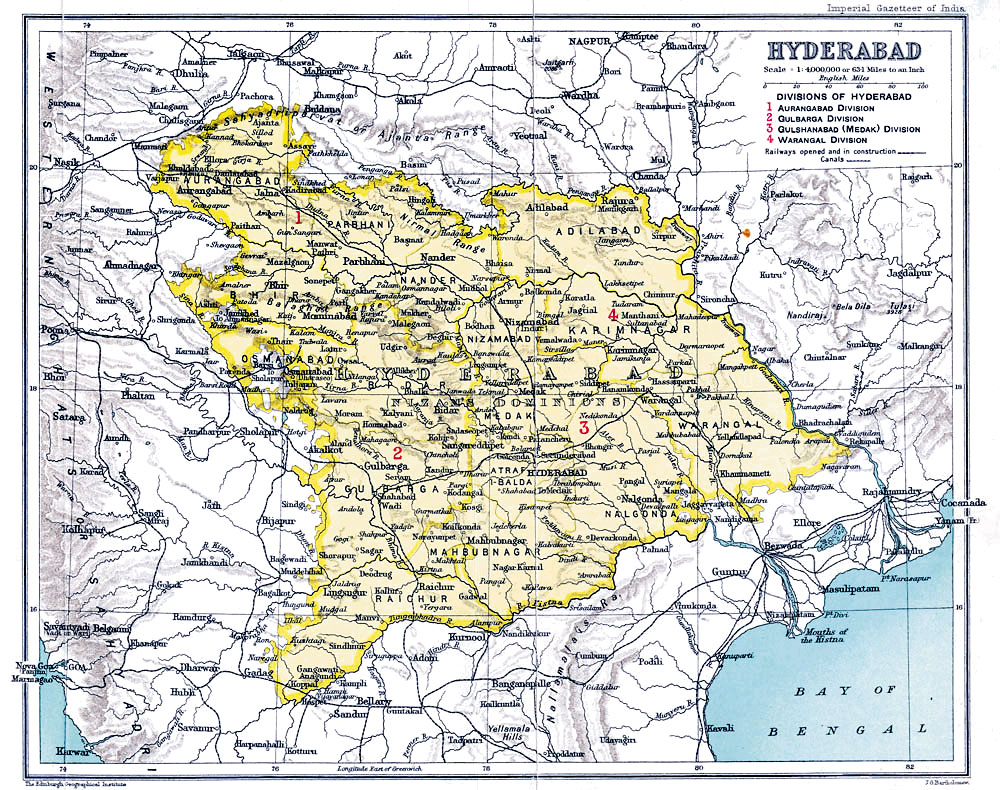
Hyderabad State was a major political entity on the Indian subcontinent from the early 18th century until the mid-20th century. Founded in 1724 by Asaf Jah I (the first Nizam), it became the largest princely state in British India. Centered in the city of Hyderabad on the Deccan plateau, the state covered a region composed of several linguistic and cultural zones and retained substantial internal autonomy under British paramountcy.
Image gallery
10 Images




Origins and government
The Asaf Jahi dynasty emerged as Mughal power waned in the Deccan. The first Nizam established a hereditary rule that lasted through successive rulers until the 20th century. Administratively the state combined traditional court structures with modern departments created in the 19th and early 20th centuries to manage revenue, law, public works and education. The ruling family presided over a predominantly agrarian economy, urban mercantile centers, and a varied social fabric made up of Telugu, Marathi, Kannada and Urdu-speaking communities.
Territory, language and economy
Hyderabad's territory shifted over time but generally included the Telangana plateau and neighboring districts to the west and south. The Berar region was administered in association with the British and later merged with the Central Provinces and Berar in 1903. The state's economy relied on agriculture, cotton and other textiles, local crafts, and trade; its capital also gained prominence as a cultural and administrative hub. Religious and linguistic plurality marked social life: although the ruling elite were Muslim, most inhabitants were Hindu and diverse regional languages were in everyday use.
Key features of the state included:
- Dynastic rule by the Asaf Jahi line of Nizams.
- Internal autonomy under British suzerainty while accepting external defense and diplomacy shaped by treaties.
- Multilingual population and a capital noted for administrative institutions and cultural patronage.
During the partition of British India in 1947 the last Nizam initially sought to remain independent rather than accede to either newly formed dominion. He declined to join the Union of India or Pakistan, a stance that created a political impasse. In 1948 the Government of India moved to integrate the state through a military action often referred to as Operation Polo, after which Hyderabad's princely status ended and it became part of the Indian Union.
Following integration, the former Hyderabad State continued as a distinct administrative unit within India until the States Reorganisation Act of 1956. That reorganization redistributed its districts largely along linguistic lines: the Telugu-speaking districts joined Andhra Pradesh (later separating to recreate Telangana in 2014), Marathi-speaking areas became part of Bombay State (now Maharashtra), and Kannada-speaking districts merged with Mysore State (later Karnataka).
Legacy and significance
Hyderabad State left a lasting imprint on regional politics, culture and architecture. Its capital remains an important urban center renowned for historical monuments, administration and commerce. The story of its rulers, the Nizam’s administration, and the complex process of accession and reorganization illustrates the broader transitions from Mughal-era polities through colonial indirect rule to the modern nation-state in South Asia. For further historical and biographical detail see sources on the Nizams and princely states of India, as well as general regional histories about south-central India.
Additional reading and archival links: Nizam history, princely state records, regional studies, partition context.
Related articles
Author
AlegsaOnline.com Hyderabad State (1724–1948): the Nizam's princely realm in the Deccan Leandro Alegsa
URL: https://en.alegsaonline.com/art/46067
Sources
- tools.wmflabs.org : 17°00′N 78°50′E / 17.000°N 78.833°E / 17.000; 78.833