
Indentured Servant
An indentured servant was a person contracted to work for a set period in exchange for passage, maintenance, or other compensation; common in early modern Europe and colonial America.
Overview
An indentured servant was an individual who entered a legally binding contract — an "indenture" — to work for another person for a fixed period. In practice this meant a laborer or craftsman agreed to several years of service in return for benefits such as transatlantic passage, food, clothing and sometimes a small payment or land at the end of the term. Indenture was one of several labor arrangements that shaped economies from the early modern period into the 18th century.
Image gallery
7 Images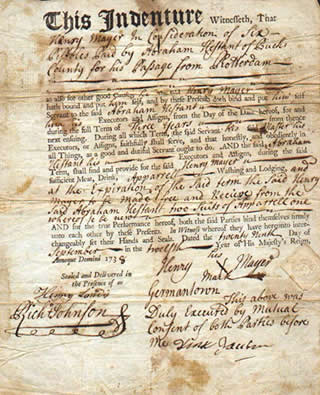


Typical terms and provisions
Agreements varied by place and time, but common elements included duration, obligations and compensations. Many contracts were written on parchment with matching copies cut in an indented pattern to prevent fraud — the origin of the word "indenture." Typical features included:
- A fixed term of service, often three to seven years.
- Provision for basic needs during the term: food, shelter, and clothing.
- Payment of passage or other debts by the employer or sponsor.
- Promises of "freedom dues" on completion, which might be cash, tools, clothing, or land.
Life, work and legal status
Conditions ranged from relatively benign apprenticeship-style arrangements to harsh, coercive labor. Indentured servants could be transferred or sold by the holder of the contract but were not legally enslaved for life. They retained some legal rights and, in many jurisdictions, could petition courts for redress against mistreatment. Women, children and skilled workers all appear among indentured populations, and terms could differ accordingly.
History and decline
Indentured labor has roots in medieval Europe but became especially prominent during the colonization of the Americas. European migrants often used indentures to pay for transoceanic travel and to secure employment in colonies. Over the 18th and 19th centuries the system declined in many areas as wage opportunities in Europe improved, transportation costs changed, and other labor systems — notably chattel slavery and later wage labor — became more dominant.
Distinctions and legacy
Indentured servitude differs from slavery chiefly in temporariness and the existence of an enforceable contract. Nevertheless, lived experiences could overlap: punishment, restricted freedom, and economic exploitation were common. The institution left a visible mark on demographic, economic and legal histories of settler societies and is often studied alongside other forms of coerced and contractual labor.
Further reading
For a concise introduction and primary examples, see general histories of colonization and migration available through academic and public resources. Many regional studies explore how indenture shaped land distribution, labor markets and family life in colonial societies.
Questions and answers
Q: What is an indentured servant?
A: An indentured servant is a worker who is bound in a contract with an employer for a specific period of time, usually three to seven years.
Q: How did indentured servants receive payment?
A: Indentured servants received payment in the form of transportation across the ocean, food, clothing, land, a place to live, and other necessities during their contract.
Q: What are indentures?
A: Indentures are contracts between an employer and an indentured servant that specify the terms and length of their agreement.
Q: When were indentures common?
A: Indentures were quite common in Colonial America during the 17th and 18th centuries.
Q: What is the difference between indentured servants and slaves?
A: Indentured servants were different from slaves in that their captivity was temporary, and they were only bound in their contract for a specific period of time.
Q: Who was most likely to become an indentured servant?
A: Usually, laborers or craftsmen were most likely to become indentured servants.
Q: What did an indentured servant receive during their contract?
A: An indentured servant received transportation across the ocean, food, clothing, land, a place to live, and other necessities during their contract.
Related articles
Author
AlegsaOnline.com Indentured Servant Leandro Alegsa
URL: https://en.alegsaonline.com/art/47037
Sources
- immigrantservants.com : Immigrant Servants Database
- amazon.com : Saxton, Martha. Being Good: Women's Moral Values in Early America New York: Hill and Wang, 2003.