
Hue — the attribute of color that distinguishes red, green, blue and yellow
Hue is the attribute of color that determines whether we label a color as red, green, blue, yellow, etc.; distinct from saturation, chroma and lightness and measured in models like HSL/HSV and CIELAB.
Hue is a principal attribute of color appearance that identifies the perceived family of a color — for example, red, green, blue or yellow. In perceptual terms it describes how similar a color stimulus is to those basic or "unique" hues. Hue is what most people mean when they use everyday color names; it is distinct from how vivid, pale or dark a color appears.
Image gallery
4 Images


Characteristics and measurement
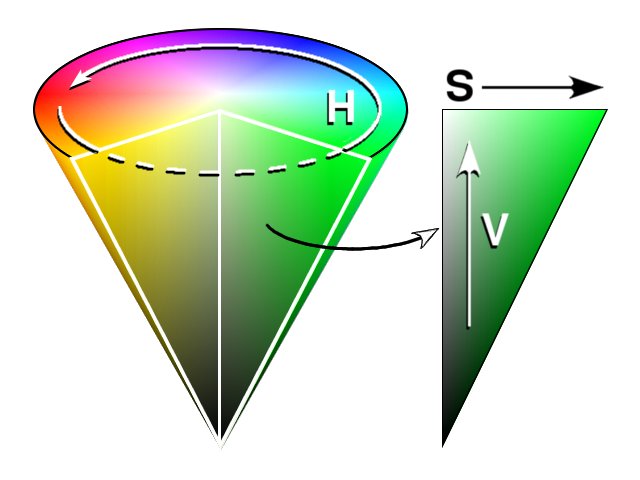
Hue is usually represented around a circular scale (a color wheel) that orders colors by gradual change from red through yellow, green, cyan, blue and magenta back to red. In digital and practical color models it is often expressed as an angle or coordinate:
- HSV/HSL: hue is an angle from 0°–360° that locates a color on a circular spectrum.
- Colorimetry: hue can be related to dominant or complementary wavelengths and can be computed from chromatic coordinates in spaces such as CIELAB.
- Perceptual measures: hue discrimination varies with lighting, context and individual vision, so reported hue is often conditional rather than absolute.
History and models
Concepts of hue trace to early color wheels and the work of scientists and artists who organized colors into circles and systems. Modern color science distinguishes hue from other attributes — notably lightness, chroma and saturation — and provides mathematical models for converting between device signals (for example RGB) and perceptual descriptions such as hue angle.
Uses, examples and importance
Hue is central to art, design, branding, navigation and data visualization. Designers pick hues to convey meaning or contrast; printers and displays must map device primaries to target hues; cartographers and information designers use hue variations to separate categories. Everyday modifiers such as "light blue", "pastel green" or "vivid red" combine hue with qualifiers of brightness and saturation.
Distinctions and notable facts
Hue should be considered separately from how intense or light a color looks. Two colors can share the same hue while differing in saturation or lightness. What observers report as a pure hue can shift with illumination and surrounding colors; there are also culturally variable color names and a small set of "unique hues" that many theories treat as reference points. For technical or further reading on perceptual stimulus concepts see stimulus.
Related articles
Author
AlegsaOnline.com Hue — the attribute of color that distinguishes red, green, blue and yellow Leandro Alegsa
URL: https://en.alegsaonline.com/art/45556