
Hog deer (Hyelaphus porcinus): a small Asian deer
A compact overview of the hog deer (Hyelaphus porcinus), its appearance, behaviour, range across South and Southeast Asia, ecology, conservation issues and notable facts including introduced populations.
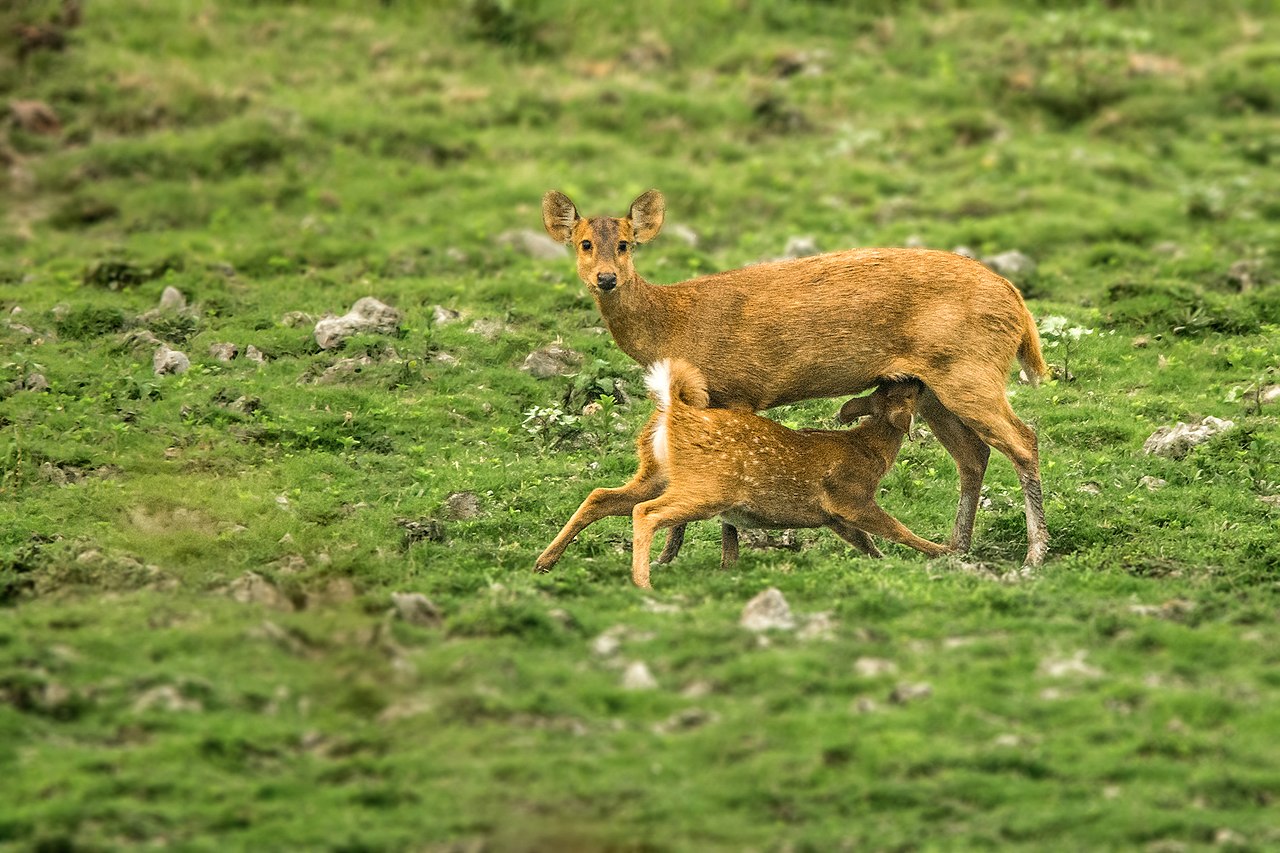
The hog deer, scientific name Hyelaphus porcinus (formerly Axis porcinus), is a small deer native to parts of South and Southeast Asia. It is named for its characteristic low, head‑down running style which helps it move beneath obstacles rather than leaping over them. Stags typically carry short antlers and both sexes display a contrasting pale rump and a white underside to the tail that is visible when the animal flees.
Image gallery
4 Images


Physical characteristics and behaviour
Hog deer are compact, with a build suited to dense grassland and scrub. Their seasonal coat varies from a warm brown in the warmer months to a duller, greyer hue when cooler. Males grow modest antlers, usually with a small number of points. They are often shy and secretive, found either singly, in pairs, or in small groups. A distinctive behavioural trait is running with the head held low; the tail is held erect to reveal the white below when alarmed.
Range and habitat
The species occurs across a broad but patchy range in Asia. Populations are known from Pakistan, Kashmir, and parts of northern India, as well as Nepal and Bangladesh. It also reaches into southwestern Yunnan province and other localities in China, extending toward western Thailand. Habitats include tall grasslands, seasonally flooded plains, riverine woodland and agricultural margins rather than open forests.
Diet, reproduction and ecology
Hog deer are primarily grazers and mixed feeders that consume grasses, forbs and tender browse. They are most active at dawn and dusk and use dense vegetation for cover. Reproductive rates and social structure vary by region, but females typically produce single offspring that are concealed in cover when very young. Males may be territorial or exhibit limited rutting displays depending on local conditions.
Conservation and human interaction
Across much of its native range the hog deer has experienced declines due to habitat loss, conversion of wetlands and grasslands, and hunting pressure. Because populations are fragmented, local declines can be severe and the species is considered threatened in parts of its distribution. Conservation efforts focus on habitat protection, management of grassland and wetland habitats, and maintaining viable populations through protected areas and careful translocations.
- Notable fact: the animal’s low running posture gives it the common name “hog” deer.
- Introductions: the species was introduced outside its native range and has established populations in some parts of Australia where management and hunting have different conservation implications.
- Management priorities include reducing habitat fragmentation and protecting seasonal floodplain grasslands.
For regional information and resources about the hog deer, consult specialist references or regional conservation agencies. General species accounts and distribution notes are available from a variety of sources, including summaries focused on the species as a small Asian deer species overview.
Related articles
Author
AlegsaOnline.com Hog deer (Hyelaphus porcinus): a small Asian deer Leandro Alegsa
URL: https://en.alegsaonline.com/art/44666