
Homotherium — the scimitar‑toothed saber‑tooth cat
Extinct genus of machairodontine saber‑toothed cats known as scimitar‑toothed cats, widespread in the Pliocene–Pleistocene and notable for shorter, blade‑like upper canines and long limbs.
Overview
Homotherium is an extinct genus of machairodontine (saber‑toothed) felids commonly called scimitar‑toothed cats. They lived from the Pliocene into the Pleistocene and were distributed across much of the Northern Hemisphere and parts of Africa and the Americas. Homotherium species are distinct from the more famous Smilodon by their relatively shorter, more flattened upper canines and limb proportions that suggest a different hunting style.
Image gallery
10 Images


Physical characteristics
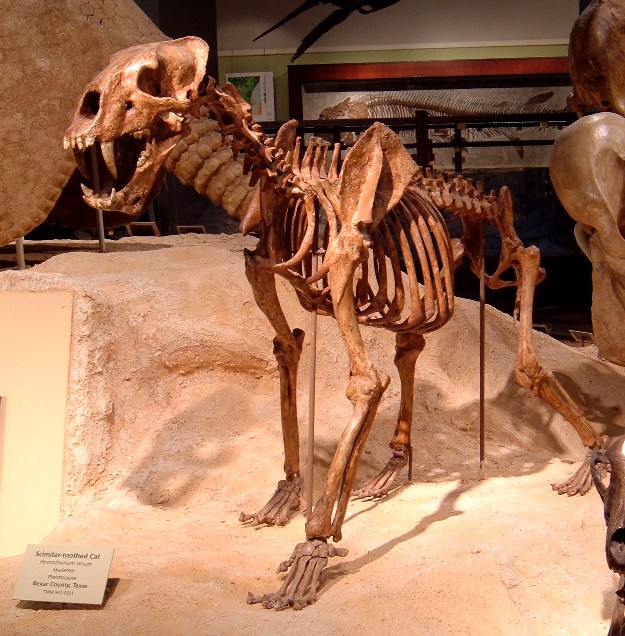
Skull and dentition in Homotherium show laterally compressed canines that form a blade‑like cutting edge rather than the long, dagger‑like fangs of some other saber‑toothed cats. Their incisors and carnassials were well developed for processing flesh. Skeletons indicate powerful forelimbs combined with relatively long, cursorial hindlimbs, giving an overall body plan adapted for running and delivering slashing bites. Coat and color are unknown from fossils, but reconstructions often portray them as tawny or patterned to blend into open habitats.
Behavior and ecology
Based on limb proportions and wear on teeth, paleontologists infer that Homotherium hunted medium to large herbivores, possibly pursuing and subduing young or weakened animals rather than ambushing large adult megafauna. Some researchers have suggested group hunting or cooperative behavior to tackle larger prey, though direct evidence is limited. Stable isotope analyses and associations with herbivore remains at fossil sites support a role as an active predator in open or mixed environments.
Fossil record, distribution and species
Fossils of Homotherium have been recovered from North America, South America, Europe, Asia and Africa. The genus appears in Pliocene deposits and persists through much of the Pleistocene. It became extinct in Africa earlier than elsewhere, with Eurasian records continuing until roughly 30,000 years ago and North American occurrences potentially lasting until about 10,000 years ago. South American finds are rarer and generally younger in the mid‑Pleistocene. Several species have been named within the genus, with Homotherium latidens often cited as a representative species.
Extinction and significance
The decline and eventual extinction of Homotherium likely involved a combination of climatic change, habitat shifts, and changes in prey communities during the late Pleistocene. As a distinctive component of Pleistocene predator guilds, Homotherium provides insight into the diversity of saber‑toothed cats and into predator–prey dynamics before the end of the last Ice Age. Its anatomical differences from Smilodon illustrate that "saber‑toothed" was a recurring evolutionary solution rather than a single lifestyle.
Notable distinctions and public interest
In popular media and museum exhibits Homotherium is sometimes overshadowed by Smilodon, but it represents a separate lineage with its own adaptations. It is commonly called a "scimitar‑toothed" cat because the canines resemble curved blades. Ongoing finds and analyses continue to refine understanding of its biology, geographic range and relationships to other felids.
Further reading and links
- General overview and taxonomy
- Machairodontinae subfamily information
- Saber‑toothed cat comparisons
- Comparison with Smilodon
- North American fossil sites
- South American occurrences
- European records and sites
- Asian fossil finds
- African occurrences and early extinction
- Pliocene context
- Pleistocene context and extinction
- Eurasian paleontology resources
- South American specimen details
Questions and answers
Q: What is Homotherium?
A: Homotherium is an extinct genus of machairodontine saber-toothed cats.
Q: How long were Homotherium's teeth compared to a modern tiger?
A: Homotherium's teeth were longer than a modern tiger, but shorter than Smilodon.
Q: What is another name for Homotherium?
A: Homotherium is sometimes called "scimitar-toothed cats".
Q: In what continents and epochs was Homotherium widespread?
A: Homotherium was widespread in North America, South America, Europe, Asia, and Africa during the Pliocene and Pleistocene epochs (5 million years ago – 10,000 years ago).
Q: When did Homotherium become extinct in Africa?
A: Homotherium first became extinct in Africa some 1.5 million years ago.
Q: When did Homotherium go extinct in Eurasia?
A: Homotherium survived in Eurasia until about 30,000 years ago.
Q: When was the last scimitar cat alive in North America?
A: The last scimitar cat could have survived in North America until 10,000 years ago.
Related articles
Author
AlegsaOnline.com Homotherium — the scimitar‑toothed saber‑tooth cat Leandro Alegsa
URL: https://en.alegsaonline.com/art/44953
Sources
- paleodb.org : PaleoBiology Database: Homotherium, basic info
- doi.org : 10.1671/0272-4634(2003)23[260:LPSOTS]2.0.CO;2
- worldcat.org : 0272-4634
- dx.doi.org : 10.1080/02724634.2011.550366