
Hexacontagon (60-sided polygon)
A hexacontagon, or 60-gon, is a polygon with sixty sides. This article summarizes its geometry, formulas, symmetry, constructibility, star forms, history, and common uses.
Overview
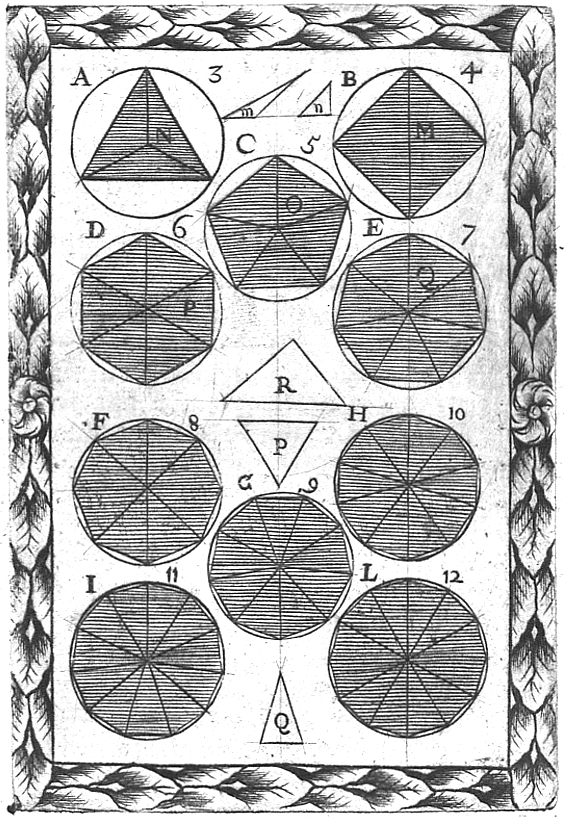
A hexacontagon, often called a 60-gon, is a planar polygon with sixty straight sides and sixty vertices. The name comes from Greek roots meaning "sixty angles." In the special case of a regular hexacontagon all sides and interior angles are equal, giving a highly symmetric figure that closely approximates a circle when drawn with many sides.
Image gallery
3 Images
Geometry and key formulas
Important numerical properties of a regular hexacontagon include:
- Each interior angle equals (n-2)·180°/n = 174°.
- The sum of all interior angles is (n-2)·180° = 10,440°.
- The exterior angle (central rotation step for adjacent vertices) is 6°.
- Number of diagonals: n(n-3)/2 = 1,710.
Area formulas for a regular 60-gon with side length s or circumradius R are standard for regular n-gons: A = (n s^2)/(4 tan(π/n)) or A = (n/2) R^2 sin(2π/n). Coordinates of vertices on the unit circle can be written as complex numbers e^{2πik/60} for k = 0,1,...,59.
Symmetry and constructibility
The symmetry group of a regular hexacontagon is the dihedral group D60 of order 120, consisting of 60 rotations and 60 reflections. The regular 60-gon is constructible with straightedge and compass because 60 = 2^2·3·5 and the prime factors 3 and 5 are Fermat primes; consequently a sequence of classical constructions can produce its vertices (for example by successive angle divisions to obtain 6° steps).
Variations and star polygons
Beyond the regular convex form, there are many star polygon versions denoted {60/k} for integers k that are relatively prime to 60. These stellations produce intricate star shapes by connecting each vertex to the k-th vertex around the circle. The family of such star figures illustrates how a single vertex set can produce multiple distinct polygonal circuits.
History, name, and uses
Polygons with many sides have been studied since antiquity in the context of circle approximation, geometry, and construction problems. The specific prefix "hexacont-" derives from classical Greek numerals. Practical uses of polygons with many sides include geometric modeling, graphic design, tiling motifs, and approximating circular arcs in engineering drawings. For more general background on polygons, see related resources.
Notable facts
Because its exterior angle is exactly 6°, the regular hexacontagon relates naturally to divisions of a circle into 60 parts—a division that also underlies the 60-minute hour and 360-degree circle in historical sexagesimal systems. The large number of diagonals and the abundance of possible star forms make the 60-gon a rich example in studies of polygonal combinatorics and symmetry.
Related articles
Author
AlegsaOnline.com Hexacontagon (60-sided polygon) Leandro Alegsa
URL: https://en.alegsaonline.com/art/43988
Sources
- books.google.com : The Facts on File Geometry Handbook
- books.google.com : The New Elements of Mathematics: Algebra and geometry
- mathworld.wolfram.com : Constructible Polygon
- mathworld.wolfram.com : Hexacontagon
- mathforum.org : Naming Polygons and Polyhedra
- books.google.com : A Mathematical Solution Book Containing Systematic Solutions to Many of the Most Difficult Problems: Taken from the Leading Authors on Arithmetic and Algebra, Many Problems and Solutions from Geometry, Trigonometry and Calculus, Many Problems and Solutions from the Leading Mathematical Journals of the United States, and Many Original Problems and Solutions