
Hexadecagon
A hexadecagon is a sixteen-sided polygon. Covers definitions, regular-case measures and formulas, symmetry and constructibility, star polygons, historical notes and practical uses.
A hexadecagon (also called a 16-gon or hexakaidecagon) is a polygon with sixteen straight sides and sixteen vertices. The simplest reference form is the regular hexadecagon, in which side lengths and vertex angles are all equal; irregular hexadecagons may have sides and angles of different lengths and sizes. For a concise reference, see hexadecagon.
Image gallery
10 Images


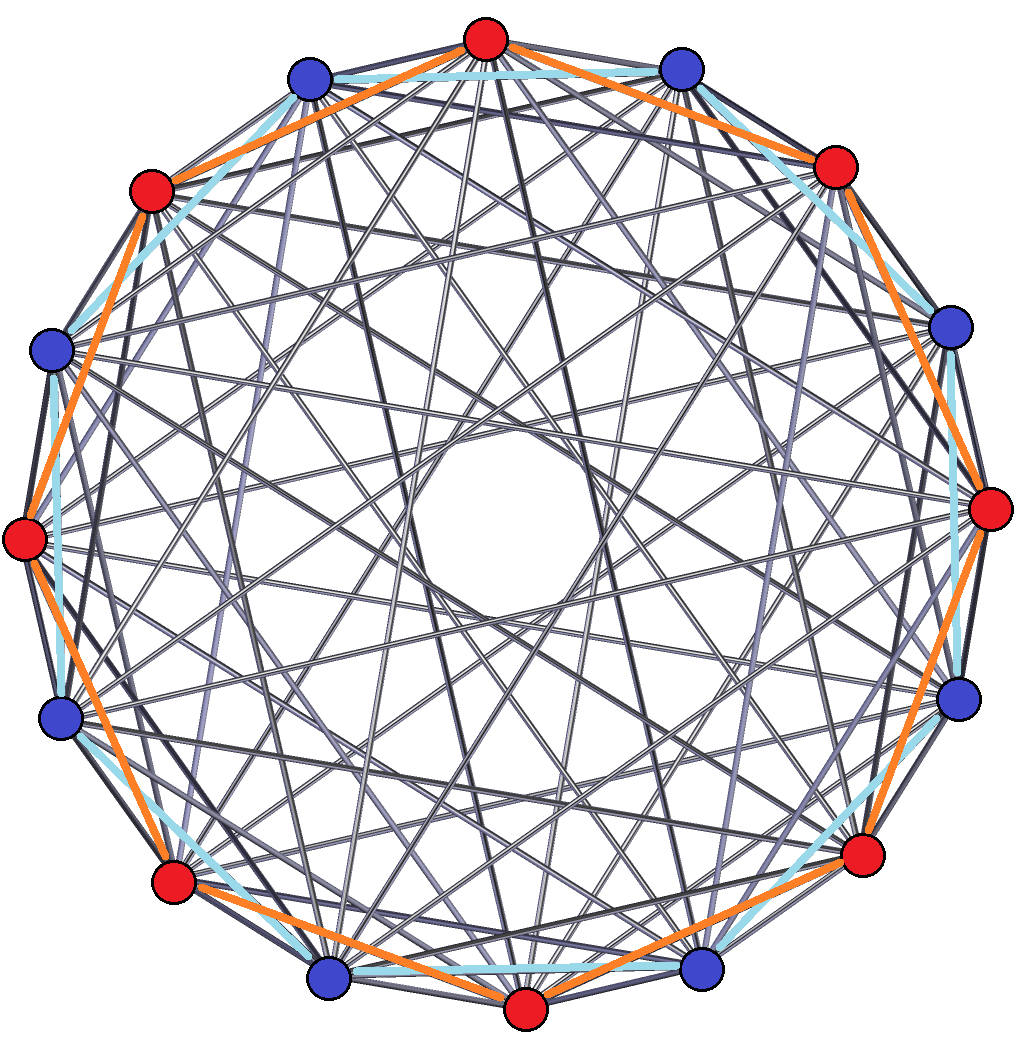

Basic measures and formulas
For a regular hexadecagon: the interior angle at each vertex is 157.5° and the sum of all interior angles is 2,520°. The central angle (the angle subtended at the center by one side) equals 22.5°.
- Side and radius: s = 2R sin(π/16), where R is the circumradius.
- Apothem: a = R cos(π/16).
- Area (in common forms): A = 4 s^2 cot(π/16) = 8 R^2 sin(π/8) = (1/2) n s a with n = 16.
Symmetry, construction and algebraic aspects
The regular hexadecagon has Schläfli symbol {16} and dihedral symmetry D16 of order 32 (16 rotations and 16 reflections). Because 16 is a power of two, a regular hexadecagon is constructible with straightedge and compass: one may start from a square and apply successive angle bisections to obtain sixteen equally spaced directions, or bisect the central angle repeatedly from an octagon.
Vertices of a regular hexadecagon placed on the unit circle correspond to the 16th roots of unity in the complex plane; their coordinates involve sines and cosines of multiples of 22.5° and are expressible using nested square roots because of constructibility.
Star forms, compounds and distinctions
Beyond the convex regular form, there are regular star polygons with 16 vertices, denoted {16/k} for k coprime to 16 (for example {16/3}, {16/5}, {16/7}). Compounds of polygons and selective vertex connections produce varied rosette and star motifs. Unlike small regular polygons that tile the plane by themselves, regular hexadecagons cannot tile the plane alone because their interior angle does not divide 360°; they appear in tilings combined with other polygons.
Hexadecagons are used decoratively in architecture, tiling patterns, clock faces and graphic design where a near-circular many-sided shape is desired. Their straightedge-and-compass constructibility has also made them a classical example in compass-and-straightedge construction problems and in elementary discussions of symmetry and roots of unity in algebra.
Related articles
Author
AlegsaOnline.com Hexadecagon Leandro Alegsa
URL: https://en.alegsaonline.com/art/43991
Sources
- doi.org : 10.1007/978-3-0348-0139-3_3
- doi.org : 10.2307/3604213