
Hesperocallis — the desert lily: description, habitat and taxonomy
Hesperocallis is a monotypic genus whose single species, Hesperocallis undulata (desert lily), occurs in North American deserts. The genus has a complex taxonomic history and close affinities to agave-like groups.
Overview
Hesperocallis is a small genus of flowering plants best known for its single widely recognized species, Hesperocallis undulata, commonly called the desert lily. It is native to arid regions of the southwestern North American deserts and is notable for producing showy, white to pale flowers from an underground bulb. The name and basic circumscription of the genus are discussed in many general plant checklists and floras (genus reference), while broader treatments cover its placement among monocot flowering plants (flowering plants overview).
Image gallery
3 Images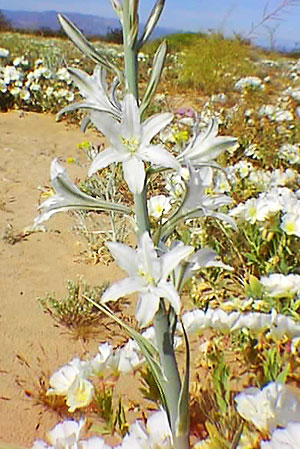


Characteristic features
Desert lily is a perennial geophyte: it survives dry seasons as a bulb and sends up a rosette of leaves and a flowering stalk when conditions permit. Key features include:
- Bulbous underground storage organ that supports annual or episodic growth.
- Linear to lance-shaped leaves arising at ground level.
- Umbel-like clusters of funnel- or bell-shaped flowers, typically white and often fragrant.
- Morphology that historically led to varying interpretations of its relationships with lilies, daylilies and agave-like plants.
Habitat, distribution and ecology
Hesperocallis undulata is adapted to desert environments where it is most often encountered in sandy washes, dunes and gravelly flats. It is generally distributed across parts of the Mojave and Sonoran deserts in the southwestern United States and adjacent areas of northwestern Mexico. Flowering is opportunistic and linked to seasonal rainfall; after favorable moisture, plants may produce conspicuous blooms that attract a range of insect visitors and other pollinators. The species is appreciated by naturalists and native-plant gardeners for its spring display though it is not a widely cultivated garden plant.
Taxonomic history and relationships
The classification of Hesperocallis has been unstable. Traditional systems often placed it with true lilies in Liliaceae (Liliaceae), while other treatments associated it with families that include daylilies or similar genera. In 1972 Hamilton Traub proposed a separate family, Hesperocallidaceae, to accommodate the genus. Modern molecular phylogenetic work led to its inclusion in broader families under the APG frameworks: APG II placed it within Asparagaceae and the monocot order Asparagales (Asparagaceae, Asparagales), with an option to recognize a narrowly circumscribed Hesperocallidaceae when other segregate families are accepted.
More recent DNA-based analyses have indicated a closer relationship between Hesperocallis and agave-like taxa. Some authors have recommended affinity with Agave and related genera, and have suggested placement near or within Agavaceae sensu lato in light of molecular evidence (agave relationship, Agavaceae discussion). These results illustrate the contrast between older morphology-based classifications and newer phylogenetic approaches.
Uses, cultural notes and conservation
The desert lily is primarily of interest for its ecological role and ornamental appeal in appropriate native-plant settings. It is featured in desert wildflower guides and is valued by conservationists monitoring desert flora. Historical or traditional uses have been reported in regional ethnobotanical sources, but such accounts should be consulted directly for verification. Like many specialized desert plants, its local occurrences can be sensitive to habitat disturbance. Conservation attention tends to focus on protecting sandy habitats and natural hydrology that support episodic flowering events.
Notable distinctions
Hesperocallis stands out because it is a monotypic genus with a striking flower display in otherwise sparse desert landscapes, and because its systematic position has shifted as botanical methods have evolved from morphology to molecular phylogenetics. For further taxonomic and botanical detail consult general plant family treatments and molecular studies cited in botanical literature (genus reference, Liliaceae context, molecular studies).
Additional reading and databases provide complementary information on distribution, identification and classification (flowering plants overview, Asparagaceae context, order Asparagales, Agavaceae discussion).
Related articles
Author
AlegsaOnline.com Hesperocallis — the desert lily: description, habitat and taxonomy Leandro Alegsa
URL: https://en.alegsaonline.com/art/43937