
Heptagon
A heptagon (or septagon) is a seven-sided polygon. This article explains its geometry, regular form, constructibility, algebraic background, related star polygons, and common uses.
Overview
A heptagon, also called a septagon or 7-gon, is a polygon with seven sides and seven vertices. In its regular form all sides and interior angles are equal. The regular heptagon is a simple, closed plane figure that appears in geometry, art, and occasional design contexts where sevenfold symmetry is desired. For a basic introduction see the term heptagon.
Image gallery
9 Images




Geometric characteristics
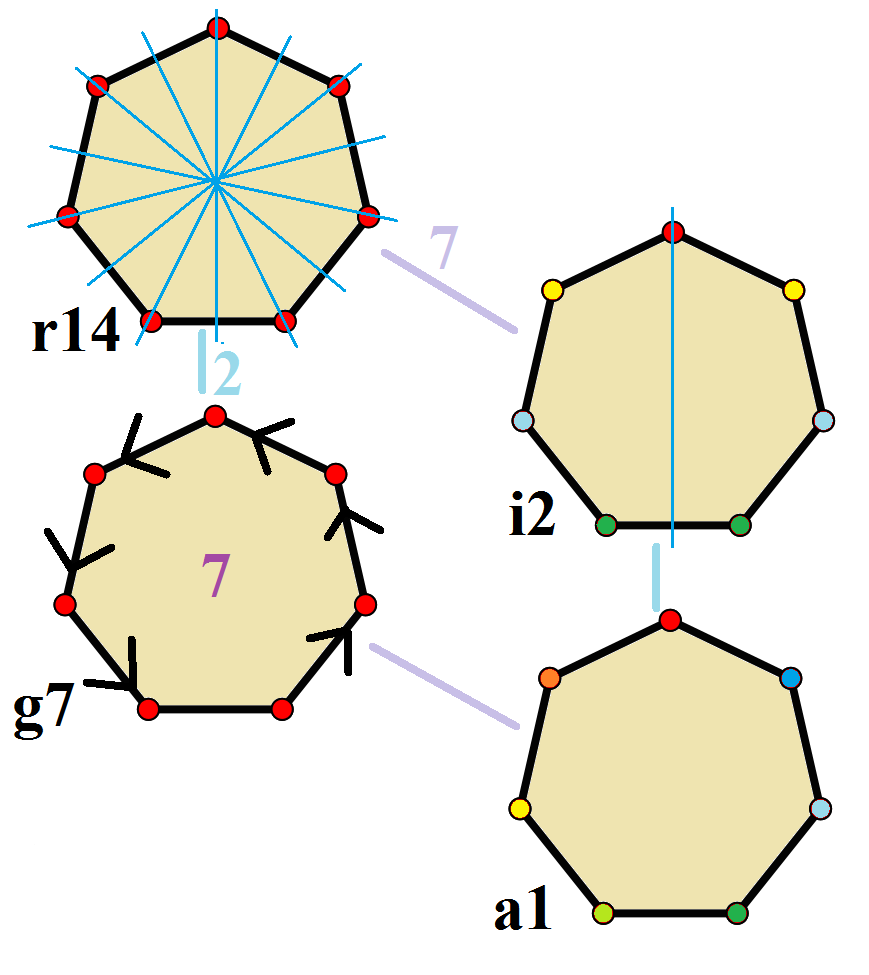
Key measurements for a regular heptagon with side length a include the interior angle, central angle and relations to a circumcircle. Each interior angle equals (5/7)·180° ≈ 128.571° and each central angle is 360°/7 ≈ 51.429°. If R is the circumradius, then R = a / (2 sin(π/7)), and the area can be expressed as A = (7/4) a^2 cot(π/7). The symmetry group of the regular heptagon is the dihedral group D7 of order 14, accounting for seven rotations and seven reflections.
Algebraic and construction facts
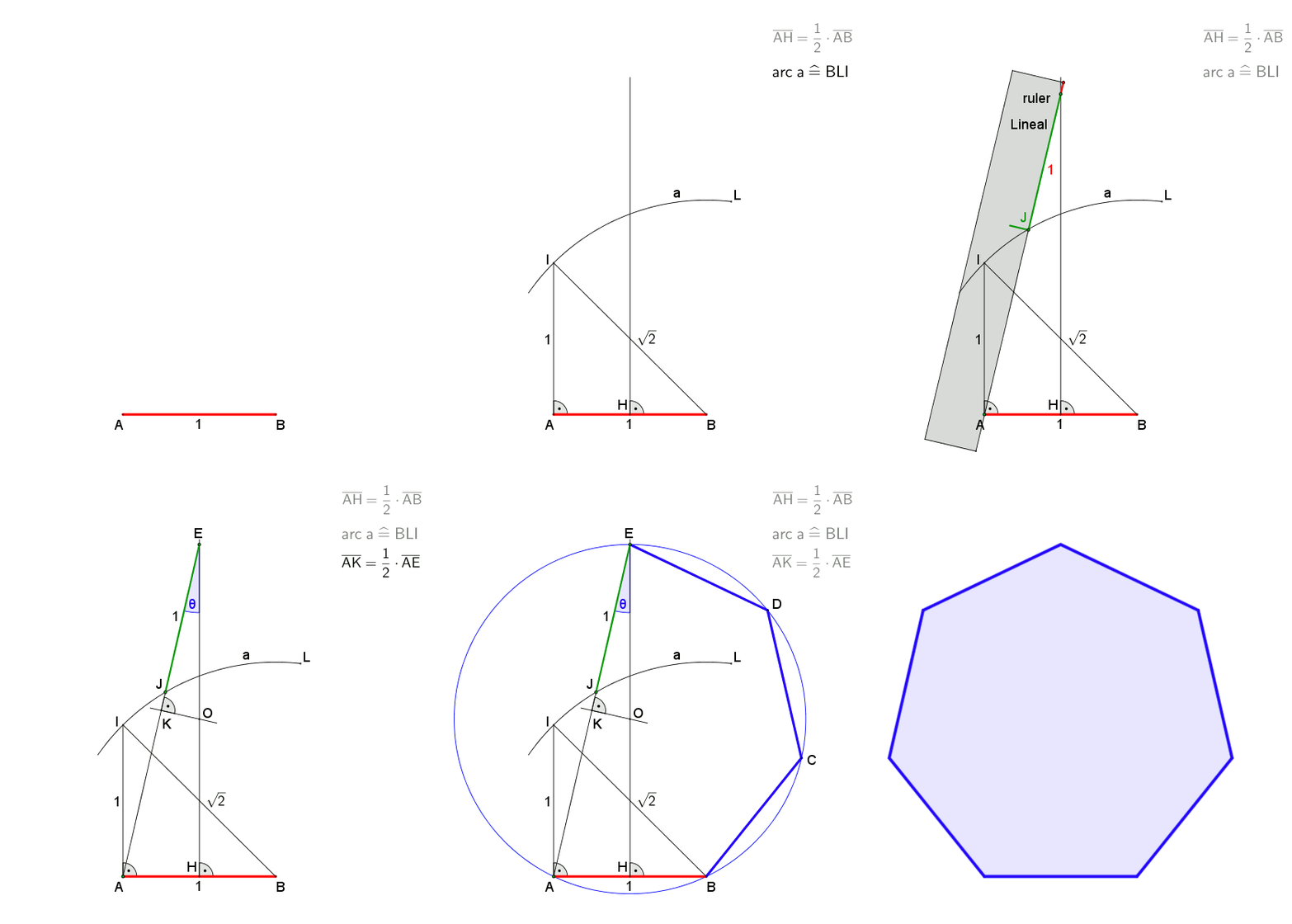
Unlike some regular polygons, the regular heptagon cannot be constructed with classical straightedge and compass. This impossibility follows from results in algebraic number theory: coordinates of its vertices are related to seventh roots of unity and certain trigonometric values, and the minimal polynomial for the relevant cosine values has degree greater than a power of two. Historically, investigations into which n‑gons are constructible led to criteria by Carl Friedrich Gauss and a proof by Pierre Wantzel that rules out a straightedge-and-compass construction for n = 7. Alternative exact constructions use methods beyond pure compass-and-straightedge, and many approximate geometric constructions are known.
Star polygons and relatives
From the seven equally spaced vertices on a circle one can form star polygons called heptagrams. The two distinct regular heptagrams are denoted {7/2} and {7/3}; they join each vertex to the one two or three steps away, producing different star shapes and crossing patterns. The study of these figures connects to graph theory and artistic ornamentation where seven-pointed stars are used symbolically.
Uses and notable facts
Regular heptagons do not tile the plane by themselves and are less common in architecture and tiling than triangles, squares, or hexagons. Nevertheless, seven-sided designs appear in logos, decorative motifs and some game tokens (seven-sided dice are rare). Because the heptagon lacks compass-and-straightedge constructibility, it serves as a standard example in courses that introduce Galois theory and classical construction problems.
Related topics
- General polygons and formulas for area and angles
- Constructibility of regular n-gons and cyclotomic polynomials
- Heptagrams and their symmetries
Related articles
Author
AlegsaOnline.com Heptagon Leandro Alegsa
URL: https://en.alegsaonline.com/art/43661