
Heptadecagon (17-gon): definition, properties and constructibility
A heptadecagon is a 17-sided polygon. This article explains its geometry, the regular heptadecagon, Gauss's constructibility result, symmetry, star forms and notable facts.
Overview
A heptadecagon, also called a 17-gon or septadecagon, is a polygon with seventeen sides and seventeen vertices. The term most often refers to the regular heptadecagon, in which all sides and interior angles are equal. For a concise visual or technical reference about the shape see the regular heptadecagon.
Image gallery
10 Images



Basic properties
The regular heptadecagon has a number of simple geometric measures that follow directly from n‑gon formulas. Important values include:
- Sides and vertices: 17 each.
- Interior angle (each): (15/17)·180° ≈ 158.8235°.
- Central angle: 360°/17 ≈ 21.1765°.
- Symmetry: dihedral group D17 of order 34 (rotations and reflections).
Constructibility and historical note
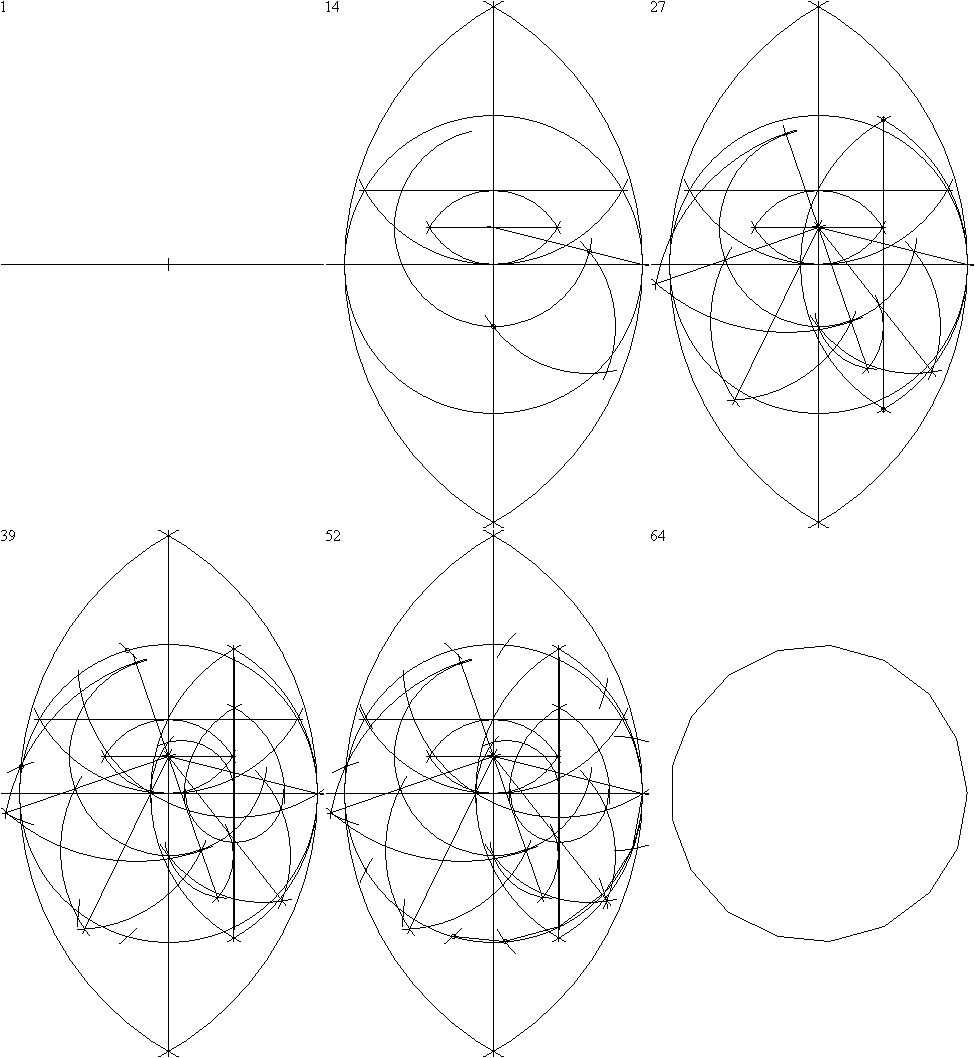
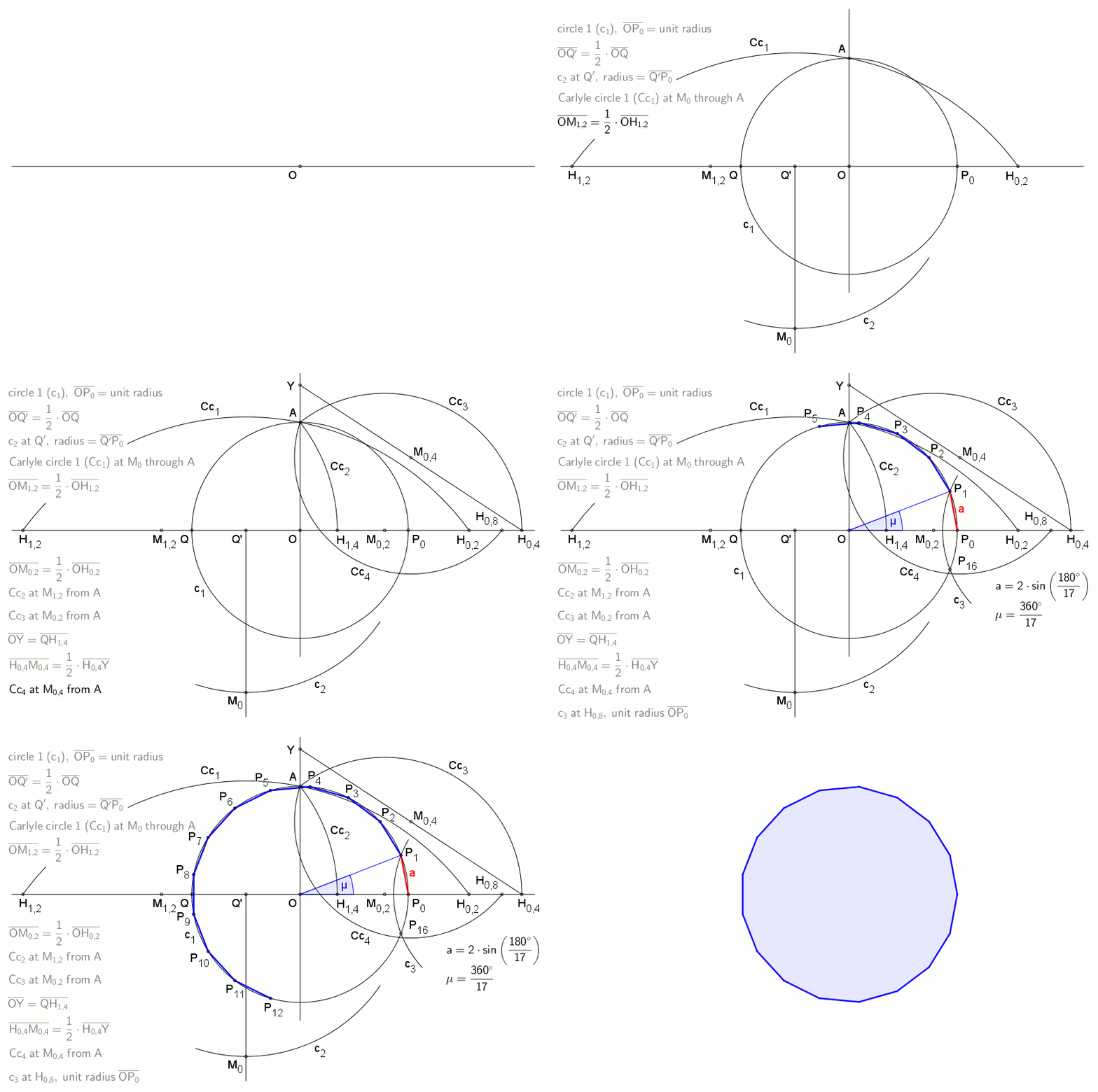
One of the heptadecagon's most notable features is that the regular 17-gon is constructible with straightedge and compass. In 1796 Carl Friedrich Gauss proved that a regular polygon with 17 sides can be constructed because 17 is a Fermat prime. This result was historically important: it showed certain regular polygons can be drawn by classical methods and that cos(2π/17) can be expressed using nested square roots, though the explicit construction is algebraically intricate.
Star polygons and variants
Because 17 is prime, several regular star heptadecagrams exist, given by Schläfli symbols {17/k} for k = 2,3,...,8. These produce distinct star shapes formed by connecting every k-th vertex in cyclic order. Their symmetry remains the same dihedral type, but the visual forms vary according to step size.
Uses, examples and notable facts
The heptadecagon is mostly of theoretical and pedagogical interest in geometry and algebra because of its link to constructibility and field theory. It occasionally appears in decorative motifs or mathematical illustrations. Its study connects elementary Euclidean construction with ideas from number theory and Galois theory, making it a classical example in courses on constructions.
Distinctions
Unlike small regular polygons (triangles, squares, pentagons), the heptadecagon is relatively large and rarely arises in elementary construction problems, but it remains a celebrated example of a polygon whose exact classical construction is possible despite the apparent complexity.
Related articles
Author
AlegsaOnline.com Heptadecagon (17-gon): definition, properties and constructibility Leandro Alegsa
URL: https://en.alegsaonline.com/art/43660