
Handball (team handball)
Team handball is a fast indoor team sport for two sides of seven players. Teams pass and dribble a ball to score in the opponent's goal; matches are typically two 30-minute halves on a 40×20 m court.
Overview
Handball, often called team handball or Olympic handball, is a high-speed indoor team sport played between two teams of seven players each (six court players and a goalkeeper). The objective is to score goals by throwing a ball into the opposing team's net. A standard match consists of two 30-minute halves with a break at halftime. The sport combines elements of running, passing, jumping and throwing, and is governed internationally by the International Handball Federation.
Image gallery
10 Images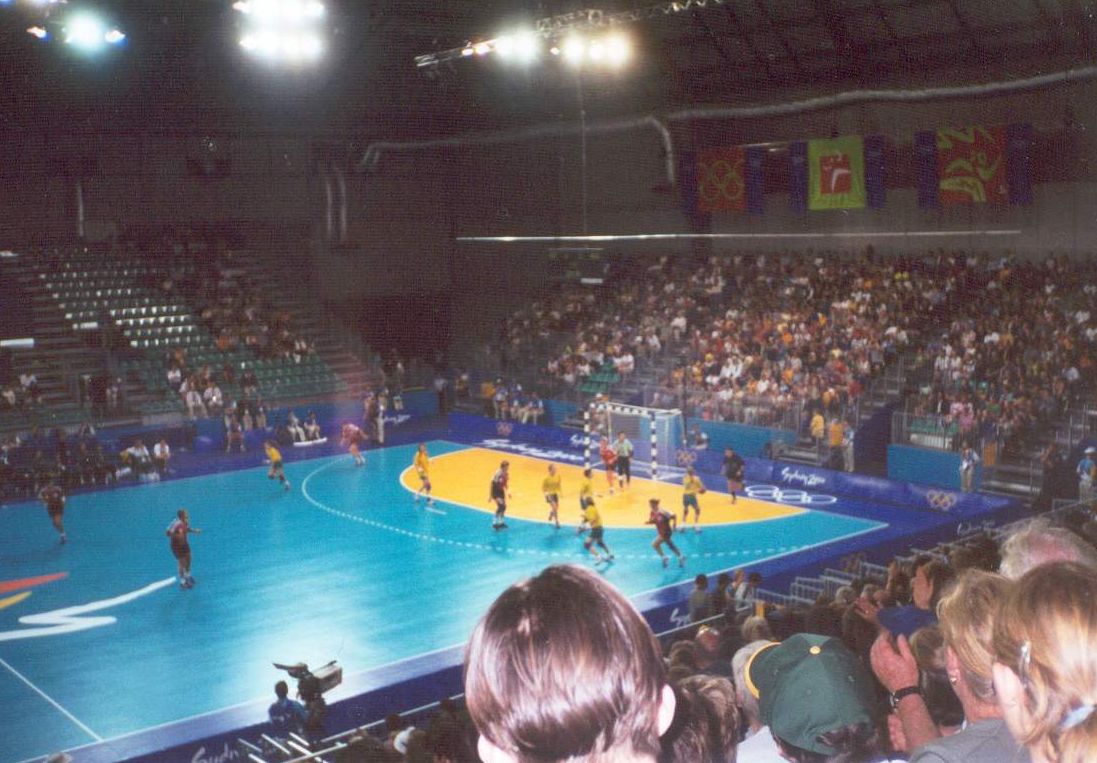


Playing area and equipment
Matches are typically played on a rectangular court 40 metres long and 20 metres wide. A key feature is the goal area, marked by a six-metre semicircular line: only the goalkeeper may occupy this area while contacting the ground. A penalty mark lies seven metres from goal for foul-related penalty throws. The ball is a leather or synthetic sphere sized for age and gender categories; see ball specifications for typical distinctions. Players use only their hands to handle the ball; for more on handling rules see use of the hands.
Basic rules and common infractions
- Possession and movement: a player may take up to three steps without dribbling and may hold the ball for about three seconds before passing, shooting or dribbling.
- Dribbling: continuous dribbling is allowed, but double-dribbling (resuming dribble after stopping) is penalized.
- Free throws and penalties: ordinary fouls usually lead to free throws; severe or clear scoring opportunities may result in a seven-metre penalty throw.
- Sanctions: referees can award warnings, two-minute suspensions, or disqualifications for serious fouls; two-minute exclusions reduce a team to six players temporarily.
Players and positions
Typical positions include left and right wings, left and right backs, centre back (playmaker), pivot (or line player) and goalkeeper. Each role carries tactical responsibilities: wings often complete fast breaks and shoot from acute angles; backs are important for long-range shooting and organizing attacks; the pivot operates near the opponent's goal area to create space and scoring chances. Goalkeepers defend the goal and can participate in fast counterattacks when they leave the area.
History and development
Modern team handball developed in northern and central Europe in the late 19th and early 20th centuries from a variety of ball games played with the hands. It evolved into indoor and outdoor variants; the indoor form became dominant in the mid-20th century and later achieved global organization and standardized rules. Team handball has been part of the Olympic programme for men since the early 1970s and for women since the mid-1970s, which helped spur international growth and professional club competitions.
Competitions, variants and distinctions
Top-level fixtures include national leagues, continental club tournaments and international championships organized under national federations and the international governing body. Variants include beach handball and small-sided or street forms adapted for recreation. Team handball should not be confused with other sports that share the name, such as the one-wall or four-wall handball games; see the separate article on handball (wall game) for that family of sports.
Notable facts
Substitution in handball is unlimited and can be made on the fly, allowing for dynamic tactical changes. Physical contact is permitted within limits—players may use their torso to obstruct opponents but may not hold, hit or endanger them. At top levels, the sport is noted for rapid transitions from defense to attack, frequent goal scoring and a combination of individual skill and structured team tactics. For the goalkeeper's specialized role and protective privileges see goalkeeper.
For general rules, training resources and introductory materials consult national federations or the International Handball Federation's official publications, and for beginner-friendly explanations of ball handling and technique see use of the hands and ball specifications.
Additional background and alternative formats can be explored through introductory guides and resources linked from governing bodies and educational sites; for an overview of recreational or non-team variants visit pages devoted to the wall-based forms of handball and beach adaptations at handball (wall game) and other summaries.
Notes: rules and competition formats may vary between age groups and national federations; the descriptions above reflect common international practices.
Related articles
Author
AlegsaOnline.com Handball (team handball) Leandro Alegsa
URL: https://en.alegsaonline.com/art/42174