
Hapkido: Korean self‑defense art of joint locks, throws and circular motion
Hapkido is a Korean martial art emphasizing self‑defense through joint locks, throws, kicks and redirection. It blends striking, grappling and circular movement and developed in the mid‑20th century.
Overview
Hapkido ( Hangul: 합기도; Hanja: 合氣道) is a Korean martial art focused on self‑defense. The name is commonly translated as "the way of coordinating energy" or "the way of harmonious spirit," reflecting an emphasis on using an opponent's force rather than meeting it with brute strength. Training covers a broad spectrum of techniques, from strikes and kicks to joint manipulation and throws.
Image gallery
10 Images


Techniques and training
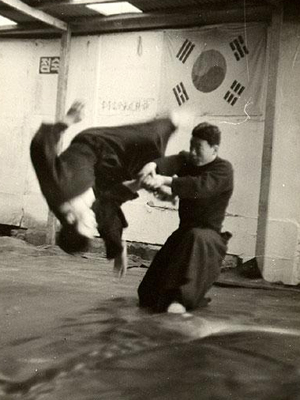
Hapkido classes typically teach a combination of long‑range and close‑range responses. Practitioners learn evasive footwork and circular redirection, hard and soft strikes, high and low kicks, joint locks, throws and pressure‑point control. Training methods include partner drills, repetitive technical practice, forms (patterns), conditioning and controlled sparring. Some schools also include basic weapon handling and defenses against armed attackers.
Core components
- Joint locks and manipulations to control or incapacitate an opponent.
- Throws and takedowns derived from grappling principles.
- Striking techniques including punches, palm strikes and elbow/knee strikes.
- Kicking techniques; Hapkido shares some kicking ideas with Taekwondo but applies them to self‑defense contexts.
- Use of circular motion and redirection rather than purely linear force.
History and development
Hapkido emerged in Korea in the twentieth century as an eclectic system drawing on indigenous Korean fighting methods and influences from Japanese and Chinese arts. Early proponents integrated joint‑locking and throwing techniques with the Korean emphasis on kicking. Over time, schools and instructors emphasized different elements—some leaning toward striking and sport, others toward traditional self‑defense and internal principles—so Hapkido appears in several stylistic variants.
Uses, philosophy and distinctions
Practically, Hapkido is taught primarily for realistic self‑defense: disarming attackers, controlling violent encounters, and escaping dangerous situations. Philosophically it stresses harmony, adaptability and the efficient use of energy. In contrast to sport‑oriented striking systems, Hapkido places greater weight on joint control and tactical neutralization; compared with Japanese aikido, Hapkido generally incorporates more kicks and striking techniques, and a more combative orientation in many schools.
Notable facts
Today Hapkido is practiced worldwide in a range of schools that vary in curriculum and emphasis. Its adaptability has made it popular among civilians, law‑enforcement personnel and mixed martial artists seeking comprehensive self‑defense skills. As with many martial arts, individual instructors influence how tradition, combat effectiveness and cultural elements are balanced in teaching.
Questions and answers
Q: What is Hapkido?
A: Hapkido is a Korean martial art.
Q: How is Hapkido different from other martial arts?
A: Hapkido is a combination of techniques from taekwondo and aikibudo.
Q: What is the focus of Hapkido's teaching?
A: The focus of Hapkido's teaching is on self-defense.
Q: How is Hapkido written in Korean?
A: Hapkido is written in hangul as 합기도 and in Hanja as 合氣道.
Q: What is the meaning of the word "Hapkido"?
A: The meaning of the word "Hapkido" is not provided in the given text.
Q: What are some of the techniques used in Hapkido?
A: The text does not provide information on specific techniques used in Hapkido.
Q: In which country did Hapkido originate?
A: The text does not provide information on the country of origin of Hapkido. However, as it is a Korean martial art, it can be assumed that it originated in Korea.
Related articles
Author
AlegsaOnline.com Hapkido: Korean self‑defense art of joint locks, throws and circular motion Leandro Alegsa
URL: https://en.alegsaonline.com/art/42325