
Halteres — the gyroscopic balancing organs of flies
Halteres are small, knobbed organs in flies derived from hind wings; they oscillate during flight and act as gyroscopic sensors that detect body rotations and stabilize maneuvering.
Overview
Halteres are small, club- or knob-shaped organs found in the order Diptera (true flies). They are the modified hind wings of these insects and are paired structures located behind the main flight wings. During flight they beat in a regular oscillation and provide rapid sensory feedback that helps the insect detect rotations of the body and maintain stable, agile flight. See general notes on flies and how their flight differs from other insects.
Image gallery
9 Images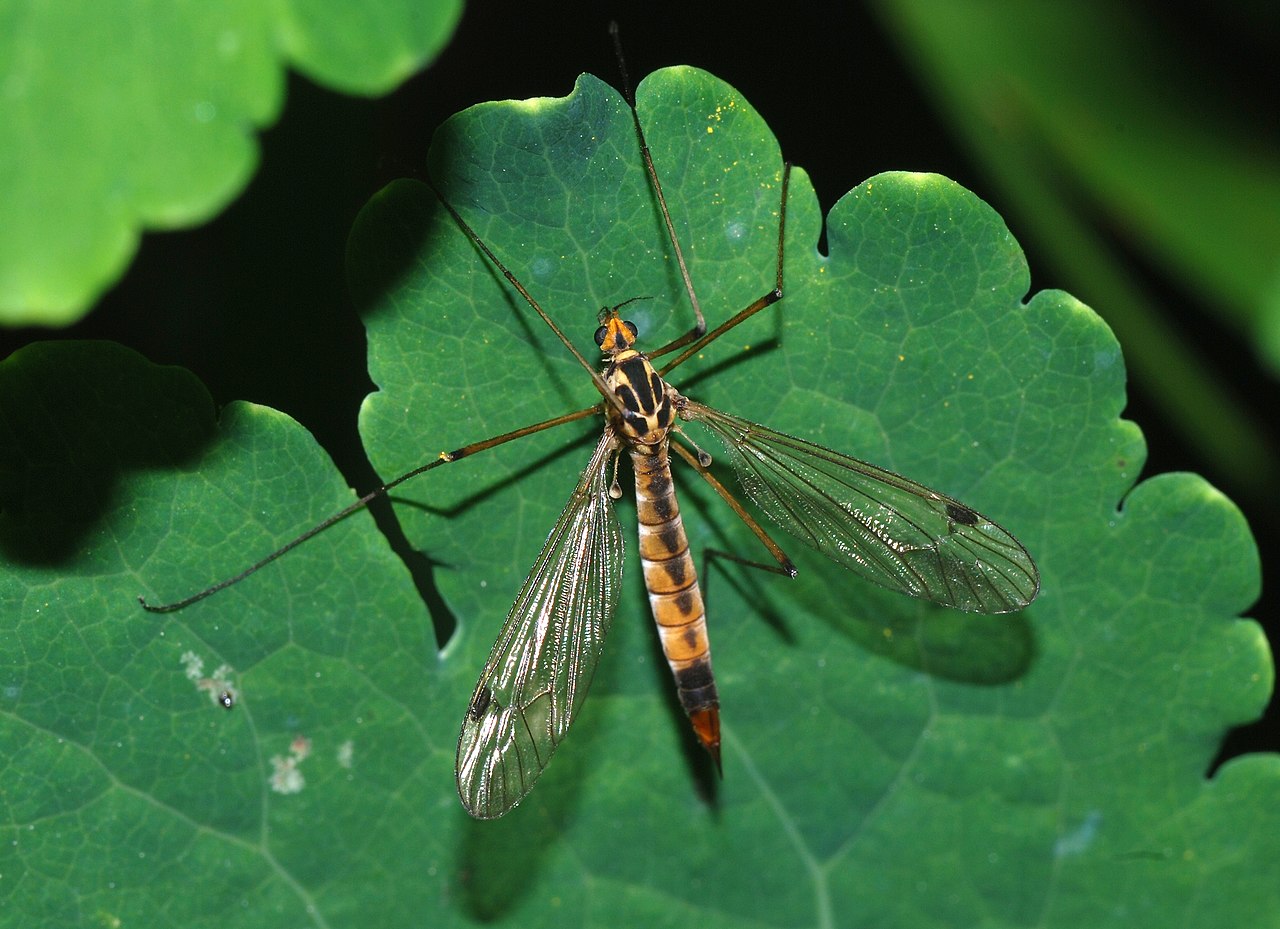


Structure and sensory anatomy
Each haltere consists of a slender stalk capped by a thicker knob. At the base of the stalk there are mechanosensory receptors that transduce mechanical forces produced when the haltere moves. The most important sensors include campaniform sensilla, which detect strain in the cuticle, and other proprioceptive organs that register acceleration and angular forces. The haltere is mechanically tuned to oscillate at approximately the same frequency as the wings, so that it samples the same dynamic environment.
How halteres work
Functionally, halteres act like tiny biological gyroscopes. As the insect rotates during yaw, pitch or roll, Coriolis forces act on the oscillating haltere and change the pattern of mechanical stress at its base. Those changes are detected by the mechanoreceptors and relayed to the nervous system, which then adjusts wing kinematics and body muscles to counter undesired rotations. In effect, halteres enable very fast reflexes that stabilize flight and permit precise aerial maneuvers. Researchers often describe this sensing as vibration-coupled gyroscopic feedback; the halteres vibrate in phase with the wings to sense such forces.
Evolution and development
Halteres evolved from ancestral hind wings. Early winged insects typically had two functional pairs of wings, as still seen in groups like dragonflies and in many orders such as hymenoptera and lepidoptera. In the dipteran lineage the hind wings became progressively reduced and transformed into halteres, while the forewings remained the primary lift-generating surfaces. Developmental genetics studies, especially in model species, show that changes in regulatory genes can switch a wing developmental program toward haltere morphology, illustrating how small genetic shifts produce major functional innovation. For a brief discussion of their origin, see evolved from wings.
Importance, examples and research uses
Halteres are essential for flight control in flies; removal or impairment of halteres produces severe instability and makes coordinated flight difficult. They are studied intensively as a model of sensorimotor control and rapid reflex circuits. Insights from haltere function have inspired bioinspired sensors and stabilization systems in small aerial robots. Typical examples of insects that rely on halteres include houseflies, fruit flies and mosquitoes — common representatives of dipteran flight behavior.
Distinctions and notable facts
- Halteres are not locomotory wings but sensory organs derived from wings.
- Convergent reductions of wing pairs occur in other insect groups, but true halteres are a dipteran innovation.
- They emphasize how sensory specializations can replace lost structures while adding new capabilities.
For concise general background on flies and flight evolution, consult introductory resources on flies and related insect orders; further technical reviews are available for readers seeking details on mechanoreceptors and neural circuitry.
Questions and answers
Q: What are halteres?
A: Halteres are small knobbed structures modified from the hind wings in flies.
Q: What is the function of halteres during flight?
A: Halteres vibrate during flight, and help the insect fly better.
Q: How did halteres evolve?
A: The halteres evolved from wings.
Q: How many pairs of wings did ancestral flying insects have?
A: Ancestral flying insects had two pairs of wings.
Q: Do dragonflies still have two pairs of wings?
A: Yes, dragonflies still have two pairs of wings.
Q: Which insect groups still have two pairs of wings?
A: Hymenoptera and Lepidoptera still have two pairs of wings.
Q: How many pairs of wings do flies have?
A: Flies have only the front pair of wings.
Related articles
Author
AlegsaOnline.com Halteres — the gyroscopic balancing organs of flies Leandro Alegsa
URL: https://en.alegsaonline.com/art/41984