
NASA Great Observatories program
The Great Observatories were four NASA space telescopes operating across the electromagnetic spectrum—gamma rays to infrared—designed as a coordinated fleet to study the universe in complementary wavelengths.
Overview
The Great Observatories program is a coordinated set of four major space telescopes launched by NASA to observe the universe in different portions of the electromagnetic spectrum. Conceived to provide complementary views of cosmic phenomena, the telescopes together enabled multiwavelength studies of galaxies, black holes, stellar birth and death, and transient events. The program emphasized high sensitivity and resolution from space, where atmosphere-free observations reveal details inaccessible from the ground.
Image gallery
10 Images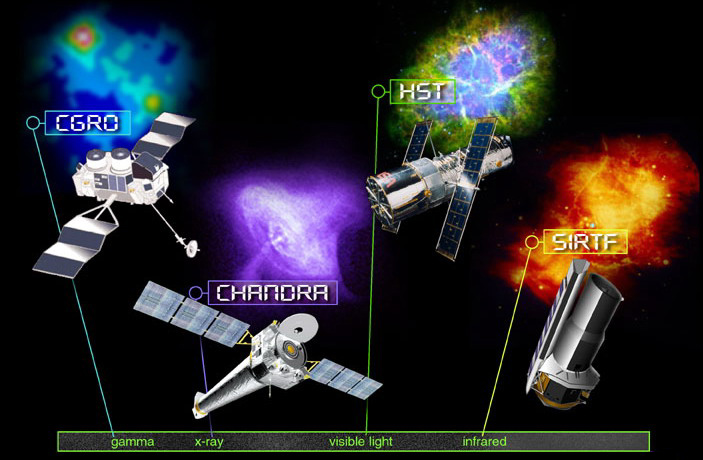



Components
- Hubble Space Telescope — optimized for ultraviolet, visible and near-infrared light; famous for deep-field imaging and precise measurement of galaxy structure.
- Compton Gamma Ray Observatory — observed high-energy gamma rays and transient gamma-ray bursts, contributing to high-energy astrophysics before its deorbit.
- Chandra X-ray Observatory — designed for high-resolution X-ray imaging and spectroscopy of hot gas, supernova remnants, and accreting black holes.
- Spitzer Space Telescope — an infrared observatory that probed dust-enshrouded regions, star-formation sites, and the thermal emission of exoplanet systems.
History and development
The program was developed in the late 20th century as part of a strategic plan to exploit space-based observatories across multiple wavebands. Each observatory had a distinct technical design and mission lifetime, and they were managed as major space science projects with international collaborations. Over time, servicing missions, orbital adjustments, and end-of-mission plans shaped their operational histories.
Scientific importance and examples
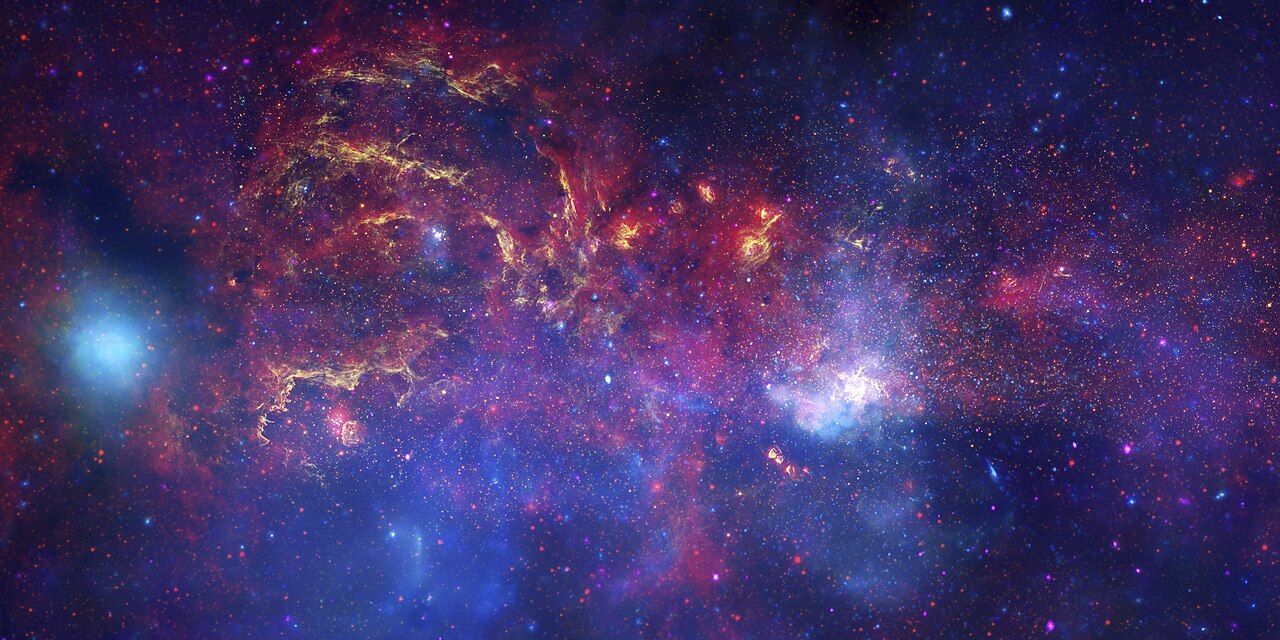
By combining observations from different telescopes, astronomers obtained a more complete physical picture of objects and events. Examples include Hubble’s detailed optical views paired with Chandra’s X-ray maps of galaxy clusters, and Spitzer’s infrared surveys revealing star-forming regions hidden by dust. Compton’s contributions to the study of cosmic gamma-ray bursts laid groundwork for later high-energy missions. Together, the observatories advanced knowledge of cosmic evolution, compact objects, and energetic processes.
Legacy and distinctions
The Great Observatories set a model for multiwavelength astrophysics and inspired subsequent missions and ground-based programs. Their complementary capabilities—each tuned to a distinct spectral band—remain a defining feature: combining data across wavebands is now routine in astronomy. For further summaries and mission pages, see program overview, detailed mission histories at archive resources, technical descriptions at agency pages, science highlights at research portals, and public outreach materials at education sites.
Related articles
Author
AlegsaOnline.com NASA Great Observatories program Leandro Alegsa
URL: https://en.alegsaonline.com/art/40528