
Great Red Spot (Jupiter's long‑lived storm)
A giant anticyclonic storm on Jupiter, visible for centuries. Notable for its size, longevity, changing color and shape, and as a laboratory for studying atmospheric dynamics on giant planets.
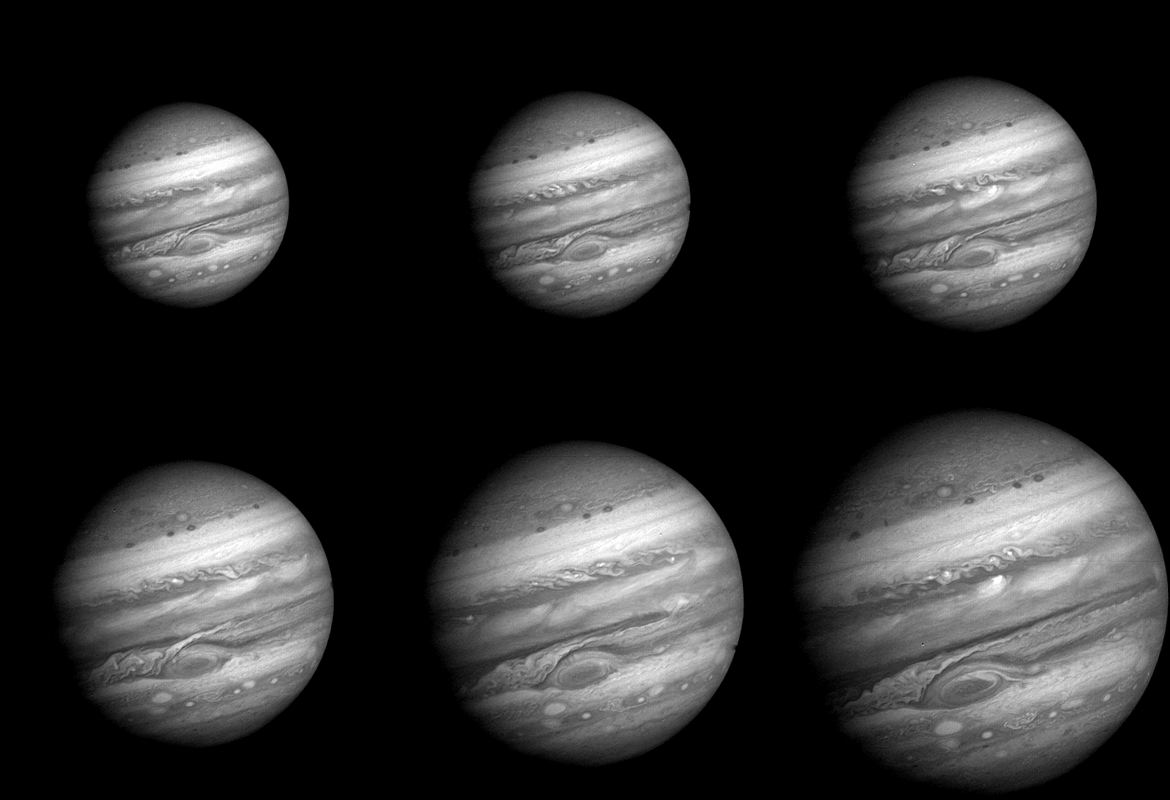
The Great Red Spot is a vast, persistent storm in the atmosphere of Jupiter. Seen as a reddish oval in the planet's southern hemisphere, it is large enough that two or three copies of Earth could historically fit inside. Unlike terrestrial hurricanes, the Great Red Spot is a long‑lived anticyclonic vortex embedded in Jupiter's banded cloud system and driven by the planet's internal heat and strong jet streams.
Image gallery
10 Images



Characteristics
This feature is an anticyclone, meaning it is a high‑pressure region with circulating winds around a central core. Its boundary is defined by powerful east–west jet streams that confine the vortex and shape its oval outline. Cloud tops over the spot contain ammonia ice and other compounds; the precise chemical cause of its red coloration remains uncertain and is an active area of research.
The spot's size and appearance have changed over time: historical records and modern measurements show gradual shrinkage and variations in color from deep red to paler orange or brown. It sits well south of Jupiter's equator and interacts with smaller vortices and bands, occasionally absorbing or merging with nearby storms.
History and observations
Observers have recorded the Great Red Spot for several centuries, making it one of the longest‑monitored atmospheric phenomena in the Solar System. Telescopes and spacecraft have tracked its motion, shape, and internal structure. Space missions such as Voyager, Galileo, Cassini, and Juno have provided increasingly detailed views, imaging the cloud patterns and probing the storm's dynamics beneath the visible tops.
Scientific significance
Studying the Great Red Spot helps scientists understand fluid dynamics, vortex stability, and energy transport in giant planet atmospheres. Measurements indicate the vortex extends beneath the cloud tops and exchanges momentum with surrounding jets, offering a natural laboratory for testing models that have applications to other planets and to physics of rotating fluids.
Notable facts
- It is the largest known storm in the Solar System and has persisted for at least several centuries.
- Its color and internal composition are not fully explained; various complex chemicals and photochemical processes are hypothesized.
- The feature has contracted and changed shape over time, highlighting dynamic processes in Jupiter's atmosphere.
Related articles
Author
AlegsaOnline.com Great Red Spot (Jupiter's long‑lived storm) Leandro Alegsa
URL: https://en.alegsaonline.com/art/40538