
Great Wall (cosmic large-scale structures)
A survey of the term “Great Wall” as applied to the largest known arrangements of galaxies and gamma‑ray burst concentrations, their discovery methods, notable examples, and the scientific debate they prompted.
The term "Great Wall" is used in cosmology to describe very large, sheet‑like assemblies of galaxies and galaxy clusters that form part of the cosmic web. These structures are among the largest coherent features identified in three‑dimensional maps of the universe. They appear as long, relatively thin concentrations of matter that separate large underdense regions called voids and trace the filamentary network produced by the growth of structure under gravity.
Image gallery
4 Images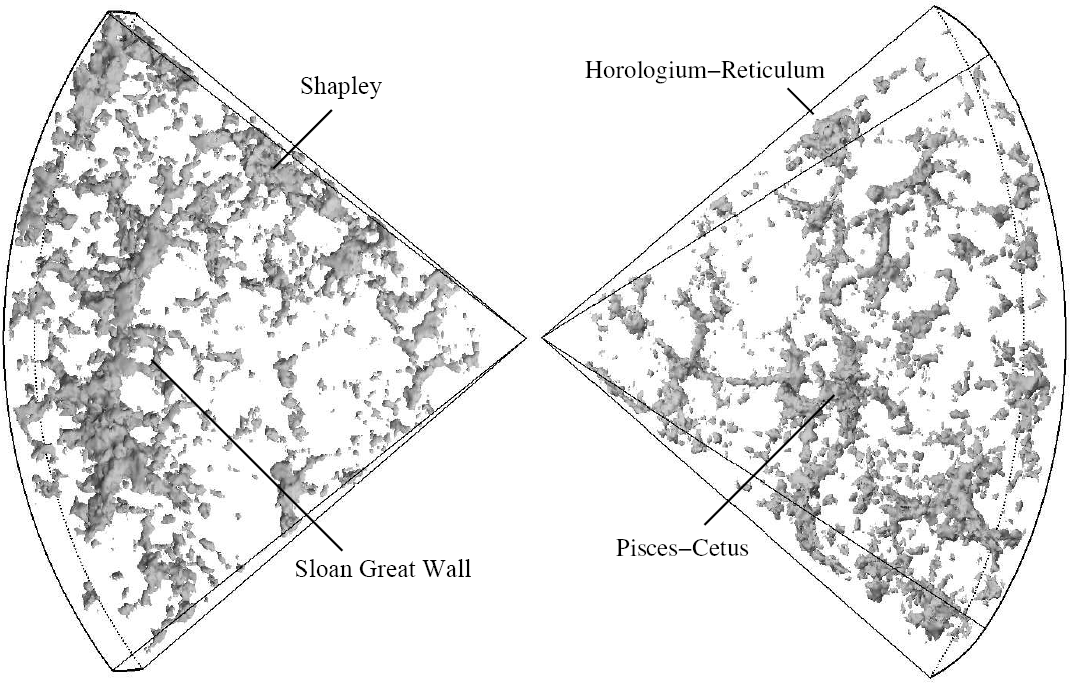


Characteristics and detection
Great Walls are identified from surveys that measure positions and distances of galaxies, quasars, or transient events such as gamma‑ray bursts (GRBs). Typical observational signatures include an overdensity of objects over a contiguous angular extent and a narrow redshift range indicating comparable distance. Modern analyses combine optical redshift surveys, infrared catalogs and high‑energy transient catalogs to map these features in three dimensions. For discussion of survey methods and large‑scale mapping techniques see survey resources and work using gamma‑ray burst mapping at GRB mapping studies.
History and notable examples
- Early redshift surveys revealed the first large walls of galaxies in the late 20th century, prompting the popular use of the phrase "Great Wall." These discoveries showed that galaxies are not distributed randomly but instead form a complex web.
- Later, larger and more distant walls have been proposed from deeper surveys and from clustering of high‑energy transients. Some claims, notably of extremely large walls detected through concentrations of GRBs, attracted attention because of their implied size.
Scientific importance and debate
Great Walls illustrate how gravity organizes matter on very large scales and help test cosmological models. However, claims of structures that span very large cosmological volumes have generated debate. If a coherent feature were shown to exceed a certain scale by a wide margin, it would raise questions about the assumption that the universe is homogeneous and isotropic on the largest scales—a foundational idea often called the cosmological principle. For accessible commentary on scale limits and related discussion see cosmological principle resources.
Current view and caution
Most cosmologists treat catalogued walls and filaments as expected outcomes of structure formation in a universe governed by gravity and dark matter. Individual extreme claims are examined carefully for selection effects, survey biases, or statistical flukes. Ongoing and planned surveys continue to refine three‑dimensional maps of the cosmos and to clarify which apparent features correspond to real, coherent structures and which arise from sampling and projection.
Questions and answers
Q: What are the Great Walls?
A: The Great Walls are the largest known structures in the universe.
Q: How were the Great Walls mapped?
A: The Great Walls were mapped based on a data set mapping of gamma-ray bursts (GRBs).
Q: What did the mapping find about the Great Walls?
A: The mapping found an unusually high concentration of similarly distanced GRBs in certain areas.
Q: How large are the Great Walls estimated to be?
A: Structures larger than 1,200,000,000 light years are incompatible with the cosmological principle according to all estimates.
Q: Why are the Great Walls significant?
A: The Great Walls are significant because they are the largest known structures in the universe.
Q: What is the cosmological principle?
A: The cosmological principle is the assumption that the universe is homogeneous and isotropic on large scales.
Q: How do the Great Walls relate to the cosmological principle?
A: The Great Walls are relevant to the cosmological principle because structures larger than 1,200,000,000 light years are incompatible with it according to all estimates.
Related articles
Author
AlegsaOnline.com Great Wall (cosmic large-scale structures) Leandro Alegsa
URL: https://en.alegsaonline.com/art/40562
Sources
- adsabs.harvard.edu : "Possible structure in the GRB sky distribution at redshift two"
- arxiv.org : 1401.0533
- ui.adsabs.harvard.edu : 2014A&A...561L..12H
- doi.org : 10.1051/0004-6361/201323020
- arxiv.org : 1311.1104
- ui.adsabs.harvard.edu : 2013arXiv1311.1104H
- arxiv.org : "Anomalies in the GRB spatial distribution"
- news.discovery.com : "Universe's largest structure is a cosmic conundrum"
- mnras.oxfordjournals.org : "A giant ring-like structure at 0.78 < z < 0.86 displayed by GRBs"
- arxiv.org : 1507.00675
- ui.adsabs.harvard.edu : 2015MNRAS.452.2236B
- doi.org : 10.1093/mnras/stv1421
- newscientist.com : "Largest structure challenges Einstein's smooth cosmos"
- ras.org.uk : "Astronomers discover the largest structure in the universe"
- mnras.oxfordjournals.org : "A structure in the early Universe at z ∼ 1.3 that exceeds the homogeneity scale of the R-W concordance cosmology"