
Grus (constellation)
Grus, Latin for 'the Crane', is a southern-hemisphere constellation notable for its bright star Alpha Gruis, several red giants and faint galaxies. It was established during European Age of Discovery.
Overview
Grus is a constellation in the southern celestial hemisphere whose name is Latin for "the Crane." It is a moderate-sized pattern of stars that is visible primarily from southern latitudes and is most conspicuous in months around the southern autumn. Historically depicted as a long-necked bird, Grus forms part of a group of constellations introduced to European star charts during the Age of Discovery.
Image gallery
6 Images
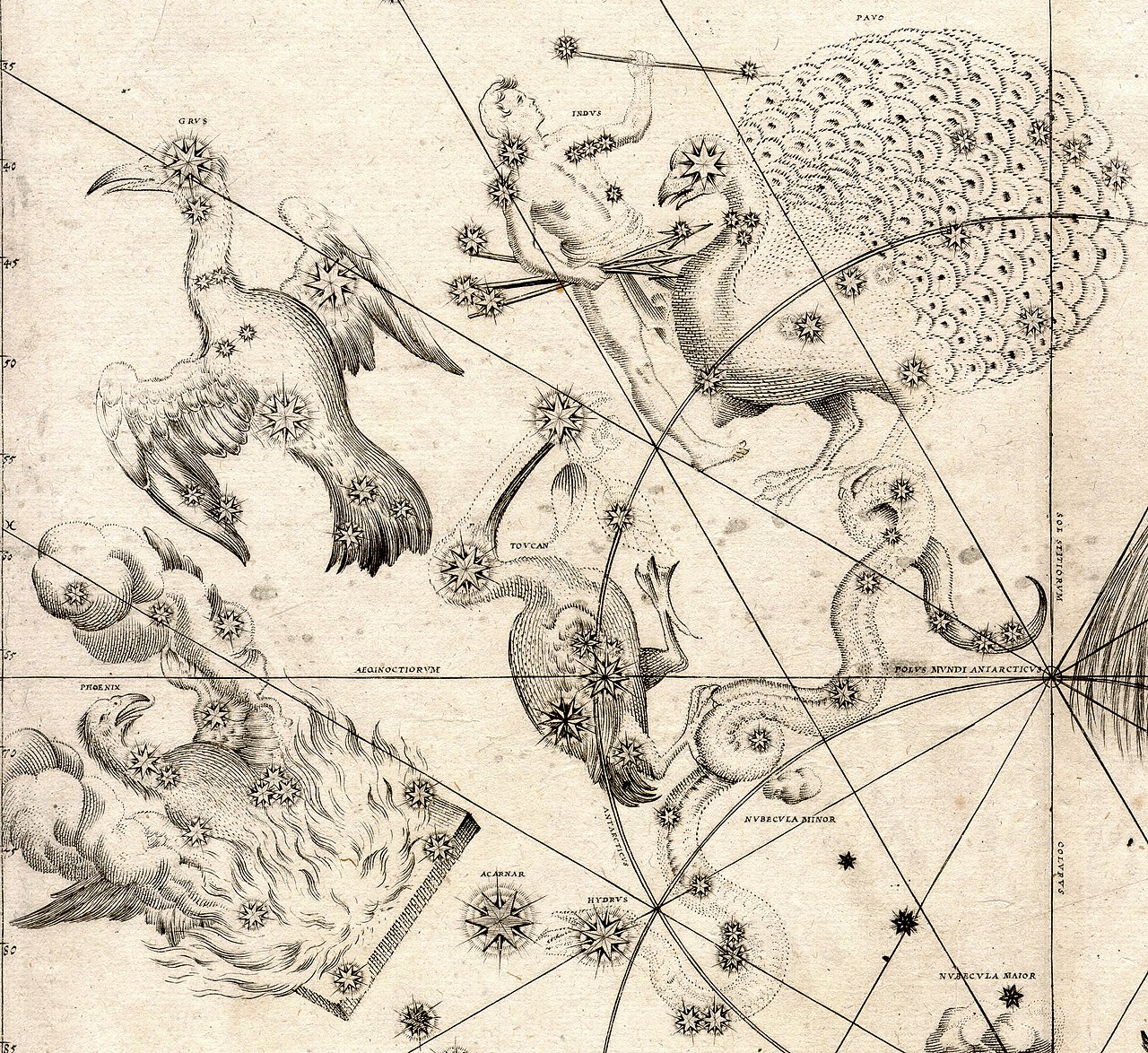



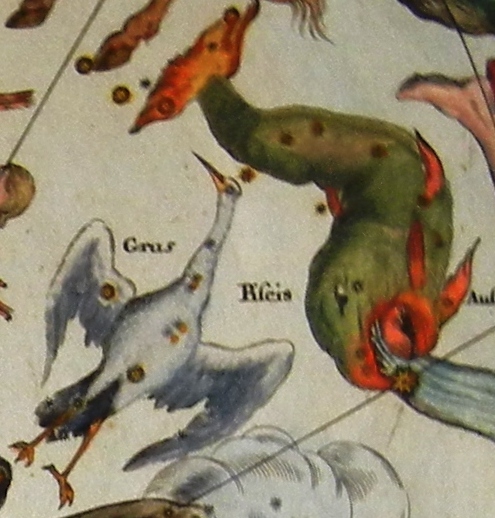
Stars and notable features
The constellation's brightest star is Alpha Gruis, often called Alnair, a blue-white star that marks the bird's body. Beta Gruis is a prominent contrasting object: a cool red giant that stands out by color to observers with modest telescopes or binoculars. Beyond its naked-eye stars, Grus contains a number of faint galaxies and galaxy groups that are targets for amateur astrophotography and small telescopes.
History and naming
Grus was established on European celestial charts in the late sixteenth and early seventeenth centuries when navigators explored the southern skies. The figure of a crane was chosen by mapmakers to complete a set of new southern constellations not visible from Europe. The constellation's modern boundaries and official recognition were fixed in the twentieth century when the International Astronomical Union standardized constellation borders.
Observing Grus
From the Southern Hemisphere, Grus rises high above the horizon and can be located near constellations such as Phoenix, Sculptor, Indus and Piscis Austrinus. Observers look for the bright, visually striking pair of Alpha and Beta as an entry point; dark skies are needed to reveal the faint galaxies within its borders. Because it lies well south of the celestial equator, Grus is largely invisible from much of the northern hemisphere.
Importance and distinctions
While not home to many well-known deep-sky showpieces, Grus is useful for studies of evolved stars and nearby galaxy groups and is a familiar landmark in southern sky atlases. Its creation during the maritime exploration era makes it representative of the historical expansion of astronomical knowledge beyond the classical Greco-Roman constellations.
Neighboring constellations
- Phoenix
- Sculptor
- Indus
- Piscis Austrinus
- Pavo
Related articles
Author
AlegsaOnline.com Grus (constellation) Leandro Alegsa
URL: https://en.alegsaonline.com/art/41110
Sources
- iau.org : "Grus, Constellation Boundary"