
Great White Spot (Saturn): periodic planet‑encircling storms
Large, bright storm systems on Saturn that recur roughly once per Saturnian year; visible to telescopes and studied by spacecraft for their chemistry, dynamics, and role in planetary weather.
Overview
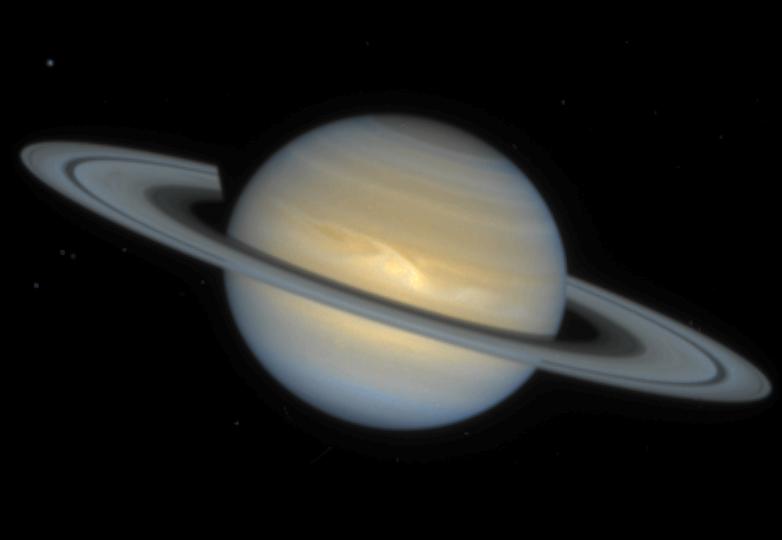
The Great White Spot (GWS) is the informal name given to exceptionally large, bright storms that periodically erupt in Saturn's atmosphere. When active, a GWS can expand to span thousands of kilometers and become visible through Earth‑based telescopes. These events are notable because they can alter the appearance and chemistry of wide latitude bands and occasionally wrap around the entire planet, producing a planet‑encircling disturbance.
Image gallery
6 Images


Characteristics and structure
Great White Spots appear as bright, white clouds produced when volatile gases condense into ice particles near the tops of Saturn's cloud deck. Ammonia ice is commonly implicated as the primary reflective material, pushed upward by deep, warmer gas. A typical outbreak begins with a compact bright "head," followed by trailing clouds and vortices that can merge into a long bright band. Observations have recorded localized cooling at storm centers, changes in hydrocarbon abundances, and enhancements of trace species such as phosphine in storm regions.
Cause and dynamics
Scientists interpret GWS events as convective storms originating from deeper, warmer layers where water and ammonia are present. Buoyant parcels of gas rise, carrying water and other compounds upward; rapid expansion and condensation form high‑altitude ammonia ice clouds that reflect sunlight strongly. The resulting injections of momentum and heat can drive powerful winds, generate lightning and radio emissions, and modify the zonal (east–west) jet structure in the affected latitude.
History and recurrence
Great White Spots are roughly periodic, recurring about once per Saturnian year (roughly 28–30 Earth years), often near the planet's northern hemisphere summer. Well‑documented outbreaks occurred in the late 19th and 20th centuries and most recently in 2010–2011. Because they grow so large, several of these storms have been recorded by amateur and professional observers using telescopes from Earth as well as by spacecraft.
The 2010–2011 event and spacecraft results
The 2010–2011 GWS provided the most detailed dataset when NASA's Cassini spacecraft observed a rapidly growing storm that eventually encircled Saturn. Cassini measurements revealed a depletion of acetylene and other hydrocarbons in the white cloud regions, an increase in phosphine concentration, and an unusual temperature drop at the storm's core. The outbreak was accompanied by enhanced radio and plasma emissions often described as an "electrostatic disturbance," and the spacecraft tracked changes in cloud morphology and storm evolution over many months.
Importance and distinctions
Great White Spots are important natural laboratories for studying moist convection, atmospheric chemistry, and energy transport in giant planet atmospheres. They differ from Jupiter's Great Red Spot: Jupiter's feature is a long‑lived anticyclonic vortex persisting for centuries, whereas Saturn's GWS are transient, episodic convective storms that can dramatically reconfigure the planet's clouds for months to years. Understanding GWS events helps comparative studies of weather across the giant planets.
Further reading and resources
- Telescopic observations and amateur monitoring
- Earth‑based monitoring programs
- Comparison with Jupiter's Great Red Spot
- Historical storm records and timelines
- Northern Electrostatic Disturbance and radio studies
- Plasma and radio emission analyses
- Observations of acetylene and hydrocarbon changes
- Phosphine enhancements in storm regions
- Ammonia ice and cloud formation processes
- Deep convection models for Saturnian storms
Questions and answers
Q: What is the Great White Spot?
A: The Great White Spot is a storm on Saturn that is large enough to be seen by telescope from Earth.
Q: Why is it called the Great White Spot?
A: It is called the Great White Spot because the spots appear to be white and the name was based on Jupiter's Great Red Spot.
Q: How wide can the spots be?
A: The spots can be several thousands of kilometers wide.
Q: What is the Northern Electrostatic Disturbance?
A: The Northern Electrostatic Disturbance is a large band of white clouds that has covered Saturn since 2010 and is causing an increase in radio and plasma interference.
Q: What is Cassini orbiter tracking?
A: The Cassini orbiter is tracking the Northern Electrostatic Disturbance.
Q: What has the Cassini information revealed about the white clouds?
A: The Cassini information shows a loss of acetylene in the white clouds, an increase of phosphine, and an unusual temperature drop in the center of the storm.
Q: What do scientists believe the white spots are made of?
A: Scientists believe the white spots are made from ammonia ice pushed up by warmer gas through the tops of the planet's clouds.
Related articles
Author
AlegsaOnline.com Great White Spot (Saturn): periodic planet‑encircling storms Leandro Alegsa
URL: https://en.alegsaonline.com/art/40570
Sources
- skyandtelescope.com : "Dissecting Saturn's Big Storm"
- hubblesite.org : "Hubble Observes A New Saturn Storm"
- news.discovery.com : "Vast Storm Rampages Across Saturn : Discovery News"
- antwrp.gsfc.nasa.gov : 2006:
- nasa.gov : Volunteers Help NASA Track Return of the Dragon