
Grand Duchy of Tuscany
Former sovereign state in central Italy (1569–1859), centered on Florence and ruled first by the Medici and later by the House of Lorraine; noted for art patronage and administrative reforms.
Overview
The Grand Duchy of Tuscany was a sovereign state in central Italy that emerged in the late 16th century and persisted, with interruptions, until the mid-19th century. In Italian it was known as the Granducato di Toscana and in Latin as Magnus Ducatus Etruriae. It replaced the earlier Duchy of Florence and had its seat in Florence, remaining a distinctive political entity within the broader region of Tuscany on the Italian Peninsula.
Image gallery
10 Images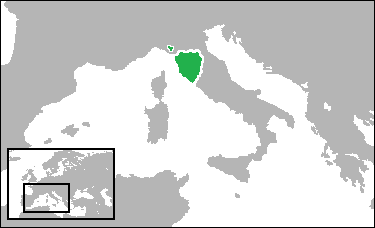



Government and ruling houses
The state was headed by a Grand Duke whose authority combined princely sovereignty with regional administration. The first ruling family to hold the title was the Medici, who established dynastic succession and a strong court centered on Florence. Later the grand ducal crown passed to the House of Lorraine, under whom different conventions governed succession and the style of the heir. The polity was considered a monarchy in contemporary diplomatic practice and retained formal ties to the Holy Roman Empire until European treaties reshaped imperial relations after the mid-17th century, notably the Peace of Westphalia.
Territory, economy and administration
The grand duchy encompassed much of central-western Tuscany, integrating urban centers, agricultural hinterlands and coastal ports. Its economy combined agriculture, textile production, trade and artisanal manufacture; Florence remained a cultural and commercial hub. Administratively the state balanced city privileges with centralized reforms imposed by the ducal court, and later rulers pursued measures to modernize taxation, legal codes and public institutions to enhance efficiency and fiscal stability.
Culture, patronage and influence
Tuscany under the grand dukes continued a long tradition of artistic and intellectual patronage that had roots in the Renaissance. Courts in Florence supported painters, architects, scholars and scientific inquiry, helping to sustain the region's reputation for artistic excellence. The grand duchy also served as a laboratory for early modern governance: a number of rulers introduced reforms that influenced neighboring states and contributed to broader currents of enlightenment reform in Italy.
End of the state and legacy
The Grand Duchy of Tuscany ceased to exist as an independent monarchy during the upheavals of the 19th century and the process of Italian unification; its institutions and cultural heritage were absorbed into the emerging national framework. Its legacy survives in Florence's museums and civic monuments, in institutional reforms that shaped later Italian administrations, and in the historiography of early modern principalities.
Notable distinctions and facts
- The official succession practices and the title of the heir differed between the Medici and the Lorrainers; under the Medici the designated heir was commonly called the "Grand Prince of Tuscany," while later dynasties used varying styles and ranks for the heir apparent (see heir titles).
- Although rooted in the Italian peninsula, the grand duchy occupied a complex diplomatic position, at times aligned with and at times distinct from the institutions of the Holy Roman Empire and other European powers.
- Histories of the region often highlight the contrast between Florence's cultural prominence and the grand duchy's smaller territorial base, an example of how artistic influence can exceed political size.
- For general reference and further reading on names, institutions and diplomatic status, see contemporary and modern sources summarized under the Italian term (Granducato di Toscana) and related archival descriptions (monarchy, Tuscany, Italian Peninsula).
Further information on the dynasty changes and treaty contexts can be found in specialized treatments of the Peace of Westphalia, the role of the House of Lorraine and the diplomatic status of the Holy Roman Empire in early modern Italy. Primary archival material and regional studies often use the local names and titles preserved in period documents (Florence, Medici, heir apparent conventions).
Related articles
Author
AlegsaOnline.com Grand Duchy of Tuscany Leandro Alegsa
URL: https://en.alegsaonline.com/art/40188