
Great Awakenings (periods of religious revival in the United States)
Series of major Protestant revival movements in U.S. history, commonly grouped as four 'Great Awakenings' from the 18th to the late 20th century, with contested boundaries and varied social impacts.
The phrase "Great Awakening" describes several widely recognized waves of Protestant revival that reshaped religious life in the United States and, in some cases, had transatlantic dimensions. The term is used in both popular and scholarly contexts to designate periods of intensified preaching, heightened lay involvement, and changes in denominational strength and practice. It is sometimes compared, for analytical purposes, to other large-scale religious transformations such as the Protestant Reformation, though the movements labeled as awakenings are distinct in their forms and historical settings.
Image gallery
3 Images
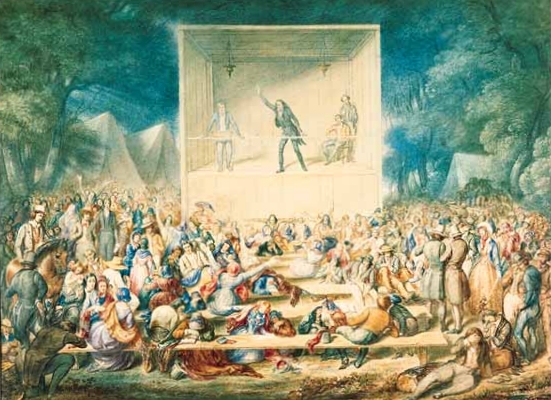

Common features
Awakenings typically share several characteristics: energetic itinerant preaching, emphasis on personal conversion and repentance, emotionally charged worship, and new formats of religious gathering such as revival meetings and camp meetings. They often encouraged rapid church growth, fostered new denominations or movements within existing churches, and increased the participation of laypersons — including women — in religious life. These features also produced controversy over authority, orthodoxy and the propriety of emotional expression in worship.
Chronology and highlights
- First Great Awakening (c. 1730s–1740s): A largely New England–centered revival, noted for leaders who stressed heartfelt faith and personal conversion. It contributed to denominational diversification and greater religious voluntarism.
- Second Great Awakening (c. 1800s–1830s): A broad movement across frontiers and towns, associated with camp meetings, expansion of Methodist and Baptist churches, and an ethic that inspired reform efforts such as temperance and abolitionism.
- Third Great Awakening (c. 1880s–1900s): Often linked with the Social Gospel, missionary expansion, and institutional growth as Protestantism adapted to industrialization and urbanization.
- Fourth Great Awakening (c. 1960s–1970s): A debated period associated by some scholars with renewed evangelical activism, charismatic renewal, the rise of the so-called Jesus movement and changing styles of worship; other historians question whether it constitutes a single, coherent awakening.
Social effects and legacy
Each awakening affected American culture beyond church pews. They influenced educational and charitable institutions, shaped moral and political debates, and helped spread missionary activity at home and abroad. The Second Awakening in particular intersected with voluntary associations and reform movements. Successive awakenings contributed to an enduring evangelical strand within American Protestantism and facilitated new forms of public religious expression.
Historiographical issues
Scholars debate whether the label "Great" and a fourfold periodization best capture the complex, regionally varied history of revival. Some prefer to view revival as recurring patterns rather than discrete national events. Comparative approaches and thematic studies (for example on gender, race, or social reform) provide alternative lenses for understanding continuities and differences across these episodes. For general background on revival as a phenomenon see treatments of religious revival.
Because the term functions both in popular memory and academic analysis, readers should note the difference between dramatic revival episodes and longer-term changes in belief, practice and institutional life. For broader context about earlier European movements and long-term reform currents consult works that compare American awakenings with continental developments such as the Protestant Reformation.
For introductions and primary-source collections, consult specialized histories and anthologies that examine regional case studies, prominent preachers, and the relationships between revival impulses and social change. Further online or library guides can point to primary documents, sermon collections and contemporary accounts for each awakening period.
Related articles
Author
AlegsaOnline.com Great Awakenings (periods of religious revival in the United States) Leandro Alegsa
URL: https://en.alegsaonline.com/art/40456