
Gran Colombia (Republic of Colombia, 1819–1831)
History and legacy of Gran Colombia: its formation after independence, territory, institutions, internal tensions, constitution, leaders, dissolution into successor states, and long-term influence.
Overview
Gran Colombia was a short-lived republic in northern South America created during the wars of independence from Spain. Formed by leaders of the independence movement, it sought to unite several former Spanish provinces under a single government after military victories over the Spanish Empire. The name Republic of Colombia was often used at the time; historians commonly refer to the state as "Gran Colombia" to distinguish it from later republics that adopted the name.
Image gallery
3 Images
Formation and founding documents
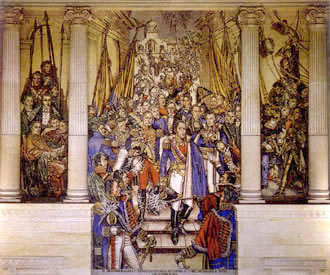
The union emerged from the political and military campaigns led by Simón Bolívar and other patriots. Representatives met in congresses and assemblies to define the new state. A constituent congress adopted a constitution in 1821 (the Constitution of Cúcuta), which established republican institutions and attempted to combine a strong central executive with representative bodies. Prominent figures included Simón Bolívar as the dominant political and military leader and Francisco de Paula Santander in key administrative and military roles. For primary documents and collections on the founding period consult contemporary archives and published guides to the period: founding records.
Territory and administration
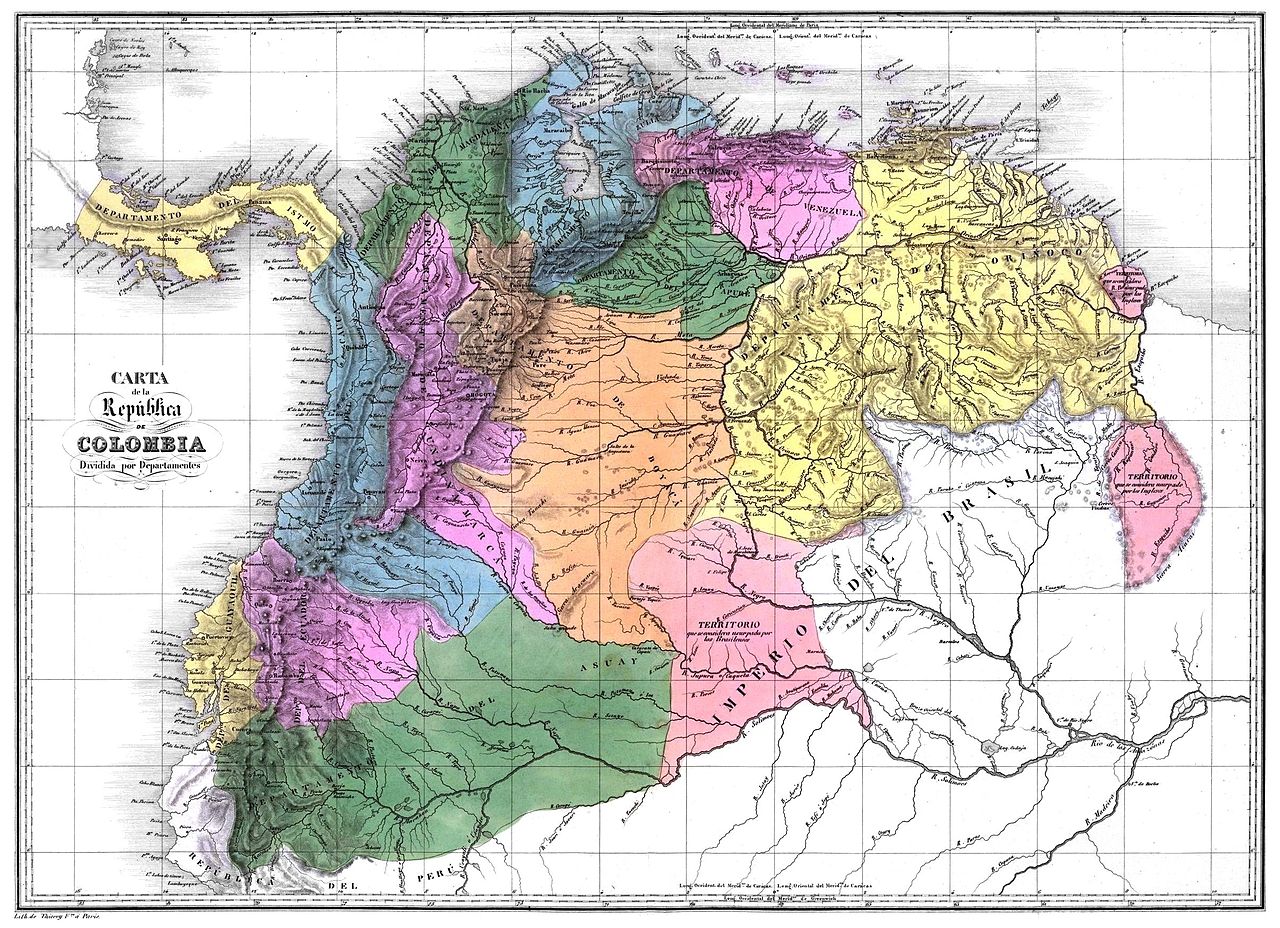
At its greatest extent Gran Colombia comprised most of present-day Colombia, Venezuela and Ecuador, and included the isthmian province that later became Panama. The capital was in Bogotá (then often called Santa Fe de Bogotá). Administrative divisions drew on the old colonial provinces but were reorganized under republican principles. Governors and local elites frequently resisted measures from the central government, producing tensions between centralist and federalist tendencies.
Political challenges and dissolution
- Geographic scale and diverse local interests made centralized administration difficult across Andean highlands, coastal areas and lowland plains.
- Political rivalries—most notably between Bolívar and regional leaders—along with economic strains and differing visions of governance weakened national cohesion.
- By the early 1830s the eastern and southern regions moved toward separate republican arrangements: the areas corresponding to modern Venezuela and Ecuador left the union, and the central territory evolved into a successor state that continued the constitutional and institutional experiment in a more restricted form.
Legacy
The experiment of Gran Colombia has been interpreted both as an ambitious attempt at continental union and as an illustration of the limits placed by geography, regional loyalties and political differences on large federations. Debates begun in this period—about centralization versus federalism, the role of military leaders in politics, and the construction of national identities—shaped much of 19th‑century political development in northern South America. Subsequent boundary formation, regional institutions and political traditions in Colombia, Venezuela, Ecuador and Panama bear traces of the problems and ideas first confronted by Gran Colombia.
For accessible introductions and archival listings see general historical overviews and collections that assemble primary sources and scholarly syntheses on the independence era and the Gran Colombia period: founding records, historical overviews, and regional studies for Venezuela, Ecuador and Panama.
Related articles
Author
AlegsaOnline.com Gran Colombia (Republic of Colombia, 1819–1831) Leandro Alegsa
URL: https://en.alegsaonline.com/art/40143
Sources
- books.google.com : The Cambridge History of Latin America