
Gerardus Mercator: Flemish Cartographer, Geometer, and Mapmaker (1512–1594)
Gerardus Mercator, a 16th‑century Flemish cartographer and mathematician, created the Mercator projection, crafted globes and an influential atlas, and left a lasting impact on navigation and modern cartography.
Overview
Gerardus Mercator (born Gerard de Cremer, also rendered Gerhard Kremer; 1512–1594) was a Flemish cartographer, geographer and mathematician whose work shaped European mapmaking. He produced globes of the Earth and the heavens, engraved detailed regional maps and pioneered an innovative cylindrical world map projection that became essential for marine navigation. Mercator’s name today is most closely associated with that projection and with the use of "Atlas" as the title for a systematic collection of maps.
Image gallery
10 Images


Life and background
Mercator was born in the county of Flanders and trained in the classical and technical arts of his time, including geometry, engraving and instrument making. He adopted the Latin form Gerardus Mercator for his published works. During his career he moved among centers of scholarship and printing, ultimately settling in Duisburg, where he spent his later years and died. His biography includes both practical map production and scholarly study; in later life he devoted more time to theological and historical studies as well as to compiling his cartographic work.
Major works and methods
Mercator produced several important objects and publications: hand‑engraved regional maps, terrestrial and celestial globes, and the large folio collection later known as an atlas. In 1585 he began issuing the volumes that would be grouped under the title Atlas; the project was completed and published after his death by his son Rumold. His workshop combined survey information, classical sources and the latest reports from sailors and merchants to improve accuracy and ornamentation.
- Globes: Made both terrestrial and celestial globes used for teaching and navigation.
- Maps and atlases: Large engraved sheets that were sometimes hand-colored and assembled into bound volumes.
- Mathematical approach: Applied geometric principles and careful scale construction to solve practical mapping problems.
The Mercator projection and its importance
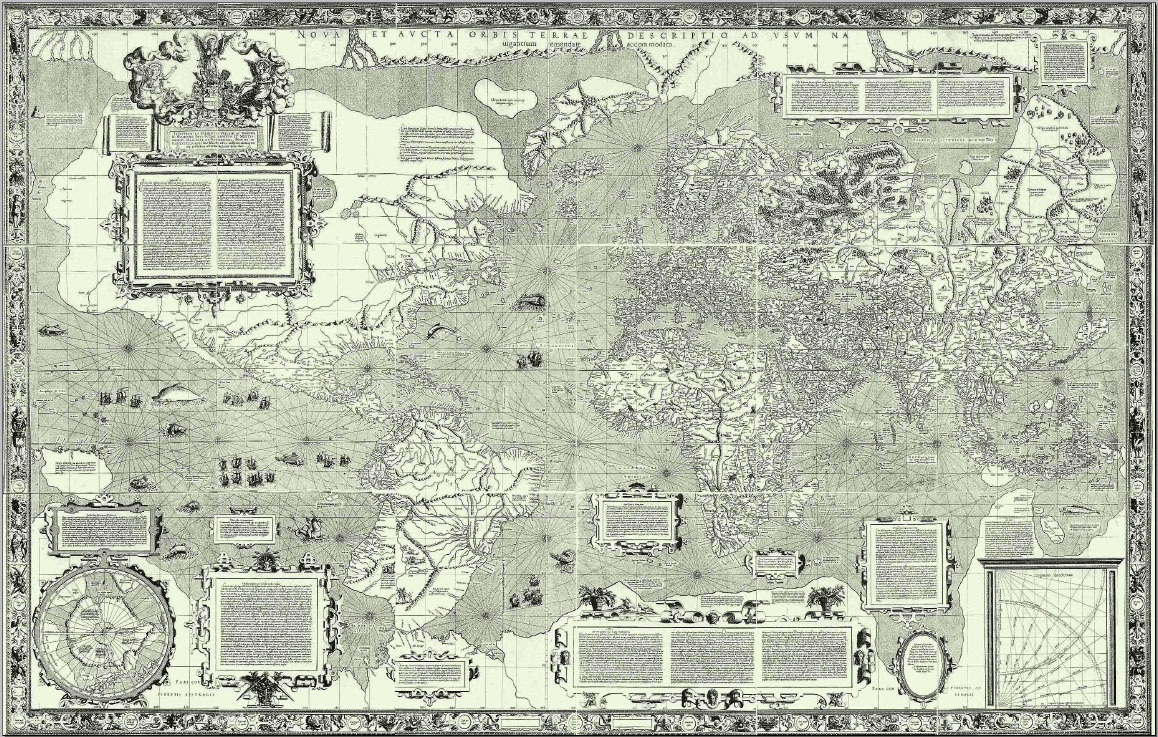
In 1569 Mercator published a world map using the projection that now bears his name. The key property of this projection is that it represents compass bearings (loxodromes or rhumb lines) as straight lines, which greatly simplified plotting a constant course on a chart. To accomplish this, parallels of latitude are spaced farther apart toward the poles according to a specific mathematical rule so that local angles and shapes are preserved (it is a conformal projection). Because it distorts area—regions near the poles appear much larger than they are—its strength is practical navigation rather than accurate depiction of relative sizes.
Legacy and influence
Mercator’s methods established standards for later mapmakers. The term "atlas" became widely used after his publications, and his projection was adopted for nautical charts and many modern mapping systems. His emphasis on combining observational reports with mathematical construction influenced both cartography and geographic education. Modern mapmakers use the Mercator projection for specific applications where straight rhumb lines are useful, while other projections are chosen when preserving area or great‑circle relationships matters.
Notable facts and further reading
- Mercator Latinized his original name and became known across Europe under this scholarly form.
- His projection is conformal: it preserves local angles but not global area.
- He compiled an influential atlas project begun late in life; its publication continued after his death.
For concise introductions to his life and work see entries on his roles as geographer and mathematician, and for regional context consult sources on Belgium and Flanders. Technical discussions of the map projection are available via summaries of the Mercator projection and general texts on map projections. The history of his atlas project and its later publication can be found under Atlas histories; biographical and theological aspects are discussed in works linked at theology and biography. For synoptic accounts of his movements and death see material connected to Duisburg.
Related articles
Author
AlegsaOnline.com Gerardus Mercator: Flemish Cartographer, Geometer, and Mapmaker (1512–1594) Leandro Alegsa
URL: https://en.alegsaonline.com/art/38410